
Anyone planting potatoes in spring hopes to fill plenty of crates by summer. Yet in reality, the bucket often contains only a few undersized tubers. The cause is frequently neither fertiliser nor variety, but one straightforward, unseen factor: how deeply the tubers are placed in the soil. This is precisely what separates a patchy row from a thick, vigorous potato crop.
The ideal planting depth for potatoes: the key to a strong start
A seed potato effectively acts as a small store of energy, from which roots, shoots and fresh tubers must develop. It needs a protective layer of soil above it, although this cover must be neither excessive nor insufficient. When planted too deeply, the shoots struggle to emerge; when too close to the surface, frost, drying out and green, inedible tubers become a risk.
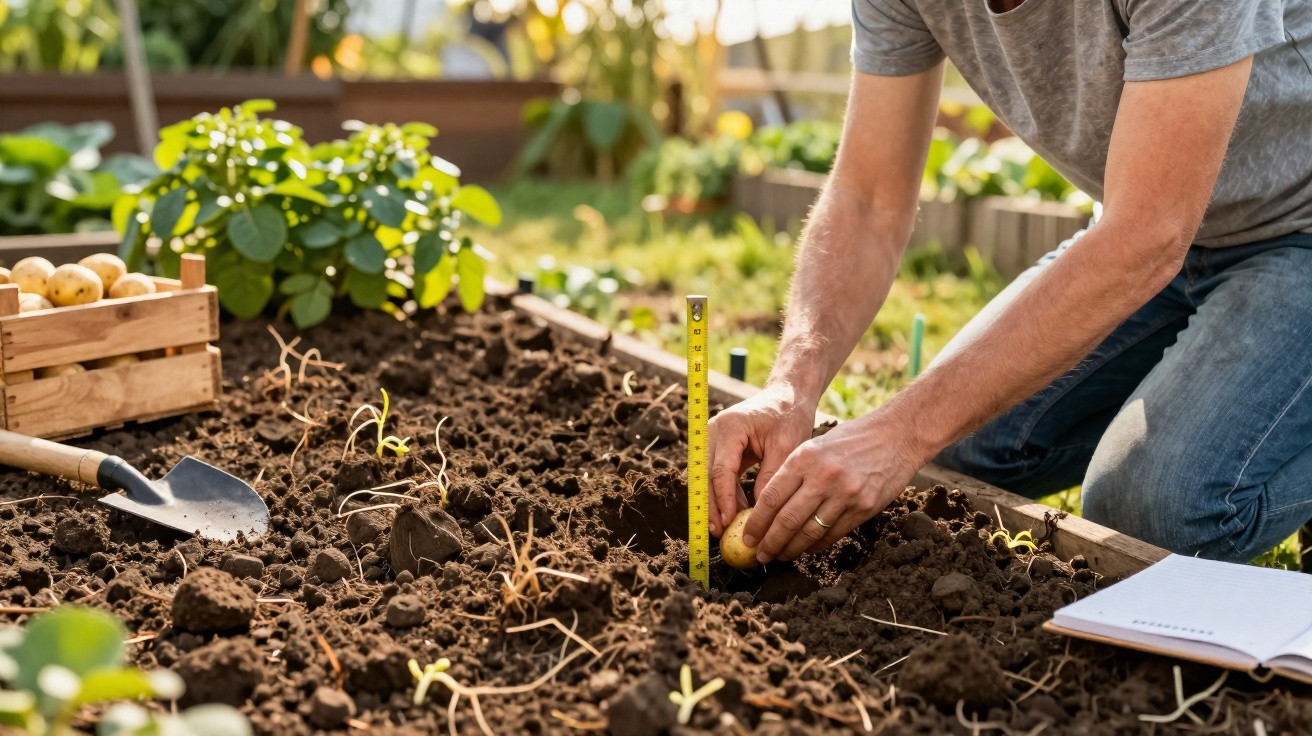
"As a rule of thumb, plant potatoes with around 10 to 15 centimetres of soil covering the tuber."
This depth strikes a practical balance. The soil is warmer than it is at the surface, fluctuations in temperature and moisture are moderated, and the shoots still have a manageable distance to travel before reaching daylight. Excessive depth can delay emergence and leave young plants weakened. Planting too shallowly, meanwhile, makes frost damage and sunscald on the tubers far more likely.
It is equally important to loosen the soil thoroughly to a depth of roughly 15 to 20 centimetres before planting. Place the tuber into this cultivated layer with its visible “eyes” facing upwards. This allows new shoots to break through to the surface quickly, rather than having to force their way through hard, concrete-like clods.
Why a few centimetres of soil cover can transform the harvest
Planting depth affects several important factors at once:
- Speed of emergence: Tubers planted too deeply take longer for their shoots to reach the light, wasting valuable growing time.
- Plant health: Well-aerated, loosened soil reduces the likelihood of rot and fungal diseases.
- Harvest volume: Even emergence produces consistent growth, making for a more reliable and more abundant crop.
- Exposure to extreme weather: The correct depth offers protection from late frosts and from the rapid drying of the topsoil.
When these elements are right, potato beds can suddenly look remarkably professional: dense green rows with very few gaps, producing plenty of medium-sized tubers rather than just a handful of oversized ones or masses of tiny potatoes.
How soil and climate influence the right depth
The 10 to 15 centimetres should not be treated as an inflexible measurement. Soil type and local climate can shift the optimum slightly higher or lower.
Planting potatoes correctly in heavy soil
Water tends to collect in loamy or clay-rich soil. Plant too deeply in these conditions and the tubers may end up in a damp grave for rot rather than a productive growing environment. The soil should therefore be loosened carefully and any large clumps broken down. Set the tubers towards the middle of the range: clearly beneath the surface, but not at the greatest possible depth.
"In heavy soils, it is better to plant a little less deeply, loosen the ground well and consistently avoid waterlogged areas."
Light, sandy soil: slightly more depth and more humus
Sandy soils allow water to drain through rapidly and dry out sooner. In this case, a combination of slightly greater depth and organic matter such as compost is helpful. Position the tuber towards the upper end of the 10–15-centimetre range, surrounded by humus-rich soil that retains water and nutrients more effectively.
This creates a fine, crumbly zone around the tuber, allowing roots to spread without difficulty while moisture does not disappear immediately.
Late frost, heat and drought: adjusting planting depth sensibly
In areas prone to late frosts, it is worth planting the tubers closer to 15 centimetres deep and earthing them up promptly afterwards. The extra soil layer provides better insulation against cold snaps. If a cold front arrives, the vulnerable young shoots are more likely to remain below the soil surface.
In dry locations, preventing evaporation is particularly important. Rather than planting extremely deeply, combining a standard depth with a layer of mulch is much more effective. After the shoots emerge, a covering of straw, dried grass clippings or leaves retains moisture and helps preserve soil structure.
Spacing, earthing up and care: getting the most from planting depth
Even ideal planting depth offers limited benefit if plants are crowded together or the tubers later become exposed to sunlight. A few basic measures will help make the most of the available depth.
Keeping the correct spacing
Potatoes need room not only below ground, but also sideways. The following distances have proved effective:
| Parameter | Recommendation |
|---|---|
| Distance between tubers within the row | 30–40 cm |
| Spacing between rows | 60–75 cm |
| Soil covering the tuber at planting | 10–15 cm |
This gives every plant sufficient light, air and nutrients. Rather than growing over one another, the tubers can develop within their own clearly defined space.
Why earthing up matters almost as much as planting depth
Once the plants have grown to about a hand’s height, the next stage begins: earthing up. Loose soil is drawn from between the rows towards the stems to form a small ridge. Repeat this process several times until the plants are supported by a stable bank of soil.
"Earthed-up potatoes produce additional tubers in the built-up soil and remain protected from light."
Combining the correct initial depth with regular earthing up ensures that developing potatoes remain well covered at all times. Green patches caused by sunlight should therefore be the exception. It also increases the usable volume of soil in which new tubers can form.
Planting-depth mistakes many home gardeners make
The same common issues appear in countless beds year after year:
- Planting far too shallowly: The first warm days can tempt gardeners to place tubers almost directly beneath the surface. A later frost may then destroy the delicate shoots.
- Correcting the problem too late: Once gardeners realise that the tubers are sitting too shallowly, they may hurriedly pile on more soil. The plants then have to grow upwards again suddenly, costing them energy.
- Unprepared soil: Tubers pressed into hard clods struggle to establish roots. Rot and poor growth become more common.
- Inconsistent depth: Planting some tubers at 5 centimetres and others at 20 means plants in the same row will be at entirely different stages of development.
Taking the time to make uniform furrows of consistent depth beforehand avoids considerable trouble later and results in much more even plants.
Practical advice for different growing methods
Depth also matters when growing potatoes in raised beds, containers or a “potato box”, although it can be managed more flexibly in these settings. In a large container, tubers can initially be planted more shallowly, with soil added gradually as the shoots grow. This produces an effect similar to earthing up in open ground.
In a raised bed, which warms up more quickly, a depth nearer the lower end of the 10–15-centimetre range is often enough. However, the upper layer should be kept regularly moist, as it dries out more easily than soil in the garden.
Why this “invisible” depth achieves more than another spoonful of fertiliser
When yields are disappointing, many people reach first for fertiliser or specialist varieties. However, anyone who pays close attention to planting depth, soil cultivation, spacing and earthing up may be surprised: the same varieties and the same area can yield substantially more marketable tubers.
Depth determines how easily plants enter the growing season. A good start leads to strong roots, lush foliage and a longer period in which the plant directs energy into its tubers. That is the energy which ultimately ends up in the basket rather than on the compost heap.
Comments
No comments yet. Be the first to comment!
Leave a Comment