
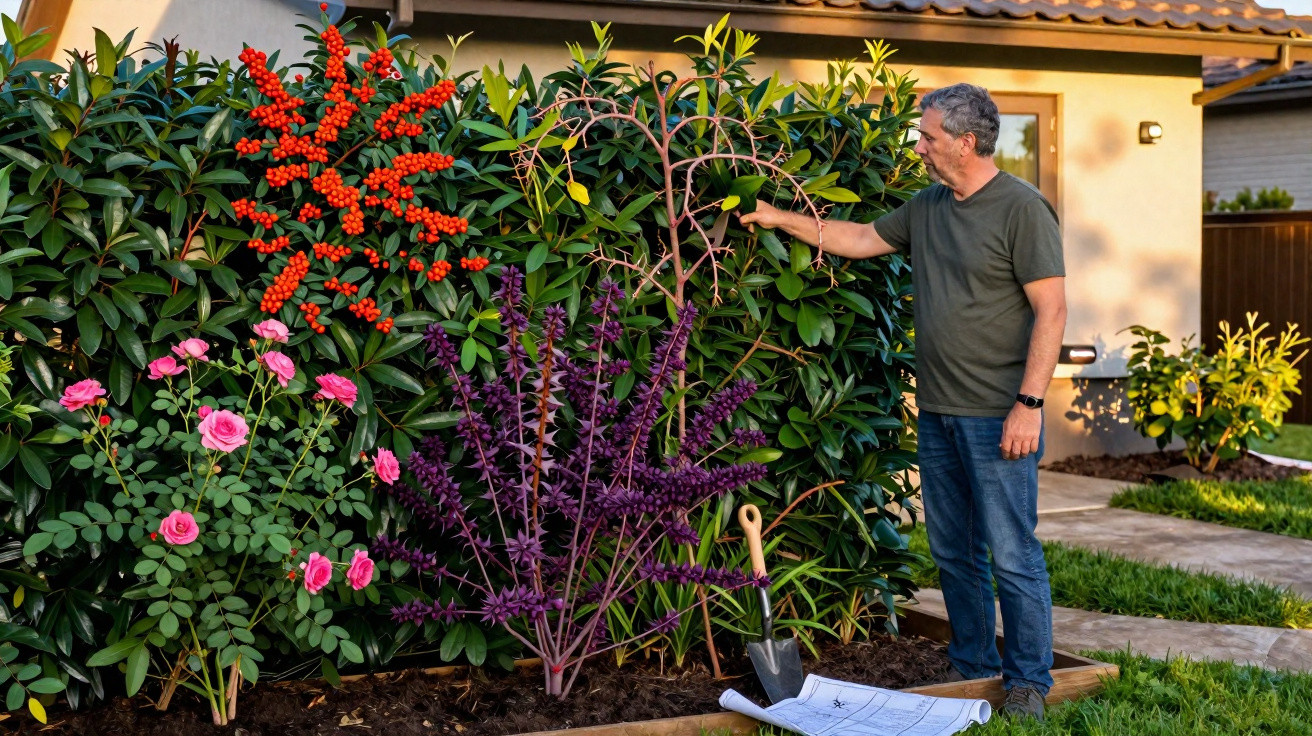
During summer holidays, long weekends and bank-holiday breaks, homes often stand empty for extended periods, increasing worries about unwelcome visitors. Police statistics repeatedly show how appealing unprotected properties can be to offenders. Cameras, smart-home systems and security doors all have their place, but planting around the home can also create a surprisingly effective defensive barrier – one that can quite literally put burglars off trying to gain access.
How a garden can genuinely deter criminals
A burglar looks for the simplest option: minimal risk of injury, as little noise as possible and a quick escape route. This is precisely where defensive planting can help. Dense, heavily thorned shrubs force intruders either to take significant detours or accept painful scratches, often while creating clearly audible noise.
“A thick, thorny hedge combined with crunching gravel turns a quick break-in attempt into a risky obstacle course.”
Research from several countries suggests that properties surrounded by deliberately planned, difficult-to-penetrate hedging face a noticeably lower burglary risk. Offenders tend to avoid homes where they could be injured, make noise or need substantially more time.
Plants are not a replacement for an alarm system; they are an addition to one. Letting a garden become overgrown can instead have the opposite effect: tall, neglected bushes provide perfect cover for someone moving unnoticed along the house. A clear, visible layout is what matters: access points should be easy to see, dark corners should be avoided, and no plants should be large enough for a person to hide comfortably behind.
Four plants that create a natural defensive hedge
Four species in particular are well suited to effective plant-based burglary protection. They are easy to maintain in German gardens while also providing a deterrent.
Pyracantha – the highly defensive firethorn
Firethorn (Pyracantha) is a classic choice among defensive plants. It develops dense, strongly branched shrubs with countless sharp thorns.
- Ideal for an impenetrable hedge along fences
- Particularly effective beneath low windows or balcony access points
- Its berries provide valuable food for birds
Plant firethorn around 50 to 70 centimetres apart, and it will soon form a closed hedge that is very difficult to pass through. Anyone attempting to climb through it will almost certainly end up with scratched hands, forearms and clothing – a risk many offenders prefer to avoid.
Barberry – a compact thorn barrier for side entrances
Barberry (often also known as sour thorn) remains somewhat lower, but grows exceptionally densely and has robust thorns. It is especially suitable for blocking concealed access routes.
- Perfect for narrow paths along the side of the house
- Well suited to shielding rear entrances or basement stairways
- Many varieties also offer attractive autumn colouring
Combined with firethorn, it creates a kind of “thorn fence” along the property boundary. It looks far more welcoming than metal railings, yet is even more unpleasant for burglars.
Rosa rugosa – the deceptive security rose strip
Japanese rose (Rosa rugosa) may look harmless, but it is extremely thorny and quickly forms a dense, very difficult-to-cross stand. This makes it especially useful beneath easily reached windows.
Typical locations include:
- Beneath ground-floor windows on the street-facing side
- In front of ground-floor patio or balcony doors
- In beds that provide direct access to window sills
Anyone trying to climb through a window while crossing a wide strip of roses has little chance of doing so unnoticed. The thorns snag on clothing, leave visible scratches and take considerable time to negotiate.
Cherry laurel – screening with an added security benefit
Cherry laurel (often referred to as laurel cherry) is not as thorny as the other plants listed, but it has an important role: it provides dense, year-round screening.
Used correctly, it serves two purposes at once:
- It shields your garden from curious looks from the street
- At the same time, it signals that the property has clearly defined boundaries
Placed in front of large glazed areas, such as full-height windows or patio doors, cherry laurel forms a green “curtain”. Burglars cannot immediately see whether anyone is at home or what is inside the living room, making the property less appealing.
Planning a thorny protective belt around your home
Anyone creating effective burglary protection with plants should not simply place shrubs at random, but work from a straightforward basic plan.
- Facing the street: Use a row of cherry laurel for screening, ideally with a gravel layer beneath that crunches under every footstep.
- Side property boundaries: Plant a dense alternating hedge of firethorn and barberry.
- Below vulnerable windows: Create a wide strip of Rosa rugosa.
- Main entrance to the home: Avoid bushes and use a clearly visible gravel path instead.
This combination ensures that offenders encounter barriers while residents and visitors can still use the entrance safely and comfortably. Important: thorny plants should not be placed directly beside children’s play areas or at the edge of a pool, to prevent accidents.
Legal distances, maintenance and lighting
Many local authorities have clear rules for hedges: anyone planting above two metres usually needs to maintain a minimum distance from the property boundary. A practical guideline is to keep tall hedges at least two metres from the boundary, helping to avoid disputes with neighbours or local authorities.
Maintenance is essential. At least once a year, hedges should be cut back, dead branches removed and any impenetrable dark areas prevented. Paths in particular must remain wide enough for family, visitors and, in an emergency, rescue services to pass through without difficulty.
“The best security hedge is maintained, easy to oversee and intelligently combined with lighting – not an overgrown jungle.”
Motion-activated lighting is a highly effective addition. If the thorny area is brightly lit as soon as someone steps into the garden, many offenders will be put off completely. Together with gravel surfaces that create noise with every step, this produces a combination of visibility, sound and risk of injury.
What these plants can do – and what they cannot
Thorny hedges cannot prevent burglary one hundred per cent of the time. Experienced offenders who have specifically targeted a particular house may still find a route despite thorns and gravel. Their main effect lies elsewhere: they move your home much further down the list of “easy targets”. Someone casually scanning a street is more likely to choose the neighbouring property without obstacles.
Many garden owners also value the visual benefits. Firethorn and barberry offer colourful berries and foliage, Japanese rose is fragrant in summer, and cherry laurel creates a calm green backdrop. Security can therefore be combined discreetly with attractive garden design, without turning the property into a fortress.
Practical tips for getting started
Those just starting out can begin with one area – often beneath the most easily accessible windows. Here are a few practical pointers:
- Younger plants cost less, but take a little longer to become dense.
- Plant thorny shrubs in two staggered rows to prevent gaps.
- Wear gardening gloves and protective clothing while working – the thorns are serious.
- Consider the eventual height from the outset, so windows do not become completely overgrown.
If you have children or pets, mark paths clearly so that nobody accidentally walks through the “thorn zone”. A small decorative fence or stepping stones can visually distinguish the safe routes.
Combined with mechanical protection such as burglary-resistant windows and doors, a simple timer for indoor lighting and attentive neighbours, this creates a layered security strategy. The plants form the quiet green line on the outside – but one that prompts many burglars to turn back straight away.



Comments
No comments yet. Be the first to comment!
Leave a Comment