
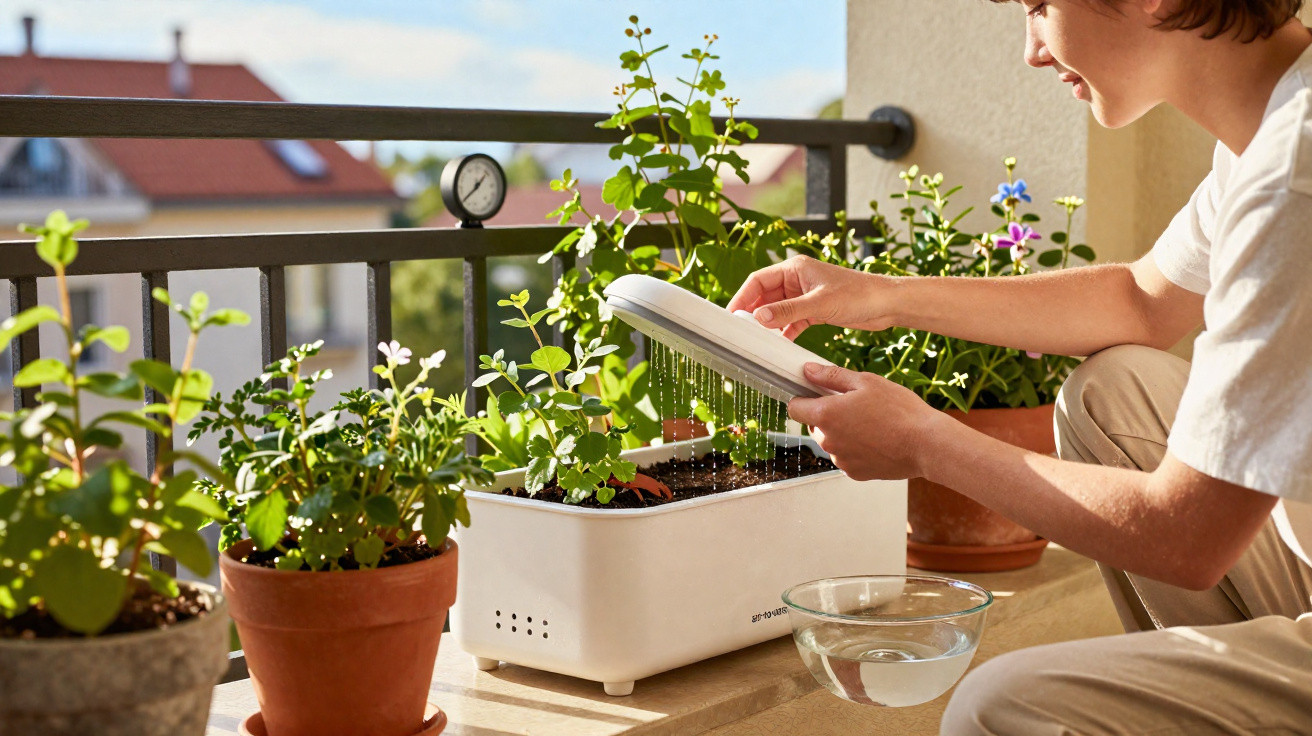
A compact, softly humming gadget has become the latest subject of conversation in garden sheds: it draws moisture from the atmosphere and releases it as slow drops for plants that need a drink. It may seem like a conjuring trick, but it relies on straightforward physics - plus a small solar panel.
I first came across one at daybreak on a warm morning, in a neighbour’s pot-filled courtyard. From the shade came the low whirr of a palm-sized fan, pushing air over a cold metal grille. Below it, a transparent tube dripped with metronomic precision into a basil pot that seemed remarkably cheerful for late August. She angled the panel towards the sky and gave a shrug - the sort people make when a modest gadget has unexpectedly changed things. We have all faced that moment when a plant is wilting just as you are heading out, without time to water it properly.
No hose. No tap. Only air.
The tiny box that “drinks” the sky
These new air-to-water planters encourage condensation to develop on cooled metal fins. A low-noise fan draws in damp air, while a compact cooler chills the fins, causing moisture to condense and run into a reservoir. A drip line or wick then carries that water directly to the roots. The clever part is not producing vast quantities of water - it is producing enough automatically, precisely where the plant needs it. That is why gardeners are buying them so readily: they are neat, uncomplicated and, honestly, rather hypnotic to watch.
One balcony grower in the city showed me her arrangement: a condenser about the size of a shoebox, a tea-saucer reservoir and two microtubes supplying cherry tomatoes. Following a week of evenings at 80% humidity, she recorded around half a litre a day - hardly a stream, but enough to keep the vines lively and the compost consistently moist. An allotment holder told me her unit made almost nothing in a dry inland heatwave, before rising to 300–600 ml on misty mornings. You quickly learn that this fluctuation matters: condensation works with the weather; it is not a vending machine.
The process is simply the physics of dew in a modern package. Water condenses when warm, moisture-laden air meets a colder surface. These small devices speed up the process by actively cooling their fins, usually with a Peltier module run by a modest solar panel or USB power bank. On humid nights, they quietly operate and can fill a cup. During clear, dry afternoons, they largely sit idle. Their smart feature is gradual irrigation. Rather than tipping a litre over the plant at midday and letting half evaporate, the system feeds water in small pulses - more in keeping with the way soil prefers to absorb it.
Getting practical results from an air-to-water planter in your garden
Position the condenser where air can circulate while the device itself remains cool. Shade is preferable to direct sunshine for the unit, as cooler fins collect more moisture. Direct the intake towards open air rather than a wall. When using a solar panel, install it in the light and use a short cable to connect it to the shaded box. Put the dripper near the plant’s crown and cover the line with mulch. Minor adjustments make a difference: a 10-degree panel angle, a hand-width of airflow or a new wick each month.
The first major error is expecting it to irrigate a lawn. It cannot. These are helpers for individual plants, not alternatives to sprinklers. The second is placing one in a stagnant greenhouse corner. It needs moving, humid air, particularly overnight and at dawn. In reality, nobody wipes down fins daily. Give them a quick clean on Sundays, rinse the dust filter and the output should remain consistent. If your nights stay extremely dry for weeks, combine the unit with a self-watering saucer to make each drop go further. Small gardens are systems - this tool works best alongside mulch, shade cloth and sensible expectations.
Treat maintenance like toothbrushing: brief, frequent attention is better than a rare marathon session.
“This little box kept my tomatoes alive while I traveled,” says Leah M., an allotment grower on the coast. “On foggy mornings, I’d wake to a full reservoir. On dry days, it still gave enough for the basil. It’s not magic. It’s rhythm.”
Here is a quick set-up checklist to screenshot:
- Keep the condenser shaded and the panel in sunshine.
- Aim the intake at open, humid air.
- Use a short drip line with no kinks to reach the root zone.
- Apply mulch around the plant to retain moisture.
- Clean the fins weekly and carry out a deeper clean each month.
A small solution with a larger idea behind it
There is a reason this gadget has moved from specialist forums to back-order lists. It addresses a low-level worry shared by many gardeners: what happens if the rain never arrives? A machine that converts heavy air into a slow supply of water can feel like defying fate, although it is really an encouragement towards resilience. Watching it drip makes you realise that water can be collected as well as supplied. That idea has a way of catching on. Neighbours ask about the humming sound. Friends share videos. Before long, you picture an entire street of balconies gathering the morning moisture.
| Key point | Detail | Why it matters to the reader |
|---|---|---|
| How it works | A fan moves humid air across chilled fins; water condenses and drips into a small reservoir | Explains the “from air” claim and establishes realistic expectations |
| Best placement | Put the unit in shade with good airflow and the solar panel in sunlight; night-time humidity helps | Straightforward set-up adjustments that increase daily output |
| What it can and cannot do | Excellent for pots, raised beds and herbs; not a lawn sprinkler or a cure for drought | Prevents disappointment and helps identify the right application |
FAQ:
- Does it work in dry climates? It can, although production falls sharply once humidity drops below roughly 30–35%. Coastal, misty or river-adjacent locations achieve the best yields.
- How much water can I expect per day? Typical reports range from 200–700 ml on humid nights, falling to almost zero on hot, extremely dry afternoons. Expect regular sips, not buckets.
- Is the water safe for plants? Yes. Condensation makes it essentially distilled, although it can collect trace dust from the air or tubing - which is fine for most ornamental and edible plants.
- What power does it need? Many models operate from a small solar panel or 10–30 W through USB. Night-time production often depends on a battery recharged by the panel during daylight.
- What maintenance is involved? Wipe the fins weekly, clean the dust filter, flush the line monthly and inspect the reservoir for algae during warm periods.



Comments
No comments yet. Be the first to comment!
Leave a Comment