
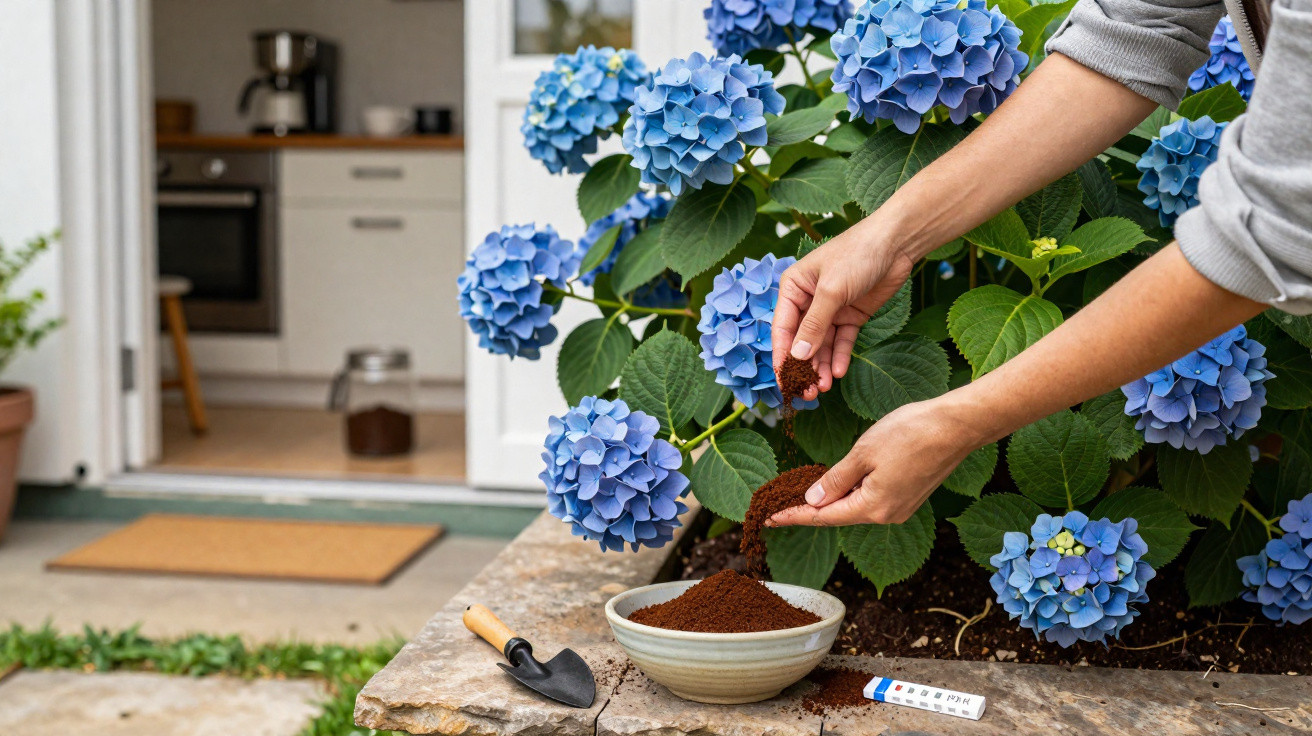
Many garden owners are amazed each year by how differently hydrangeas flower: sometimes pink, sometimes purple, and sometimes a rich blue. What many people do not realise is that these colour variations are not down to chance. With a little knowledge of soil and clever use of a simple kitchen waste product, you can guide your plants towards vivid blue flowers.
Why hydrangeas change colour at all
Hydrangeas are small indicators of conditions in the flowerbed. They are highly responsive to the make-up of the soil, particularly its pH level. Although that may sound like a chemistry lesson, the principle is easy to understand.
The pH value shows whether soil is more acidic or more alkaline. The respected gardening specialists at the Royal Horticultural Society in the UK stress that this very figure determines whether a hydrangea tends to produce blue or pink shades.
In acidic soil (pH 5.5 or lower), hydrangeas are more likely to flower a strong blue, whereas in alkaline soil (pH 6.5 or higher), they are more likely to be pink.
The reason is that hydrangea roots can absorb particular aluminium compounds only when the soil is slightly acidic. These compounds colour the petals blue. Without this effect, the flowers shift towards pink.
The surprising kitchen helper: coffee grounds
The easiest option for amateur gardeners is not found at the garden centre, but in the kitchen: used coffee grounds. Rather than throwing them away, you can use them to help create a display of blue flowers.
Coffee grounds are mildly acidic. This is exactly what the soil around a hydrangea needs if its flowers are to change from pink to a more intense blue. By regularly working small quantities into the area around the roots, you gradually move the pH level in a more acidic direction.
Coffee grounds gently lower the soil pH and therefore help create the conditions for bright blue hydrangea flowers.
Do not expect overnight results. Gardening organisations point out that this is a gradual process. Soil changes slowly, and the plant needs time to respond as well. You will generally see more stable colour changes only in the following flowering season.
How to use coffee grounds correctly
Simply tipping wet coffee grounds onto the soil can lead to mould and other problems. Following a few straightforward rules will make their use much more effective.
Step-by-step guide to blue hydrangeas
- Allow the coffee grounds to cool completely and, ideally, dry out a little.
- Scatter a thin layer around the hydrangea’s root zone, without placing it directly against the stems.
- Gently work it into the top layer of soil using your hand or a small hand trowel.
- Water lightly afterwards so that the substances can spread more evenly.
- Repeat every few weeks, using only small amounts each time.
If you already have a compost bin in the garden, you can add the coffee grounds there first. In compost, they combine with other organic materials, mature, and later provide a wider range of nutrients when added to garden soil.
How much coffee grounds is sensible?
More is not better in this case. Gardening websites specifically warn against overdoing it. Layers that are too thick may clump together, have poor airflow and, in the worst case, seal the surface of the soil. This leaves the roots with less oxygen and makes the soil less welcoming for the plant.
Use coffee grounds only in moderate quantities – as an addition, not as the main component of the soil.
As a rough rule of thumb, a thin layer of a few millimetres around the plant, spread across the season, is enough in an ornamental garden. If you brew several pots of coffee every day, it is better to divide the grounds between different plants and the compost bin.
Extra boost: aluminium compounds for intense blue
For particularly deep-blue hydrangeas, you can also use a specialist garden product: aluminium sulphate. This salt supplies the aluminium ions that hydrangeas need for their characteristic blue colour, provided the soil is sufficiently acidic.
Always follow the dosage on the packet exactly. Excessive concentrations can harm roots and soil life. Combined with soil that has been made slightly more acidic using coffee grounds, this additive has a much stronger effect.
Testing the soil: how to identify your hydrangea’s potential
Before investing lots of effort and coffee grounds, it is worth checking the soil itself. Simple testing kits are available from retailers and show the pH value within minutes. This lets you estimate how much adjustment is required.
| Soil pH value | Likely flower colour | Recommended action |
|---|---|---|
| 5.0–5.5 | Blue to purple | Stabilise only lightly with coffee grounds |
| 5.6–6.4 | Purple to pink | Use small amounts of coffee grounds regularly, and aluminium salt if necessary |
| 6.5 and above | Pink to bright pink | Long-term acidification, using coffee grounds plus specialist acidic compost |
Which other plants benefit from coffee grounds
Hydrangeas are not the only garden plants that appreciate this mildly acidic, nutrient-rich coffee residue. Typical candidates include:
- Roses, which require plenty of nutrients
- Rhododendrons and azaleas
- Blueberries, which thrive in strongly acidic soil
- Evergreens such as camellias
The same principle applies here: use only small amounts and spread them well. Coffee grounds are not a complete fertiliser, but rather a useful supplementary ingredient.
Common mistakes when using coffee grounds
To ensure the blue hydrangea trick does not backfire, it is worth knowing the most frequent pitfalls:
- Wet, clumped coffee grounds: encourage mould and restrict soil aeration.
- Layers that are too thick: create a hard crust that makes it harder for water to penetrate.
- One-sided use: using only coffee grounds with no other organic matter leaves the soil structurally depleted.
- Unrealistic expectations: colour changes take time; often, only the next season’s flowers respond.
What is really behind the “magic”
Once you understand what happens in the soil, you can act with greater precision. Mildly acidic coffee grounds slowly alter the chemical conditions around the roots. Microorganisms break down the organic material, nutrients are released, and the pH value falls slightly.
In this environment, the hydrangea can absorb aluminium from the soil more effectively. That aluminium is deposited in the flower cells, shifting the perceived colour towards blue. If the soil remains neutral or alkaline, the aluminium stays bound in the soil and barely reaches the plant, so the flowers remain in pink to bright-pink tones.
A practical example for starting next season
If you want your hydrangeas to be intensely blue next year, ideally begin applying small amounts of coffee grounds in late summer or autumn. This gives the soil time to change through autumn and winter. Test the pH again in spring, then work in further small quantities if needed.
It is also worth considering other factors at the same time: hydrangeas dislike waterlogged soil, but appreciate consistently moist ground and a bright location that does not become too hot. Only when the site, watering and soil are reasonably suitable will the coffee grounds trick have its full effect.
By following these few basic rules and remaining patient, you can use a free kitchen waste product to influence the flower colour of your hydrangeas and gradually work towards an impressive sea of blue blooms.
Comments
No comments yet. Be the first to comment!
Leave a Comment