
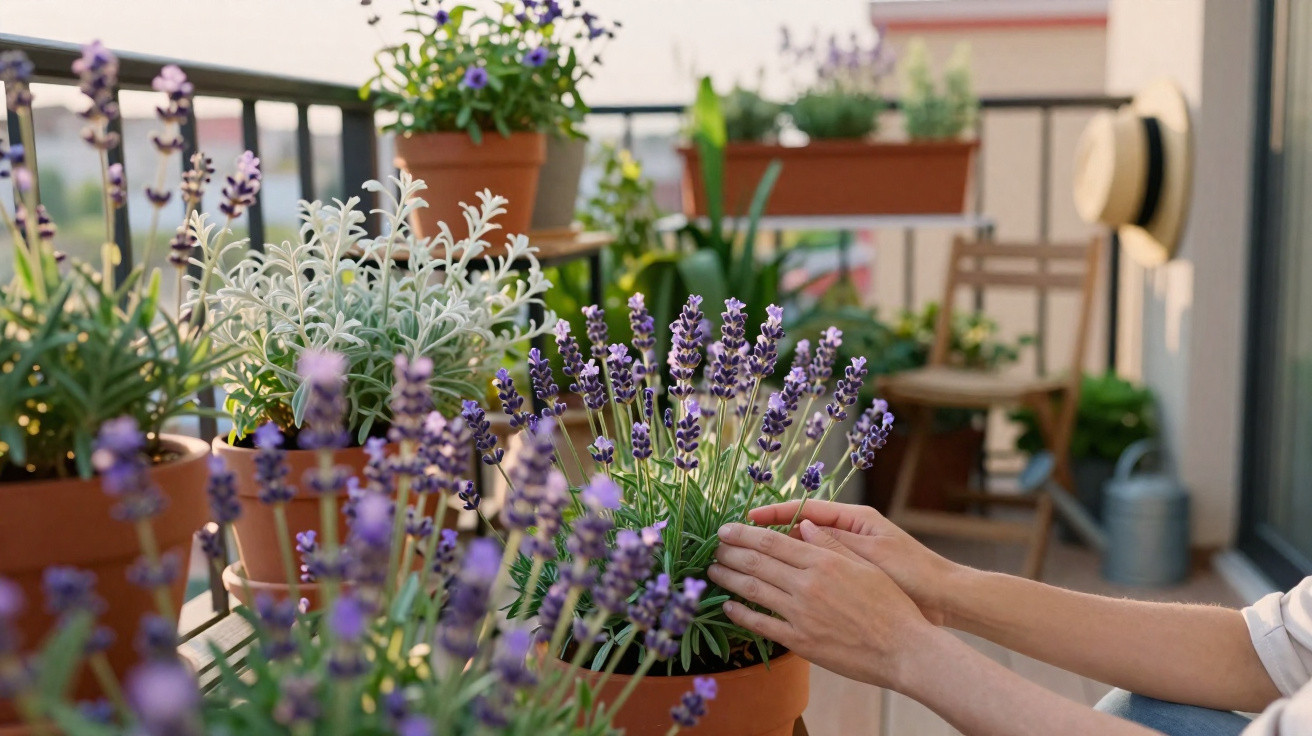
The neighbour stood on his balcony with a mug of coffee, shaking his head at his tiny back garden. Concrete, a narrow strip of soil and a dented barbecue – that was all there was. “Nothing will grow here,” he muttered, partly to himself and partly across to me.
Three months later, he paused there again: same mug, same view. Yet the garden had changed completely. Soft green swathes, delicate flowers and a hint of lemon fragrance now drifted even over the crumbling wall. The space was still exactly the same size. Only one decision had changed.
That morning, I realised just how powerfully the right plant can transform a small garden – turning it from a problem into a favourite place.
And yes, there is one plant that does it almost embarrassingly well.
Why Lavender Makes Small Gardens Feel Bigger
Anyone short on space does not need a diva. You need a plant that copes with heat, survives dry spells and still looks attractive when you have done little more than acknowledge it in passing for three weeks. This is where lavender reveals its understated superpower. It stays compact, tends to spread rather than shoot up aggressively, and creates soft transitions that make limited spaces seem more generous.
Its slender leaves and upright flower spikes soften the severe edges of fences, walls and patio borders. All at once, a miniature garden stops resembling a storage area and starts to feel like a small piece of Provence nestled between wheelie bins and bicycle racks.
You can see this clearly on typical terraced housing estates. The usual arrangement is often the same: 20 square metres of lawn, two thuja trees in the corner and a wobbly parasol. Then there is one garden that stands out. No extensive renovation has taken place. It simply has a narrow border running alongside the patio, densely planted with one lavender variety, such as Lavandula angustifolia ‘Hidcote’.
In July, it hums like an airport for bees. The purple cloud takes the rigidity out of the square plot, and even the narrow path leading to the garden bench suddenly feels like a short stroll. Passers-by often do not notice how little space is actually there. That is the trick.
Much of this effect comes down to perception. Lavender separates an area into zones without cluttering it. The plant allows visual breathing room, offers structure rather than bulk, and draws the eye towards details: shimmering foliage, vibrating flower spikes and the interplay of light and shade.
At the same time, lavender works on several levels – visually, through fragrance and through the sound of insects buzzing. Because it engages more senses, a small garden gains depth. And when everything else is already flagging in high summer, lavender often continues to hold its own, preventing the overall look from slipping into bleakness.
Getting the Most from Lavender in a Mini Garden
The simplest way to begin a “lavender garden in a small space” is with a clear line. Rather than creating a riot of unrelated colours, repeat one plant to introduce calm. Set lavender in a row along a path, in front of a fence or as a border around a bed.
For a container garden, a trio makes a strong impression: three pots of the same size, holding the same variety at the same height – like little soldiers, but more fragrant. Use a mineral-rich, relatively poor compost mixed with sand or grit. Water infrequently but thoroughly. Lavender prefers its roots not to be constantly wet.
Something many people only discover later is that pruning determines whether lavender remains attractive or starts looking like a woody broom after three years. The principle is straightforward: prune it back each year by roughly one third to one half of the green growth, but never cut into old wood. In reality? Let us be honest: nobody actually does this every day, or times it with a stopwatch at the end of August.
If you establish one fixed “lavender day” each year – for instance, shortly after the main flowering period – you will protect the appearance of your small garden over the long term. One ageing, woody shrub can create more visual chaos than three bicycles lying across the lawn.
Lavender is forgiving, but it has its limits. A gardener from southern France once told me:
“Lavender forgives drought, but not wet feet. And it likes company – just not too close.”
So, if you are planning to fill your small garden with lavender, it is worth carrying out a brief reality check:
- How much direct sunlight does the space genuinely receive each day? At least 4–5 hours is ideal.
- Can water drain freely, or does it collect in containers and beds?
- Does the variety suit your region? Choose more frost-hardy lavender varieties in colder areas.
- Are you after low edging plants (for example, ‘Munstead’) or taller clouds of colour (for example, ‘Hidcote’)?
- Are you willing to prune annually, even if the television series finale is on?
A Small Garden That Tells Stories
Perhaps lavender’s greatest quality is not its colour at all, but the atmosphere it creates. A narrow balcony can suddenly feel like a roof terrace somewhere south of Lyon when its scent rises in the evening and the air gradually cools. A tiny courtyard loses its back-garden gloom when bees and butterflies begin to claim it as their own.
Small gardens, patios and balconies often have underestimated potential to become a stage rather than simply a storage space. Lavender is like a quiet director, rearranging the entire scene.
When space is limited, you do not need to think bigger; you need to think more precisely. A recurring plant, changing predictably through the seasons, provides a sense of continuity. In spring, you wait for the first fresh green growth; summer raises the curtain on flowering; and autumn leaves behind a calm structure. Especially in crowded towns and cities, this offers a small but noticeable counterpoint to feeling constantly enclosed by appointments, roads and screens.
Brush against the lavender once, pause briefly, and the day takes on a different temperature.
You may know that moment when you are standing in somebody’s courtyard or on their balcony and suddenly realise: something feels right here, even though everything is tiny. Often, it is not expensive fittings or designer furniture. It is one carefully selected, recurring plant that gives the space a story.
Lavender is ideal for small gardens because it does exactly this – using simple means, requiring little effort and lasting for many years. In the end, the question is not whether there is enough room. It is really this: what story should these few square metres tell, and who would you like to show it to next?
| Key point | Detail | Reader benefit |
|---|---|---|
| Lavender structures small spaces | Compact growth, clear lines and no overpowering bulk | The garden feels larger and more orderly without becoming sparse |
| Undemanding, but dependent on pruning | Likes sun, poor soil and requires annual pruning | Attractive plants over the long term with minimal time commitment |
| Multisensory effect | Colour, scent, insects and sounds | A small garden gains emotional depth and a holiday feeling |
FAQ:
- Which lavender is best for very small gardens or balconies? Low-growing varieties such as Lavandula angustifolia ‘Munstead’ or ‘Hidcote’ are ideal for miniature spaces. They remain compact, do not flop open as quickly and are well suited to containers.
- Can lavender grow in shade? It can tolerate a little partial shade, but without several hours of sun per day it will stay weak and flower only sparsely. Other plants are better choices for genuinely shady courtyards.
- How often does lavender need watering? In a border, water deeply only during extended dry spells; in a pot, water every 1–2 days during hot weather. More important than frequency is ensuring that excess water can drain away properly.
- When is the best time to prune lavender? Shortly after the main flowering period, usually in late summer, is ideal. It will then produce fresh growth again and remain compact without being weakened too severely over winter.
- Can I overwinter lavender in a pot? Yes, provided the variety is frost-hardy and the pot does not freeze through. Move it against a sheltered house wall, protect the pot with fleece or a hessian sack if needed, and water sparingly only on frost-free days.
Comments
No comments yet. Be the first to comment!
Leave a Comment