
Between the first mow of the year and plans for new planting, snakes are rarely on most people’s minds. Yet from spring until early autumn, these animals deliberately seek out warm, sheltered spots. One common garden item that many people simply leave lying around can become an ideal hiding place, with unpleasant consequences for both people and animals.
Why spring marks snake season in the garden
The first reliably warm days bring snakes’ winter dormancy to an end. Across Central Europe, they generally emerge from around mid-March to late May, although this can happen earlier or later depending on the region and weather conditions. At that point, their main need is warmth.
Snakes are ectothermic, meaning that they do not generate their own body heat and depend on their surroundings. Temperatures of roughly 25 to 30°C are ideal. This makes every small heat store appealing, particularly those close to the ground where snakes feel protected.
Typical favourite places in a garden include:
- transition areas between a lawn and a hedge
- narrow strips alongside walls and wall bases
- tall grass, banks and dense shrubs
- damp, slightly dark corners offering some cover
During this transitional period, two things happen at once: you start working in the garden again, while snakes actively look there for warm places to rest.
In countries such as France, hospitals record well over a thousand bite incidents each year, mostly involving vipers. The situation cannot be transferred directly to Germany, but it clearly demonstrates one point: when people and snakes share the same space, the likelihood of unintended encounters rises.
The overlooked risk: why a garden hose attracts snakes
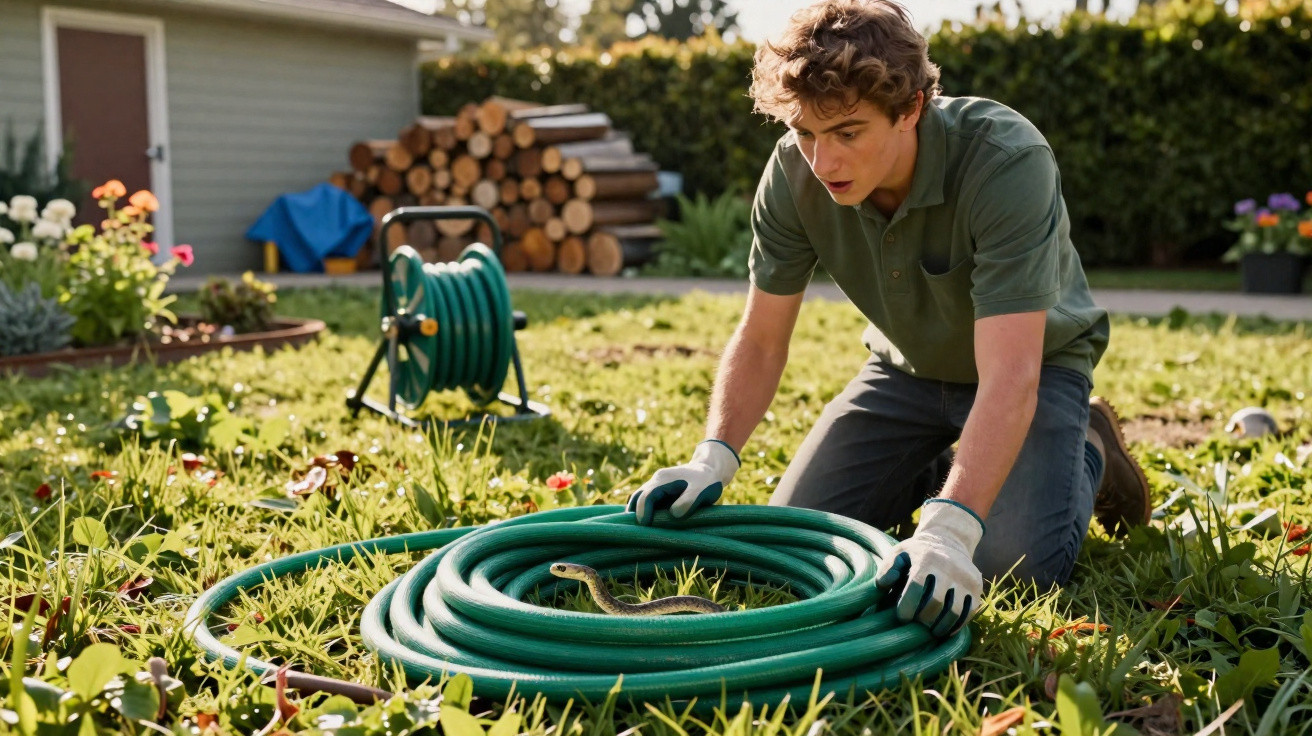
The most problematic object is a familiar one: a garden hose left on the ground after watering, especially when it is coiled or looped up.
Several features make it particularly attractive to snakes:
- Heat storage: The material warms quickly in sunlight and releases that heat gradually.
- Camouflage: Green or grey hoses blend into lawns and soil, both for people and for animals.
- Moisture: After watering, condensation can form and the surrounding area remains slightly damp, creating pleasant conditions for many species.
- Structure: When the hose lies in loops, it creates small cavities and sheltered spaces in which a snake can comfortably curl up.
To a snake, a coiled hose resembles a ground-level radiator with a built-in hiding place. It is especially tempting in the late afternoon, when the material begins to release the heat it has stored.
Before simply picking up the hose, always inspect its full length first – including the underside if it is lying in grass.
Many people are startled because, at first glance, they cannot tell the snake apart from the hose: dark or green markings, an elongated body and everything close to the ground make confusion an obvious possibility.
Other garden traps: tarpaulins, corrugated sheets and woodpiles
A garden hose is not the only item that can draw in snakes. Anything that retains warmth while leaving a dark gap beneath it can become a retreat.
Tarpaulins and covering sheets
Dark plastic tarpaulins, used to cover firewood, building materials or garden furniture, work rather like a roof with underfloor heating:
- Sunlight heats the material intensely.
- The air below becomes noticeably warmer than the surrounding area.
- The space stays shaded, sheltered from wind and relatively undisturbed.
Under a black tarpaulin, temperatures can rise well above the day’s actual maximum. For snakes, it is an ideal place to warm up after the night.
Metal sheets and fibre-cement boards
Corrugated metal sheets or fibre-cement boards lying flat on the ground also create pockets of warmth. Metal conducts and retains heat very effectively, while the gap below can be used without difficulty. Storing such sheets loosely in the garden unintentionally creates perfect snake shelters.
Damp corners, clutter and wood storage
Another concern is untidy, damp ground around the edge of the garden. Rodents find food and cover there – and where there are mice, snakes tend to follow.
The following are particularly critical:
- tubs, wellington boots, watering cans and buckets left lying on their sides
- piles of tarpaulins, boards and old pots placed directly on the ground
- firewood stacks with no clearance from the soil
Anyone storing wood should raise the stack at least 20 centimetres above the ground – airflow makes the spot less attractive to snakes.
How to make your garden safer with a few simple steps
The best protection is to prevent typical hiding places from developing. Even minor changes can have a major effect, and usually take only a few minutes.
Storing a garden hose correctly
- Let the hose drain briefly after each use so that no water remains inside.
- Wind it onto a wall-mounted holder or hose reel trolley.
- Do not leave it in long grass; instead, store it visibly and off the ground.
- Check it regularly for cracks and leaks, as puddles attract other animals as well.
Making tarpaulins, sheets and clutter less inviting
- Store dark tarpaulins stretched out or upright wherever possible, rather than folded loosely on the ground.
- Place metal and fibre-cement sheets on pallets or trestles so that air can circulate underneath.
- Clear away damp clutter near outdoor taps consistently.
- Raise woodpiles on a structure made from stones, pallets or metal rails.
Putting these measures into practice not only removes potential snake refuges, but also takes away much of the cover available to mice and rats. This reduces the garden’s appeal to snakes in two ways.
How to protect yourself while gardening
Even on a well-maintained property, a little caution is worthwhile. Most bites occur because someone unexpectedly and carelessly reaches into a hiding place.
- Wear sturdy footwear or wellington boots when working in dense vegetation.
- Always use thick gloves when lifting sheets or tarpaulins.
- Never lift objects from underneath with bare hands; first tilt them using a tool.
- Leave the animal an escape route rather than trapping or pressuring it.
Always pull a possible hiding place towards you, so that it acts as a shield between you and the ground – not the other way around.
Many native snake species in Germany are protected. Killing them or deliberately pursuing them is generally prohibited. Gentle deterrence, such as removing hiding places and keeping escape routes open, is permitted and sensible.
What to do if you see a snake in the garden
The most important rule is to stay calm and keep your distance. Most native species are timid and will retreat as soon as they can see a way out.
Sensible steps include:
- Do not try to catch the animal or drive it away with tools.
- Keep pets, particularly curious dogs, on a lead or take them indoors.
- If the snake has taken refuge in a corner, avoid that area for a while.
- If you are unsure of the species, contact local nature conservation authorities or experts.
Viper bites are painful and require medical treatment, but in Central Europe they are rarely life-threatening when the person affected receives prompt medical help. The best approach is therefore to prevent an encounter from happening in the first place.
Why tidy gardens offer other benefits too
Anyone who hangs up hoses, stores tarpaulins properly and raises wood storage in spring benefits in several ways. The garden looks better maintained, fewer pests can find shelter, and gardening tasks become safer. At the same time, hedges, wildflower strips and deadwood can be deliberately arranged to benefit insects and birds without becoming a source of danger.
One practical approach is to keep pathways open and clearly visible in areas where children play or where you work regularly, while creating more structured, wildlife-friendly zones around the edge of the property. This keeps the garden full of life – but the garden hose is no longer left on the ground as an invitation to snakes.

Comments
No comments yet. Be the first to comment!
Leave a Comment