
Rather than accepting a brown, muddy enclosure, small-scale keepers can use late winter to lay the foundations for a healthy, green and almost self-sustaining chicken run. A carefully selected blend of hardy forage plants can turn the ground into a living pantry within a few weeks – benefiting both the birds and the household budget.
Why the chicken run looks so miserable after winter
Anyone looking into their chicken run in February or March will recognise the scene: the soil is trampled, compacted, wet and almost entirely bare. Rainwater pools on the surface, while every movement of the birds makes matters worse. It is certainly no longer a “lawn”.
Simply waiting for spring to fix everything rarely works. As temperatures rise and conditions become drier, unwanted weeds gain an advantage, while tender seedlings can dry out quickly. On top of that, chickens scratch, peck and dig – so every delicate blade is soon swallowed.
“Sowing now, at the end of winter, makes use of the remaining moisture in the soil and rising temperatures, giving the desired plants a decisive head start.”
The aim is not an immaculate lawn, but a resilient layer of forage that repeatedly regrows. It needs to withstand trampling, regulate moisture, provide nutrients and at the same time “process” the many chicken droppings in the soil.
The brilliant three-plant mix: clover, ribwort plantain and wild chicory
Instead of using a conventional grass seed blend, an increasing number of keepers rely on three unassuming yet exceptionally useful plants. All are perennial, tough and provide chickens with a surprisingly complete supplementary feed:
- White clover: fixes nitrogen in the soil and supplies plenty of plant protein. Its soft leaves support egg production and are actively sought out by chickens.
- Ribwort plantain: modest in appearance, but a useful all-round plant for animal health. Its leaves support digestion and breathing, have a mildly anti-inflammatory effect, and are readily nibbled.
- Wild chicory: uses its deep roots to loosen the soil, draws minerals and trace elements upwards, and stimulates appetite and liver function.
Together, these plants form a natural feeding trough growing directly in the chicken run. They provide vitamins, secondary plant compounds and micronutrients that are often lacking in ordinary grain feed, especially after a long winter.
“This plant cocktail replaces a substantial proportion of costly supplementary feeds – and regrows year after year.”
Small quantities of other forage plants, such as lucerne or chicory, can be added to the blend if desired. However, the core should remain this robust trio, which copes well with foot traffic and intensive grazing.
How to sow successfully despite scratching chickens
The greatest obstacle is not the seed itself, but the chickens. They love freshly scattered grains – and that is exactly what the seeds look like to them. Spreading them on the ground and hoping for the best almost always means the birds peck up everything before a single seedling appears.
The answer is to protect seeded areas consistently for a short period. A simple but clever construction has proved effective.
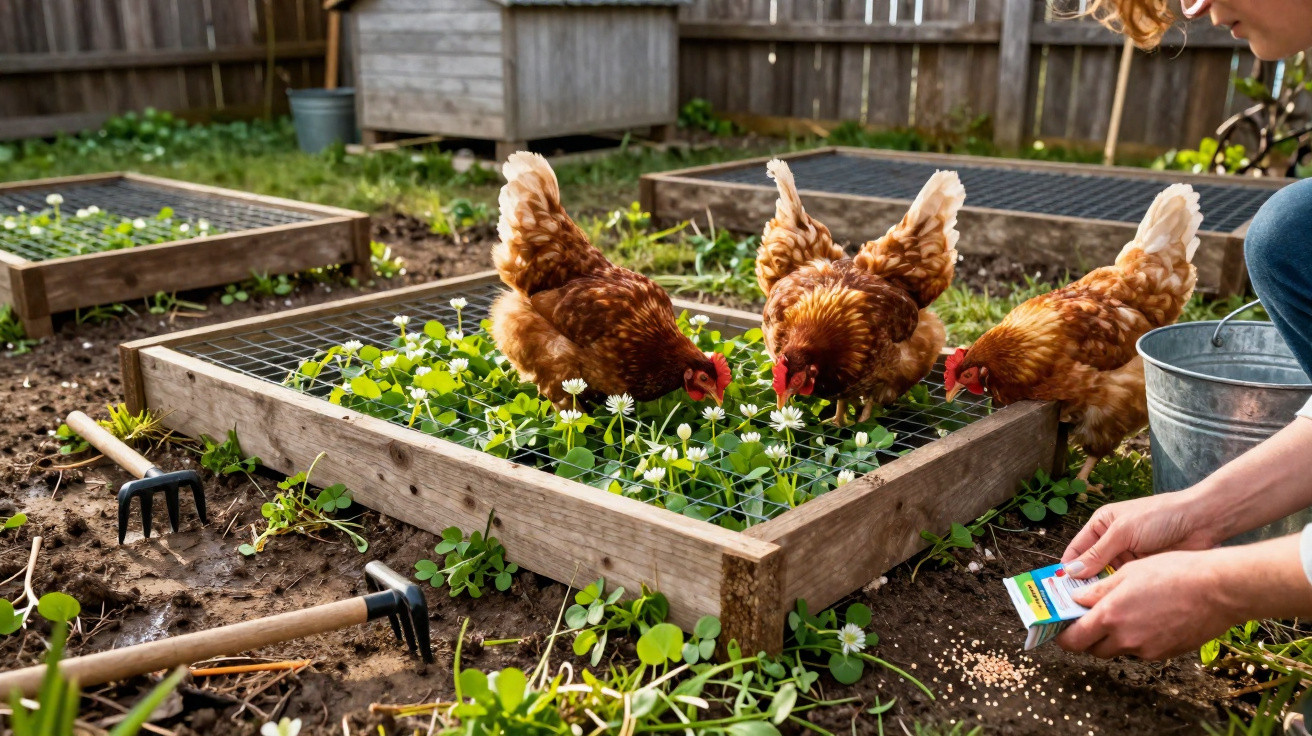
The “salad bar” trick using wooden frames and mesh
This is how to put it into practice in your own garden:
- Make several shallow wooden frames, for example from roofing battens, measuring roughly 80 × 80 cm or 1 × 1 m.
- Cover each frame with sturdy small-mesh wire netting.
- Loosen several patches in the run and remove large stones and remaining roots.
- Scatter the seed mixture evenly, then work it in lightly or roll it into the soil.
- Place the wooden frames directly on the ground so that the chickens cannot dig there.
Beneath the mesh, clover, ribwort plantain and chicory can germinate safely. Before long, the plants grow upwards through the openings. The birds can nibble the green shoots without pulling out the roots.
“This creates an ‘everlasting salad bar’: feed above ground, with a protected root system below that keeps producing more.”
Where space allows, create several of these islands and move the frames around during the year. This gradually transforms the entire chicken run into a permanently green foraging area.
From muddy puddle to a hard-wearing green chicken run
The effect on the ground is clearly noticeable. Clover and chicory create a dense root network that acts like a mesh: it stabilises the soil, improves water distribution and helps puddles disappear sooner. After rainfall, the run dries out more quickly.
Less standing water means less mud, fewer filthy feet, a lower risk of skin problems on the legs, and reduced parasite pressure. Dry, planted ground interrupts the life cycle of some worms and protozoa far more effectively than bare, wet soil.
The plants absorb nutrients from piles of chicken droppings and turn them into leafy growth. What previously sat in the soil as a problem is returned to the birds’ beaks as high-quality feed – a small nutrient cycle operating directly in the garden.
More activity and less stress in the chicken coop
Fresh greenery offers more than nutritional value; it also changes how the birds behave. Chickens naturally spend hours searching for food, pecking at a leaf here and a small insect there. A monotonous, bare run simply frustrates them.
With varied vegetation, the birds spend more time foraging and “grazing”. They remain occupied, calmer and appear more balanced. Aggressive pecking at other chickens often decreases when there is plenty to scratch through and sample.
“A living chicken run is also a psychological benefit for the flock – less boredom, less stress and less feather pecking.”
Adding a few logs, roots or small sand baths creates a genuine chicken playground, with a range of zones and structures.
Low costs and noticeable savings on feed
Another advantage is that the switch is quickly felt in the budget. Seed for white clover, ribwort plantain and wild chicory is inexpensive. Even a small packet covers several square metres, enough for a substantial section of a typical smallholder’s chicken run.
As all three species are perennial, there is no need to start again every year, provided the areas remain protected by mesh frames and are not dug over completely. Reseeding is generally only needed in isolated spots.
Those who begin early in the year can see results quickly: sowing in late February or early March means that, in many areas, chickens can start picking their first fresh leaves in April. The more greenery the birds eat, the less grain feed they require – without any loss of health or egg production.
Practical advice: site, mixture and common mistakes
Choosing the right site for the plant mix
- Light: full sun to partial shade; dense shade greatly slows down clover.
- Soil: it should not be too heavy, but can be nutrient-rich – chicken droppings provide plenty of nutrients.
- Waterlogging: avoid it wherever possible, as roots can rot.
If the soil contains very heavy clay, work in a little sand or fine gravel before sowing to improve drainage.
Common mistakes in the chicken garden
- Scattering seed without protection – the chickens eat it.
- Adding too much grass – it withstands trampling less well than expected.
- Opening up areas too early – young plants are pulled out completely.
- Creating only one small island – the chickens descend on it and overuse it.
It is better to establish several protected zones and only move the frames once the plants have formed strong root systems.
Why these plants work so well with chickens
The combination of clover, ribwort plantain and wild chicory brings together three key qualities: nutrient-rich growth, the ability to recover, and resistance to trampling. Clover rapidly fills gaps and adds protein to the feed. Ribwort plantain provides a kind of “home medicine cabinet” in the run. Chicory sends roots deep down and loosens even compacted soil.
Because they complement one another in the root zone, they compete less than might be expected. Clover tends to root near the surface, chicory pushes deep into the ground, and ribwort plantain establishes itself well in the spaces between them. In this way, even a heavily used chicken run can gradually be restored to a functional, green habitat for the birds.

Comments
No comments yet. Be the first to comment!
Leave a Comment