
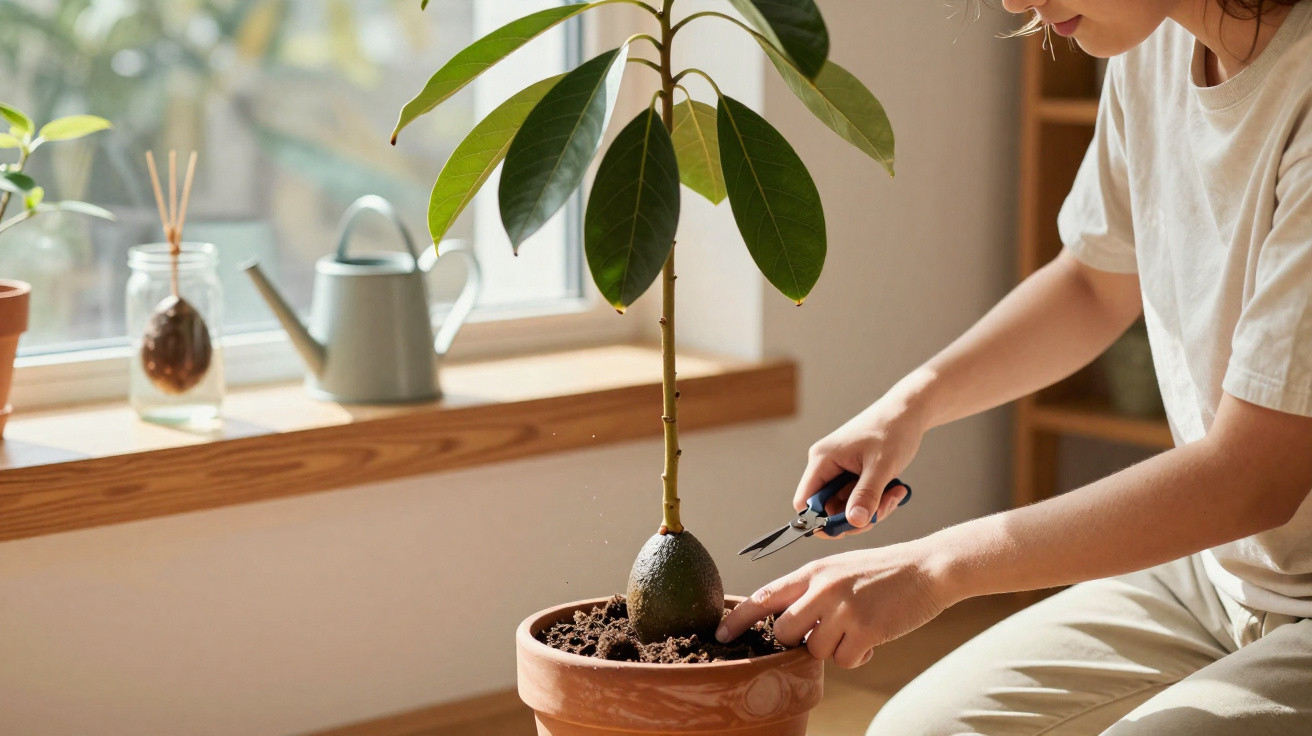
An avocado tree grown from its own stone can feel like a small miracle on the windowsill. First the root emerges, then a delicate shoot develops and the first leaves unfurl – before growth suddenly comes to a halt. The plant either dries out or is drowned, sheds its foliage in winter and, eventually, ends up in the bin. Yet an ordinary stone can become a long-lasting tropical houseplant if several essential rules are followed.
From kitchen stone to a true houseplant
The traditional method is simple: place a freshly cleaned stone in a glass of water, half submerged and supported with a few toothpicks. Within several weeks, the stone splits open, sending a root downwards and a shoot upwards. By this point, the kitchen experiment has become a long-term plant-growing project.
“Anyone who treats their avocado tree as a real houseplant – with a suitable pot, good compost, light and a care routine – can enjoy it for years.”
Whether it will ever produce fruit indoors is highly uncertain. Specialist sources mention five to ten years in ideal conditions – if it fruits at all. A more realistic aim is a strong, decorative tree with rich green leaves that gives the living room a tropical feel.
Mistake 1: Starting with the wrong stone and pot
Many difficulties begin with the planting material itself. Choose a stone from a ripe, flavoursome avocado; it should be plump and undamaged. Three germination methods have proved effective, each at a room temperature of around 20 to 25 degrees:
- in a glass of water, half submerged and held in place with toothpicks
- directly in loose, lightly moist compost
- first wrapped in damp cotton wool or kitchen paper
Do not give up too soon. It normally takes three to eight weeks for the stone to split, the root to emerge and the first shoot to become visible. Patience is an essential part of the process.
Once the shoot is several centimetres tall, the second and often underestimated step becomes important: choosing the right pot. A container that is too small constricts the roots, while an oversized pot encourages waterlogging.
The ideal first pot for an avocado tree
A diameter of around 20 to 25 centimetres is sufficient at first. Two details are particularly important:
- a drainage hole in the base, allowing excess water to run out
- a drainage layer, such as expanded clay pellets or coarse gravel
Add loose, nutrient-rich houseplant compost above this. When planting, leave half of the stone above the compost and spread the roots carefully so that they do not curl around themselves. After four to five months, you can consider moving it into a slightly larger pot – but not sooner, and not into one that is excessively large.
Mistake 2: The wrong position – too dark or too hot
Avocado trees originate from tropical regions. They need plenty of light, but do not cope with relentless sunshine intensified through glass. A spot directly at a south-facing window during the summer midday sun can quickly scorch the leaves.
“A bright position with plenty of daylight, but without hours of unfiltered midday sun, is ideal.”
Suitable locations include:
- an east-facing window for gentle morning sun
- a south-east or south-west position with a light curtain
- a west-facing window with filtered evening sun
Temperatures should generally remain between 18 and 25 degrees. Draughts from tilted open windows in winter or a radiator directly beneath the pot will stress the plant. Heat from a radiator dries the root ball rapidly, while leaf tips can appear almost scorched.
Air that is too dry – a quiet leaf killer
Another location-related mistake is extremely dry heated air. Avocado trees prefer a more humid environment. Ignore humidity and brown leaf margins or curled tips will soon follow.
What helps:
- mist the leaves regularly with low-limescale water
- place the pot on a saucer filled with moist expanded clay pellets
- group several plants close together to create a small microclimate
Mistake 3: Watering by instinct rather than checking
Most avocado trees do not die through neglect, but because of well-intentioned constant watering. Permanently wet compost causes root rot; the plant turns yellow and collapses.
“Your fingertip is the best measuring tool: only water when the top one to two centimetres of compost feel dry.”
The right watering frequency depends on the temperature, location and pot size. These pointers can help identify the problem:
- soft, drooping leaves and dry compost: too little water
- yellow leaves and heavy, wet compost: overwatering
- brown, curled margins: air that is too dry or heat stress
After every watering, water should not be left standing in the saucer. Leaving the puddle there continually soaks the roots and risks damage over time.
Water quality – often overlooked
Avocado trees can react badly to very hard tap water. A typical warning sign is leaves becoming pale while the veins remain green – an indication of nutrient deficiency (chlorosis), which limescale makes worse.
Better options are:
- tap water left to stand
- filtered water
- rainwater, if it has been collected cleanly
During the growing season from March to October, a liquid feed for green houseplants or citrus plants every two weeks supports the production of new leaves. In winter, use fertiliser very sparingly or not at all.
Mistake 4: Never pruning or repotting
Without intervention, an avocado tree usually develops into a thin, tall stem with a few leaves at the top. This rarely looks attractive and is not especially stable either.
“Those who prune early and regularly will get a bushier, sturdier tree rather than a wobbly stem.”
Once the plant reaches around 15 to 20 centimetres, cut or pinch out the tip immediately above the second or third pair of leaves. This encourages the plant to form side shoots. This “pinching” can be repeated on fresh shoots until an evenly shaped crown develops.
For root space, repotting every two to three years is usually enough. A slightly larger pot, a fresh drainage layer and new compost are rarely more than it needs. Moving it too frequently into ever-larger pots makes the plant unstable and encourages waterlogging.
Mistake 5: Ignoring warning signs in the leaves
An avocado tree “speaks” through its leaves. Watching them closely makes it possible to spot problems early and take action before the plant dies.
| Symptom | Likely cause | Action |
|---|---|---|
| evenly yellow leaves | too much water, insufficient light, hard water | water less, move to a brighter location, check water quality |
| brown tips and edges | dry air, heat stress, too much fertiliser | mist more often, move away from the radiator, pause fertilising |
| fine webbing beneath the leaves | spider mites caused by dry air | rinse the leaves, then follow up with mild soapy water |
| sticky patches, white cottony clusters on stems | scale insects or mealybugs | wipe affected areas, treat repeatedly with a soap solution |
Placing the tree outside on a balcony or patio for part of the warm season gives it more light and fresh air. The position should be sheltered from wind and frost-free; harsh, direct midday sun remains a risk outdoors too.
Realistic expectations: an attractive plant rather than a harvest miracle
Many amateur gardeners dream of picking avocados for breakfast from a tree beside the living-room sofa. In practice, fruit in a typical home remains unusual. These trees require abundant light, space and steady warmth, as well as, often, a genetically suitable partner tree for pollination – conditions that are usually absent indoors.
Viewing the tree as a decorative tropical foliage plant makes the process more relaxed. The pleasure then comes from its development: fresh shoots in spring, fuller foliage after every prune and a trunk that steadily becomes stronger.
Practical everyday tips for an avocado tree
Simple routines can prevent old mistakes from returning:
- set a watering day and check the compost with your finger each time
- inspect leaves and shoots briefly once a week for discolouration or pests
- in winter, check the distance from the radiator and adjust humidity as needed
- in spring, see whether roots are growing out through the bottom of the pot – if they are, it is time to repot
If you start several stones at the same time, you can experiment with different forms: grow one specimen tall and slender, and another heavily branched and bushy. This quickly reveals how strongly pruning, pot size and position shape the tree’s character.
With proper care, a spontaneous kitchen experiment becomes a long-lasting houseplant that accompanies everyday life. Although an avocado tree responds sensitively to care mistakes, it can recover when its signals are taken seriously and problems are corrected quickly. That is precisely its appeal: you get to know your plant – and it rewards you with every new leaf.
Comments
No comments yet. Be the first to comment!
Leave a Comment