
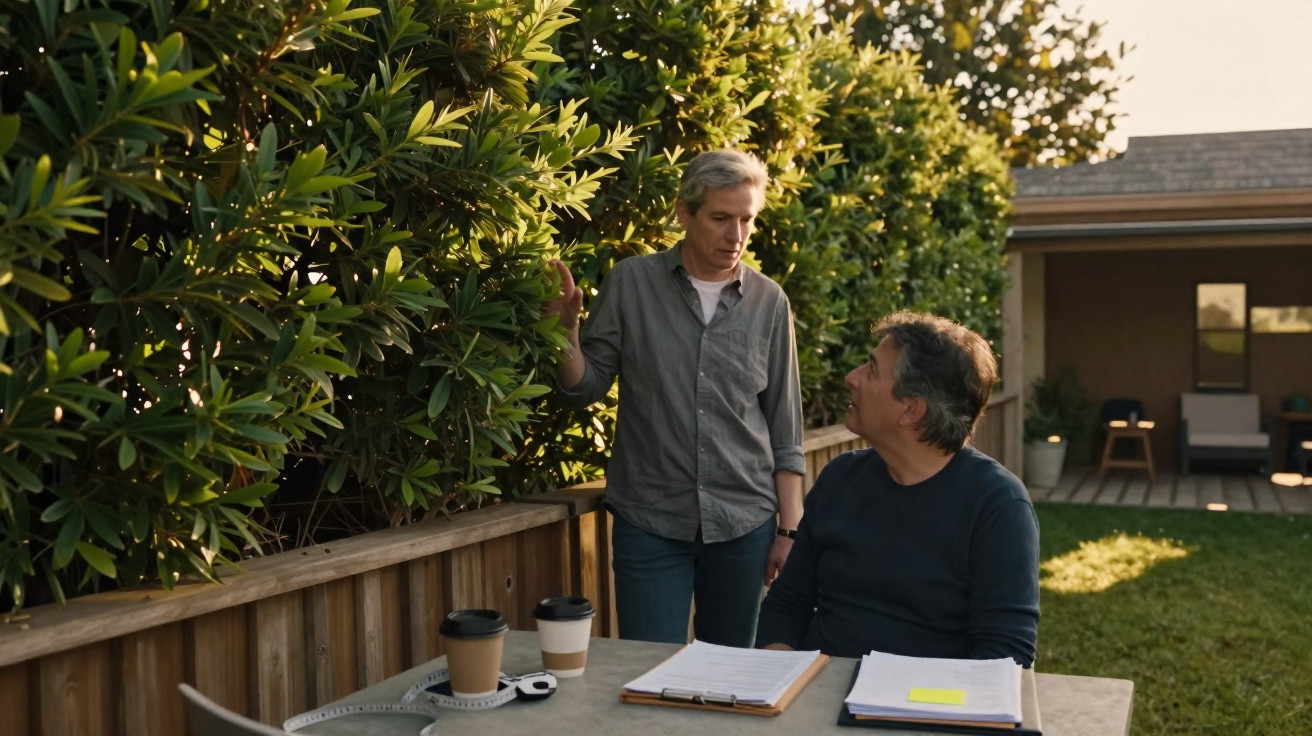
The patio is in shade, the neighbour’s hedge keeps getting taller, yet they do not respond?
There is a lawful way to break the deadlock.
Many garden owners know the problem: the green wall next door grows and grows, taking away light, space and peace of mind, while every attempt to raise the issue with the neighbour comes to nothing. Taking a saw to it yourself can quickly lead to conflict and even legal action. However, the law sets out clear rules and provides a rather effective means of persuading a neighbour who refuses to cut their hedge.
When a hedge becomes a nuisance
Hedges provide screening and privacy, but they can easily become unmanageable. When your own garden gets progressively darker, the lawn feels hemmed in or branches extend far beyond the fence, relations between otherwise peaceful neighbours can deteriorate quickly.
“Many people affected feel as though they are losing control over their own property.”
Fear of an argument leads plenty of people to stay silent, while others simply reach for the shears in secret. Neither approach is ideal: those who say nothing may remain frustrated for years, and those who cut without permission can damage someone else’s property and breach the law. In fact, the issue is regulated far more closely than many people realise.
Is the hedge on the boundary or entirely on the neighbour’s land?
The first crucial question is who legally owns the hedge. It may sound obvious, but it is fundamental to every subsequent step.
Shared hedge: joint responsibility
Where a hedge runs exactly along the boundary, it will generally be regarded as belonging jointly to both property owners. Each party shares responsibility and must maintain their side. The issue is then usually not “your hedge” versus “my hedge”, but finding a shared solution, such as agreeing a fixed annual cutting date.
Hedge located entirely on the neighbour’s property
If the hedge is clearly within the neighbour’s land, it belongs solely to them. Even so, they cannot simply allow it to grow without restriction. The law links planting to minimum boundary distances and maximum heights. In many respects, the requirements resemble French rules; in Germany, they are usually set out in the neighbour law of the relevant federal state or in local by-laws.
The usual basic structure of the distance rules is as follows:
- Tall hedges (over approximately 2 m): must be planted further away from the boundary
- Low hedges: may be planted closer to the boundary
- Height is measured from ground level to the top
- The distance is generally measured from the centre of the trunk to the boundary
Anyone uncertain about the position should first check the local by-laws or the neighbour law of their federal state. This alone often gives discussions with the neighbour a much firmer basis.
Overhanging branches and invasive roots: what is permitted?
This is a familiar situation: the hedge may stand on the neighbour’s land, but its branches extend well across the property boundary. Alternatively, roots, creepers and brambles may spread across your lawn.
The law draws a firm distinction between branches above ground and roots below it. In simplified terms:
| Situation | Legal position |
|---|---|
| Branches extend over the boundary | The hedge owner must cut them back once they have been asked to do so. |
| Roots, creepers or brambles enter the property | The frustrated neighbour may cut them off at the boundary themselves. |
| The hedge fails to comply with distance and height requirements | Cutting back, or even removal, may be required depending on state law and how long the situation has existed. |
Important: in many circumstances, you may not cut overhanging branches yourself, however irritating they may be. Cutting them remains, in principle, the responsibility of the hedge owner. Anyone who takes pruning shears to them without first speaking to the owner could ultimately become liable for damages.
Step-by-step plan: how to get the neighbour to cut the hedge
Legal professionals recommend a clear, staged process. Following and documenting this order significantly improves your chances while reducing the risk of an unpleasant escalation.
1. A friendly conversation over the fence
The first measure is straightforward but often effective: speak to the neighbour directly. Stay calm and avoid accusations; instead, explain the specific consequences. For example, the patio may be in shade for almost the whole day during summer, or damp may be building up against the exterior wall of the house.
“Many people are more likely to respond when they understand how greatly the hedge affects their neighbour’s daily life.”
Knowing the legal distance requirements beforehand makes you appear more credible during the conversation, without coming across as patronising.
2. A written request with a deadline
If the conversation changes nothing, the next step is a clear and factual written request, preferably sent by recorded delivery with acknowledgement of receipt. It should include:
- A precise description of the issue, such as the height, shade or overhanging branches
- Reference to the applicable legal provisions or local requirements
- A reasonable deadline for cutting the hedge back, for example four weeks outside bird-protection periods
- Notice that, if no action is taken, the next step will be an independent mediation service
This letter is not just a signal to the neighbour. It also becomes an important document for every later stage, from mediation through to court proceedings.
3. The underestimated tool: a mediator or conciliator
The real “secret trick” in a hedge dispute is neutral mediation. In France, this role is performed by the conciliateur de justice. Germany has comparable options, including arbitration offices, municipal mediation services and voluntary arbitrators.
The principle is always the same: an independent person brings both parties together at the table. The hedge is no longer debated over the fence, but calmly in an office or meeting room. This reduces pressure and prevents the dispute from becoming personal.
To make the meeting effective, it helps to prepare the following:
- Recent photographs of the hedge from your own property
- Where appropriate, a simple sketch marking the property boundary and the hedge’s position
- Notes of the times when the patio or garden is in shade
- Print-outs of the relevant legislation or municipal requirements
- A copy of the recorded-delivery letter and any replies
At this point, many neighbours recognise that the matter is serious, but has not yet reached court. That alone often persuades them to get out the hedge trimmer after all.
4. If nothing works: court action
If the neighbour remains obstinate despite mediation, going to the local court or regional court is the final step. Before doing so, it is usually worthwhile securing evidence, for instance through a written record made by an arbitrator or a formal inspection report.
A court can require the hedge owner to reduce or remove the planting and can attach a financial penalty if the order is not followed. In practice, merely warning of such a judgment is often enough for the hedge to suddenly be brought back under control.
Why this route is often better than taking matters into your own hands
Using your own saw can seem tempting: the problem is “solved” immediately and nobody has to have an awkward conversation. In reality, however, it can create further problems:
- Possible claims for damages because plants have been harmed
- Ongoing friction in daily life, from parking spaces to where bins are placed
- A toxic atmosphere throughout the neighbourly relationship
By contrast, the official route of conversation, letter, mediation and, if necessary, court action provides clarity. It shows that you respect the neighbour’s rights while also being prepared to assert your own.
Practical tips for everyday life with a neighbour’s hedge
Those who want to avoid hedge disputes should act as early as possible. When planting a hedge, it is advisable from the outset to position it so that it will not create legal issues in the long term. A few rules of thumb can help:
- Leave a little more space from the boundary than the bare minimum
- Consider the growth rate of the species: thuja and cherry laurel quickly become tall
- Discuss the desired height with the neighbour from the outset
- Agree fixed cutting dates, such as once a year in late summer
Anyone moving into a house where hedges are already established should assess the situation early. If it has existed for a very long time, legal claims may be limited. A brief discussion with a specialist solicitor in tenancy and neighbour law, or with a local authority advice service, can then prevent costly mistakes.
Hedges are more than green decoration. They affect safety, sunlight, quality of life and property rights. Anyone who knows their options and does not rush to use a saw is in a clearly stronger position if a dispute arises; often, simply announcing an approach to a mediation service is enough to make the neighbour reach for the hedge trimmer after all.






Comments
No comments yet. Be the first to comment!
Leave a Comment