
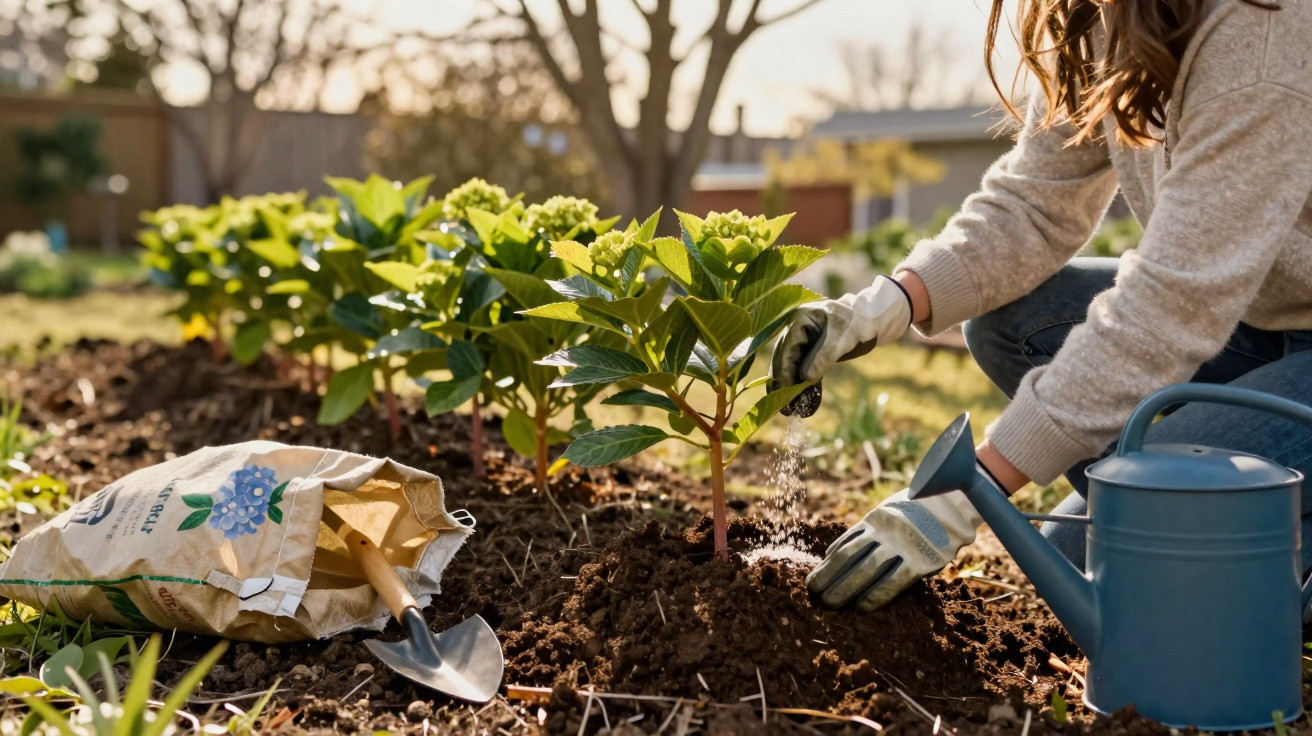
Many amateur gardeners only spot the issue in July: the foliage is lush and healthy, yet there are hardly any flower heads. The reason often dates back several months, to the end of winter. Looking after hydrangeas properly between late February and early March lays the groundwork for strong bud development and far more blooms in summer.
Why the period before March matters so much for hydrangeas
Hydrangeas set their “flowering plan” very early in the year. As temperatures rise and daylight hours lengthen, sap starts moving through the shrubs again. This is when new shoots and flower buds begin to form.
“Feeding hydrangeas with the right nutrients before March encourages bud formation rather than simply producing leaf growth.”
If the plant is growing in nutrient-poor soil at this point, it prioritises what is most useful for survival: leaves and shoots. Flowers demand considerably more energy, so this is precisely where the hydrangea economises.
The outcome becomes apparent in summer: bushy, green plants with only a few blooms, or none at all in extreme cases. Many gardeners then blame incorrect pruning or frost damage, but weak or unsuitable late-winter fertilising is often the real cause.
Which fertiliser genuinely benefits hydrangeas before March
Hydrangeas are among the plants that prefer acidic, humus-rich soil. An overly strong, purely mineral fertiliser can stress them rather than support them. A mild, steady supply of nutrients works much better.
Compost: a gentle boost for hydrangeas
Mature, well-rotted compost is ideal. It does more than feed hydrangeas: it also improves soil structure and helps the ground retain moisture.
- Layer depth: around 7 to 10 centimetres
- Area: approximately 40 to 50 centimetres around the stem
- Type: use only fully rotted compost, never fresh material
This compost layer acts as a natural slow-release fertiliser. Every time it rains or the plant is watered, small amounts of nutrients dissolve and gradually seep down to the roots. Instead of receiving a brief nutrient shock, the plant is supplied consistently for weeks.
Suitable specialist fertilisers for hydrangeas
Not everyone has enough home-made compost available. In that case, an organic or organo-mineral specialist fertiliser for hydrangeas is suitable, as it releases nutrients gradually.
The NPK figures on the packaging offer useful guidance. They show the proportions of nitrogen (N), phosphorus (P) and potassium (K). Common blends for hydrangeas before March include the following:
| NPK ratio | Characteristic |
|---|---|
| 7–4–5 | balanced and relatively gentle, suitable for regular applications |
| 8–3–9 | slightly more potassium for sturdier shoots and improved flower quality |
The exact numbers matter less than ensuring the fertiliser is not excessively high in nitrogen. Too much nitrogen promotes leaf growth, while flowering falls behind.
“When fertilising hydrangeas, it is better to use a little regularly than too much in one go.”
Many manufacturers state fairly high maximum application rates. Gardening professionals advise starting with a slightly reduced dose and watching how the plant responds. Excessive feeding can easily make a hydrangea put all its energy into leafy growth and neglect bud formation.
How to apply fertiliser to hydrangeas correctly
Fertiliser works best when it reaches the area containing most of the fine roots. These are not located right beside the stem, but tend to sit around the outer section of the root ball.
Hydrangeas planted in the ground
- Mark the area: Imagine a circle slightly wider than the plant’s current canopy.
- Create a fertiliser ring: Spread compost or granules in this zone as a broad ring, keeping it away from the stem itself.
- Work it in lightly: Use a rake or hand cultivator to incorporate it shallowly, without disturbing the roots deeply.
- Water well: Water thoroughly afterwards so the nutrients dissolve and move into the soil.
For hydrangeas growing in a border, one application in late winter is normally sufficient. Only in very sandy, free-draining soils may a second, lighter feed in late spring be worthwhile.
Caring for hydrangeas in pots
In a container, the volume is limited and the compost becomes depleted more quickly. As a result, a late-winter application alone will usually not last for the whole season.
- Late February to early March: give the first feed with compost or specialist fertiliser.
- Late May to June: apply a small follow-up feed using a weaker liquid or slow-release fertiliser.
- At all times: avoid waterlogging, as wet roots absorb nutrients less effectively.
Potted hydrangeas are much more sensitive to overfeeding. Anyone adding liquid fertiliser to watering water should follow the lower recommended dosage exactly, or use slightly less.
Common mistakes that reduce flowering
Many well-intentioned care routines weaken hydrangeas without gardeners realising it. Certain pitfalls occur repeatedly in gardens.
Too much nitrogen in spring
General-purpose fertilisers with a very high nitrogen content may create deep green foliage, but the plant effectively “forgets” to flower. If using these products, apply them very sparingly and do not spread them on hydrangeas in late winter.
Tipping fertiliser directly against the stem
Granules or fresh compost placed directly against the shoots can cause scorching or encourage rot. The fertiliser ring should always sit in the outer root zone.
Fertilising too late
Those who only begin stronger fertiliser applications in April or May have already missed the crucial period for bud development. The plant may become stronger, but the number of flowers can then only be influenced to a limited extent.
What hydrangeas need besides fertiliser for abundant flowers
Nutrients alone do not guarantee a spectacular display of flowers. Several aspects of position and care have a direct effect on how freely hydrangeas bloom.
- A partially shaded position: morning or evening sunshine is ideal; intense midday sun stresses the plants.
- Consistent moisture: soil should never dry out completely, but it must not remain constantly wet either.
- Correct pruning: many varieties flower on the previous year’s wood. Cutting them back too hard in spring can unintentionally remove the flower buds.
- Slightly acidic soil: a pH value between 5 and 6.5 suits most varieties well.
Pruning in particular causes repeated frustration. With some hydrangea types, hard pruning in spring results in a year without flowers even when fertilising has been perfect. Before reaching for the shears, check the variety name and its pruning instructions.
Extra advice for blue and pink varieties
Many garden enthusiasts want vivid blue or pink flowers. Their colour depends on the amount of aluminium available in the soil and on the pH value. Intensely blue varieties need slightly acidic soil with added aluminium, for example through specialist blue hydrangea fertilisers.
Anyone wishing to retain pink flowers should generally avoid these products and should not push the pH value too far into the acidic range. Feeding before March remains equally important in both cases: it provides the energy needed for flower number and size, while pH and aluminium mainly determine the shade.
Anyone who invests a wheelbarrow of compost or a handful of mild specialist fertiliser now, between late February and very early March, will see the result in summer: large, dense flower heads that stand out in the garden even from a distance.

Comments
No comments yet. Be the first to comment!
Leave a Comment