
A silent frost killer lurks beneath balcony planters and containers in March – yet an inconspicuous base can save your lemon tree.
Winter may appear to be over, daylight hours are increasing and the first fresh leaves are emerging – and that is precisely when a late frost can strike. Many amateur gardeners protect the canopy and branches of their lemon tree but overlook the most dangerous route for cold: the ground below the pot. A small, almost invisible aid beneath the container can make all the difference.
Why March is so risky for potted lemon trees
Anyone keeping a lemon tree in a container on a balcony or patio often feels safe once February has passed. The sun brings warmth during the day, the tree starts producing new growth and everything seems settled. However, in March, a clear sky and a cold night are enough for temperatures to drop suddenly below freezing.
Most owners respond by wrapping the canopy, moving the pot against the house wall or watering less. These measures help to a degree, but they do not address the main issue: cold creeping straight into the pot via the balcony slab, concrete or paving.
The most dangerous frost reaches a lemon tree not from above, but gradually from below through the ground.
It is this so-called “cold bridge” between the base of the pot and the surface beneath it that harms the sensitive roots. The tree may have looked healthy the previous evening, only for its leaves to droop by morning and later turn brown or black – often a classic sign that the root zone has frozen through.
The simple solution: an insulating board beneath the pot
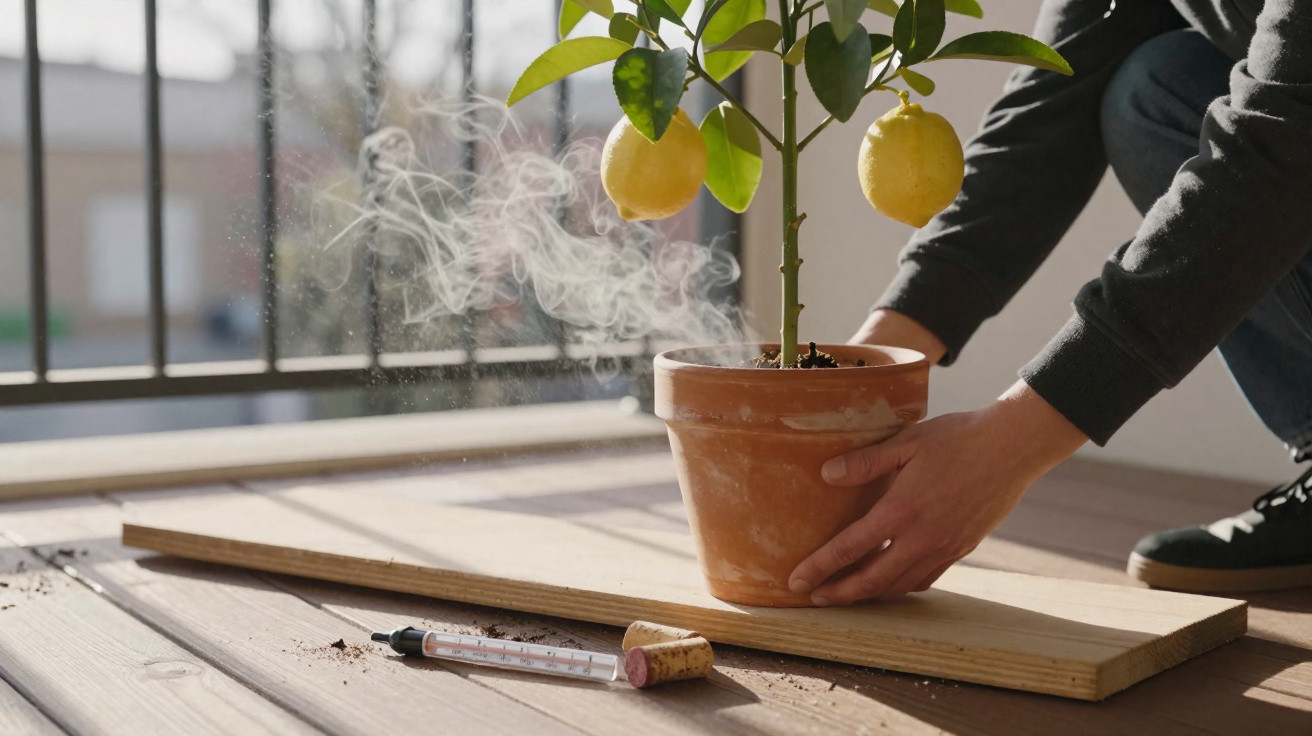
The most effective protection is surprisingly straightforward: placing an insulating board directly under the pot breaks contact with the icy ground. No high-tech solution or costly specialist accessory is needed; it can be made from something many people already have at home.
Suitable materials
Materials that insulate well and are several centimetres thick are particularly suitable:
- a rigid piece of expanded polystyrene or packaging polystyrene
- a thick cork board or an old cork mat
- a wooden board combined with thin foam
- a dense rigid-foam board, such as those often used for deliveries
Ideally, the board should:
- be 2 to 5 centimetres thick
- extend 1 to 2 centimetres beyond the pot base on all sides
- be strong enough to support the weight of the container
This simple base cuts off the cold bridge from the ground – a small plinth with a big effect.
How to create frost protection in five minutes
- Choose a suitable board and cut it roughly to the size of the pot.
- Carefully lift the pot or place it to one side.
- Position the board where you want the pot to stand.
- Make sure the pot’s drainage hole will not rest tightly against the board.
- Put the pot back on the base and align it.
Leave the board beneath the pot until around mid-May – in other words, until the risk of late frosts and the traditional Ice Saints period has passed.
The cold-bridge problem: how a balcony attacks your roots
Concrete, stone paving and tiles retain the night’s cold very effectively. Even when the air becomes milder again in the morning, the surface continues to radiate cold for a long time. It then travels through the bottom of the pot and directly into the compost.
The consequences inside the pot are:
- fine root tips freeze
- water uptake collapses
- leaves become dull, curl up and later turn black
A lemon tree planted in the ground copes better with these fluctuations because soil responds far more slowly. In a pot, by contrast, the root zone is small and exposed, so the cold shock hits it directly.
A typical scenario is a south-facing balcony with mild daytime temperatures of 15 degrees, followed by a sudden overnight low of minus two degrees. Without an insulating base, the root area can cool sharply within a few hours, while the canopy remains fairly well protected by a fleece cover. The damage starts unnoticed at the bottom of the pot.
Do not block drainage: simple cork tricks for good water run-off
Cold is one concern, but excessive wetness is another. Simply placing a dense board beneath the container risks water collecting in the saucer or blocking drainage. Waterlogging immediately before a frosty night can make the damage significantly worse.
Protect roots while keeping drainage clear
A brilliantly simple household solution is cork. It creates both air space and insulation at the same time.
- Cut several corks in half lengthways.
- Place the halves flat-side down on the insulating board, distributed across three or four points.
- Stand the pot on these “cork feet”.
This achieves three things:
- The pot base does not sit in full direct contact with the board.
- A thin layer of air forms, adding further insulation.
- The drainage hole remains clear, allowing water to run off freely.
Cork pieces beneath the pot create an additional air layer and keep drainage secure – with zero material cost.
Combine protection: getting your lemon tree safely through the Ice Saints
The insulating base is the foundation. On very cold nights, however, you can add further protection without completely enclosing the tree.
Protective layers you can combine
| Measure | Benefit |
|---|---|
| Insulating board beneath the pot | Breaks the cold bridge from the ground and protects the roots |
| Winter-protection fleece over the canopy | Keeps the air around leaves and branches a few degrees warmer |
| Place the pot against a south-facing house wall | Uses stored warmth from the façade and reduces wind exposure |
| Raise the pot slightly further | Improves air circulation beneath the base and reduces waterlogging |
| A “second skin” around the pot | Insulates the sides of the root zone |
For this “second skin”, for example, use bubble wrap directly around the pot and cover it with a layer of hessian so it does not look like a moving box. This insulates the sides of the container, while the insulating board cuts off cold from below.
Watering, temperature and position: what matters in spring
Wet compost conducts cold far more effectively than a slightly dried-out growing medium. Before a frost is forecast, it is worth checking the pot:
- Do not allow waterlogging before a cold night.
- Water in the morning rather than shortly before sunset.
- During the growing period, water moderately but regularly.
If the pot stands on a particularly cold surface, such as stone paving, it may be worthwhile raising it slightly more with bricks or sturdy pot feet. Combined with the insulating board, this increases the effect further.
A sheltered spot directly against a south-facing house wall acts like a natural heater: the wall stores warmth during the day and releases it slowly overnight. Those extra few degrees can make the difference in borderline conditions between frost damage and healthy new growth.
Why the effort is worthwhile – and what else to know
A potted lemon tree is a long-term project. It takes years before a tree bears strongly. One careless late frost can undo that work. A simple reusable board under the pot significantly reduces this risk, meaning you do not have to rush the tree indoors every time temperatures fall.
Anyone growing several Mediterranean container plants, such as olive, kumquat or bay, can use the same trick for all of them. Wherever frost-sensitive roots stand on a cold surface, this insulation acts like a safety belt.
There is another point that many people underestimate: a tree that is properly protected for a short period and comes through March without frost damage begins the season much more vigorously, produces steadier new growth and reacts with less stress to heatwaves in summer. Healthy roots are the best insurance against unpredictable weather – and that is exactly where the unobtrusive board beneath the pot comes in.

Comments
No comments yet. Be the first to comment!
Leave a Comment