
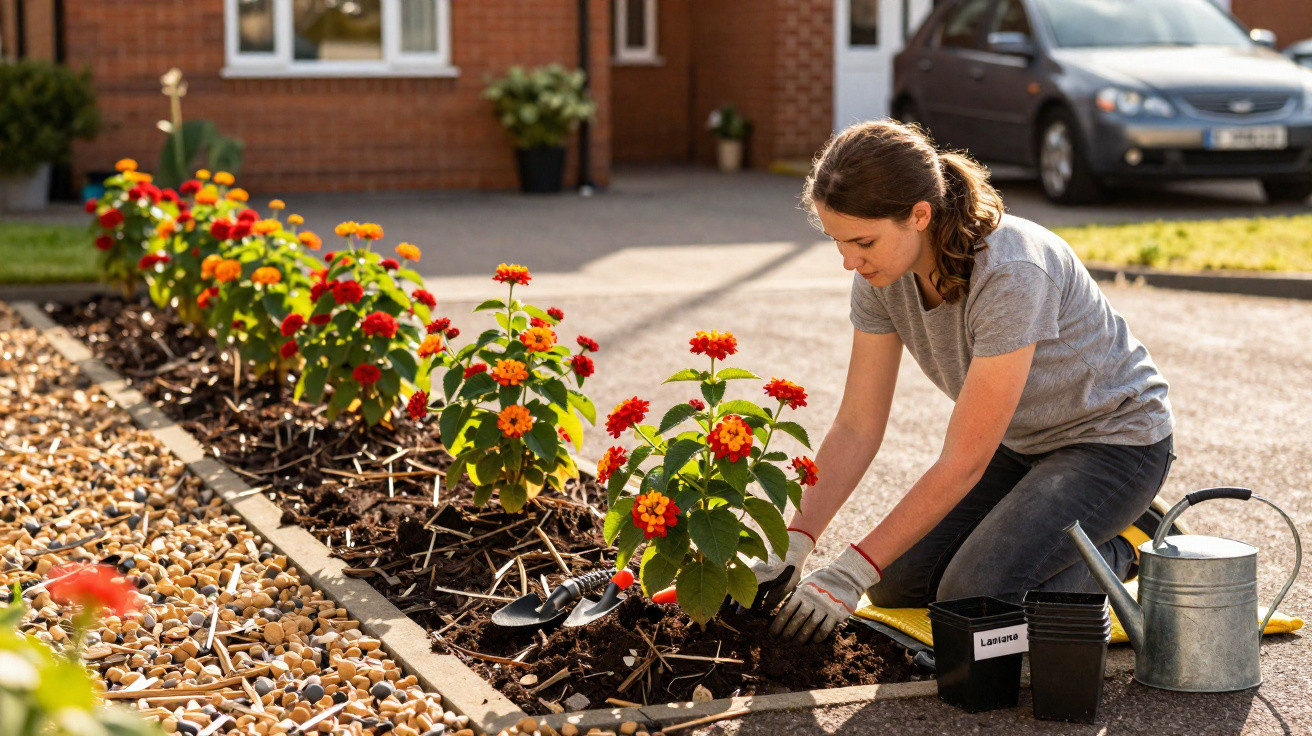
Fiery blooms instead of grey dullness: an otherwise understated shrub from warm regions creates a spectacular ribbon of colour along driveways.
Many homeowners face the same issue: a driveway may be practical and neatly paved or surfaced with tarmac, yet still look lifeless despite every effort. Few plants can withstand the combination of heat, vehicle traffic and road salt for long. However, a compact ornamental shrub with vivid red flowers proves that it is possible, performing remarkably well in hot spots and beside sunny driveways.
Why this red shrub excels beside a driveway
The focus here is the compact lantana shrub cultivar Lantana camara ‘Hot Blooded’. Native to warm climates, it belongs to the verbena family. Its greatest advantage is that it thrives in places where other plants have long since failed: at the sunny, heat-baked edges of driveways and car parks.
The shrub forms a dense, cushion-shaped mound measuring around 60 centimetres in both height and spread. It therefore does not project too far into the driveway, obstruct visibility or get in the way when car doors are opened. Visually, though, it is a real standout: flowers open in rich yellow, shift through orange and eventually become deep red. A single plant will often display every shade at once.
This creates a fiery, colourful strip along the driveway that draws attention from spring well into autumn.
Its abundance of flowers is highly appealing to bees and butterflies. At the same time, the plant is relatively easy to care for. It copes far better than traditional bedding perennials with heat, radiation reflected from tarmac or paving, and extended dry spells.
A key benefit: sterile and easy to control
Another advantage of ‘Hot Blooded’ is that the cultivar is considered sterile. It produces no viable seeds, so it will not self-seed uncontrollably. Anyone wanting a clean, crisply designed border beside a driveway need not worry about plants straying into the lawn or gravel bed.
Despite being sterile, its flowers provide food for insects and nectar-feeding birds. This makes it an appealing blend of tidy design and ecology for wildlife-friendly gardens in heat-stressed locations.
Location: where the fiery red shrub performs best
Lantana originally comes from warmer climates. It will only survive outdoors through winter where frost is not severe. In the United States, it is commonly rated for regions roughly equivalent to USDA hardiness zones 7 to 11.
For the United Kingdom, this means it may survive as a perennial with a little luck in very mild wine-growing areas or sheltered city centres. In most locations, it is better suited as a lavishly flowering summer plant or a container specimen that is moved into winter protection in autumn.
A position in full sun is essential: at least six hours of direct sunlight each day are required for dense flowering.
Soil conditions at the driveway edge
Ground alongside driveways is generally heavily compacted. Tyres, construction machinery and rain often press the soil into a hard surface. This is problematic for many ornamental plants, but lantana can handle it provided some preparation is done at planting time.
The soil should be:
- loose and free-draining;
- unable to retain standing water;
- ideally sandy or gravelly in structure.
With a few targeted measures, even difficult sites can be turned into a suitable planting strip.
How to plant Lantana camara ‘Hot Blooded’ along a driveway
To transform a grey driveway into a red line of flowers, ideally allow for a narrow, sunny border alongside the tarmac or paving. The eventual effect-an uninterrupted ribbon or looser splashes of colour-depends on the spacing between plants.
Creating a flowering strip step by step
- Dig a planting hole at least twice as wide as the root ball.
- Loosen the soil thoroughly at the bottom of the hole so that roots can spread.
- Mix heavy, clay-rich soil with gravel, sand or expanded clay to improve drainage.
- Position the plant with the top of its root ball level with the surrounding soil.
- Water thoroughly after planting, allowing the soil and root ball to settle together.
- Apply a thin layer of gravel or decorative chippings as mulch, choosing a colour that complements the driveway.
For a continuous strip, spacing of around 60 to 90 centimetres between plants has proved effective. Closer planting fills gaps more quickly, while wider spacing produces a more open look and gives each shrub more room.
Seasonal care: from heat to winter
The most sensitive period is the first summer after planting. This is when the roots need to establish themselves in the new soil. If young plants are watered too infrequently in the first few weeks, they may dry out despite their high heat tolerance.
Watering and heat tolerance
During the first year, water regularly, especially in prolonged dry weather and where tarmac or concrete creates intense reflected heat. Later, lantana shows its resilient nature. Established plants can withstand several weeks without extra watering, provided the soil does not become permanently hard as concrete and completely dry.
Particularly beside hot driveways, where other perennials wilt, the lantana shrub remains remarkably vigorous and free-flowering.
There is another benefit for driveways in snowy areas: the plant is fairly unfazed by splashes of road salt that are unavoidable during winter gritting. Deer also tend to show little interest in its strongly aromatic foliage, which is a genuine advantage on rural edges.
Pruning and overwintering
How hard the shrub should be cut back depends on the climate and how it is grown:
- Mild regions: Prune the shoots back firmly in late winter. This prevents the plant from becoming woody and encourages fresh new growth with plenty of flowers.
- Cooler regions: Shoots can be cut down close to ground level. A thick mulch of leaves or bark chips protects the base. For the most reliable option, grow the shrub in a large container and overwinter it in a frost-free but bright place.
When grown in a pot, lantana can be positioned flexibly beside the driveway and simply moved into a garage or bright, unheated room in autumn.
Caution: beautiful but toxic
As appealing as the red blooms may be, every part of the plant is considered toxic. Households with young children or pets should place the shrub where nobody is likely to nibble at it regularly. Gardening gloves are advisable when pruning to prevent skin irritation.
The bright flowers invite people to touch them, so the position needs careful consideration-especially in family gardens.
That does not mean the visual effect must be missed. Along a driveway used mainly by adults, near a garage or in a front-garden area away from play spaces, the risk remains manageable.
Where this fiery flowering shrub works especially well
Lantana beside a driveway is particularly suited to modern, clean-lined designs featuring gravel, concrete or large-format paving slabs. The red flowering border softens a stark layout without compromising its orderly structure.
It is particularly effective when combined with:
- ornamental grasses that visually soften hard edges;
- low, silver-leaved perennials such as cotton lavender or curry plant;
- pale or dark gravels that intensify the colour contrast of the flowers.
For a more playful colour scheme, the red cultivar can be mixed with yellow-orange or pink lantana varieties. Maintaining consistent spacing along the driveway remains important so that the overall planting does not appear restless.
Practical advice for home gardeners in the United Kingdom
In many areas, it makes sense to treat lantana initially as a premium seasonal planting: put it into the prepared border from May, after the risk of frost has passed, enjoy the display throughout summer, then decide in autumn whether and how it should be overwintered.
Anyone without suitable winter accommodation can simply plant a fresh specimen the following year. For homeowners who redecorate their driveway every spring anyway, this is a flexible option. Gardeners in mild urban climates or protected south-facing positions, meanwhile, may wish to test whether the plant remains perennial with good winter protection. Both approaches work as long as the site is sunny and the soil is well drained.
This turns a previously bleak strip beside tarmac or paving into an eye-catching, low-maintenance calling card for the home, with a red, flaming band that provides colour from the first to the last warm day of the season.
Comments
No comments yet. Be the first to comment!
Leave a Comment