
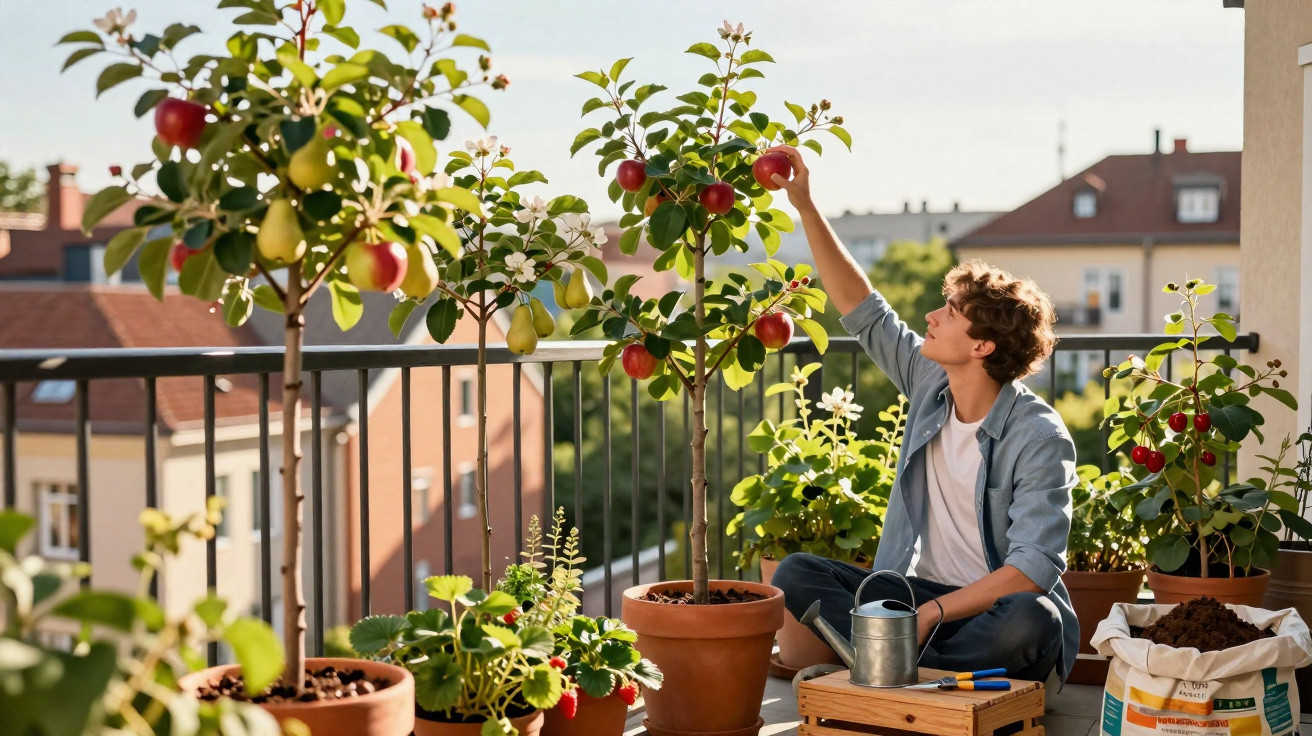
This unusual fruit tree will fit into a container – yet still produces a remarkably generous crop.
Anyone living in a city knows the challenge: the balcony is tiny, the courtyard is full of parked cars and the shared garden has long since become overcrowded. Fresh, unsprayed fruit can quickly seem like a luxury reserved for people with large gardens. But a particular type of fruit tree is changing those rules, turning an ordinary planter into a surprisingly productive miniature fruit garden.
The fruit tree as a column: turning a balcony into a mini fruit garden
What creates the columnar growth habit
The defining feature of these trees is their shape: they grow almost entirely upwards while remaining exceptionally narrow at the sides. Specialists refer to them as columnar or pillar fruit trees.
Rather than producing many long lateral branches, the tree directs its energy into a strong central leader. Fruit grows directly from this trunk or from very short fruiting spurs. The result is a slim green column that requires scarcely more room than its container – often less than one square metre.
“A columnar fruit tree provides a real harvest in the footprint of a chair.”
This is a game changer, especially in urban settings. A space that once accommodated no more than a tomato plant can now support reliable fruit production – on a balcony, against a house wall or in a small corner of a courtyard.
Which fruit varieties work as columnar trees
Many nurseries now stock dedicated columnar or spindle-trained fruit varieties that naturally retain a compact habit. Typical options include:
- Apple trees with crisp, aromatic varieties for eating fresh
- Pear trees producing sweet fruit with melting flesh
- Dwarf or columnar cherry trees with a surprisingly abundant display of blossom and fruit
Many of these varieties are bred to be hardy and disease-resistant and, ideally, to thrive without chemical treatments. Anyone specifically asking for “columnar fruit” at a specialist retailer will usually find several options, often with details of their eventual height and expected yield.
How a container becomes a “replacement garden”
The right container size: a small garden needs a large pot
Although the tree itself stays slender, its roots require substantial volume. A small decorative pot will not do; a container holding around 30 to 50 litres is ideal.
This capacity offers several advantages:
- Sufficient space for a strong root system
- A dependable supply of water and nutrients
- The container can still be moved with some effort if the position needs changing
Whether the container is plastic, terracotta or wood matters less than ensuring it is frost-proof and has one or more drainage holes. Without them, waterlogging can develop – a sure way to kill young fruit trees grown in containers.
Drainage and compost: a small laboratory for strong roots
Because the tree is not planted in open ground, the growing medium needs particularly careful planning. Basic supermarket potting compost is often the equivalent of fast food here.
The following layered arrangement has proved effective:
- At the base: around five centimetres of expanded clay or coarse gravel for drainage
- Above this: high-quality planting compost enriched with mature compost
- Slow-release nutrients: a handful of organic fertiliser, such as horn shavings
- On top: a layer of mulch, for instance straw, hemp bedding or pieces of bark
Together, these layers keep the compost loose and well aerated while preventing waterlogging. Mulch also helps the container retain moisture for longer, which is a major benefit on sunny balconies.
Planting columnar fruit trees systematically: using every gap without overdoing it
How many trees fit on a balcony?
Since these trees remain so narrow, they can be positioned much closer together than traditional orchard trees. A gap of 60 to 80 centimetres between two containers will normally be entirely sufficient.
This means that three fruit trees can easily stand along the balustrade of a two-metre-long balcony – perhaps an apple, pear and cherry in a row. With a longer balcony, this approach can create a genuine “fruit avenue” above street level.
“Three different types of fruit along two metres of balcony edge – that is how concrete becomes growing space.”
Step by step to a well-established columnar fruit tree
Start with a high-quality grafted young tree from a specialist nursery. It should have a well-rooted root ball and a sturdy central leader.
- Prepare the container with drainage and compost.
- Position the plant so that the root ball is fully covered.
- Keep the graft union – a small swelling low on the trunk – above the compost surface.
- Firm the compost gently so that no large air pockets remain.
- Water thoroughly until water runs out from the base.
Taking care over this initial planting provides the foundation for quick, reliable establishment during the first year.
Low-stress care: little effort, strong results
Watering, pruning and feeding to keep the tree in shape
Compost dries out faster in a container than soil in the garden. This makes regular checks essential, particularly in summer. Once the upper layer of compost appears dry, the tree needs more water. Rainwater is ideal, though tap water is usually suitable too, provided it is not extremely hard.
Pruning columnar fruit is surprisingly straightforward. It is enough to remove individual shoots that break clearly away from the slim outline or grow inwards. Leave the central leader untouched, as it forms the tree’s “backbone”.
One or two applications of liquid organic fertiliser during the growing season support fruit development. In spring, a little compost can also be worked into the top layer of the growing medium.
When you can finally expect home-grown fruit
Many amateur gardeners automatically assume fruit trees require a wait of five to ten years. Container-grown columnar fruit follows a different timetable. Thanks to grafting and a good nutrient supply, the first worthwhile crops can often arrive after just two to three years.
“After two to three years, in good conditions, the slender trunks can already bend beneath apples, pears or cherries.”
The harvest may still be modest in the first fruiting year. With every seasonal cycle, however, the tree becomes more productive without losing its compact form. That makes it a long-term yet space-saving “yield machine” for city dwellers.
How balcony fruit changes city living
More than decoration: ecological and practical benefits
A columnar fruit tree on a balcony does more than look attractive. It also creates a more pleasant microclimate, provides a little shade and improves air quality immediately outside the home. Its flowers attract bees and other pollinators, an especially valuable side benefit in densely built-up neighbourhoods.
There is also a very practical advantage: harvesting your own fruit saves journeys, packaging waste and some grocery costs. You retain complete control over where the fruit comes from and how it is treated.
Common pitfalls and how to avoid them
People starting with columnar fruit often make similar mistakes. This brief checklist helps prevent problems from the outset:
- Containers that are too small: cause stress, weak growth and poor yields.
- Permanently wet compost: encourages root rot – drainage holes are essential.
- Full shade: fruit needs light; at least four hours of sunshine each day is ideal.
- Hard pruning: ruins the characteristic columnar form, so make corrective cuts only.
Keeping these points in mind gives you a good chance of enjoying a container fruit tree for many years.
Smart ways to complement columnar fruit
Combining herbs and berries
There is room for other plants beneath or beside a columnar fruit tree. In larger containers, shallow-rooting herbs such as thyme or chives can be planted around the edge. Nearby on the balcony, potted berry bushes, including redcurrants or blueberries, are excellent additions if the location suits them.
Step by step, this creates a small but highly productive edible garden that offers something from spring through to autumn: blossom first, then early berries, followed by apples, pears or cherries.
Anyone willing to try it soon discovers that growing a fruit tree does not require a garden in the countryside. A well-planned container, the right variety and a little attention are enough to achieve surprisingly record-breaking harvests in the smallest space – right in the city, a few metres above the tarmac.

Comments
No comments yet. Be the first to comment!
Leave a Comment