
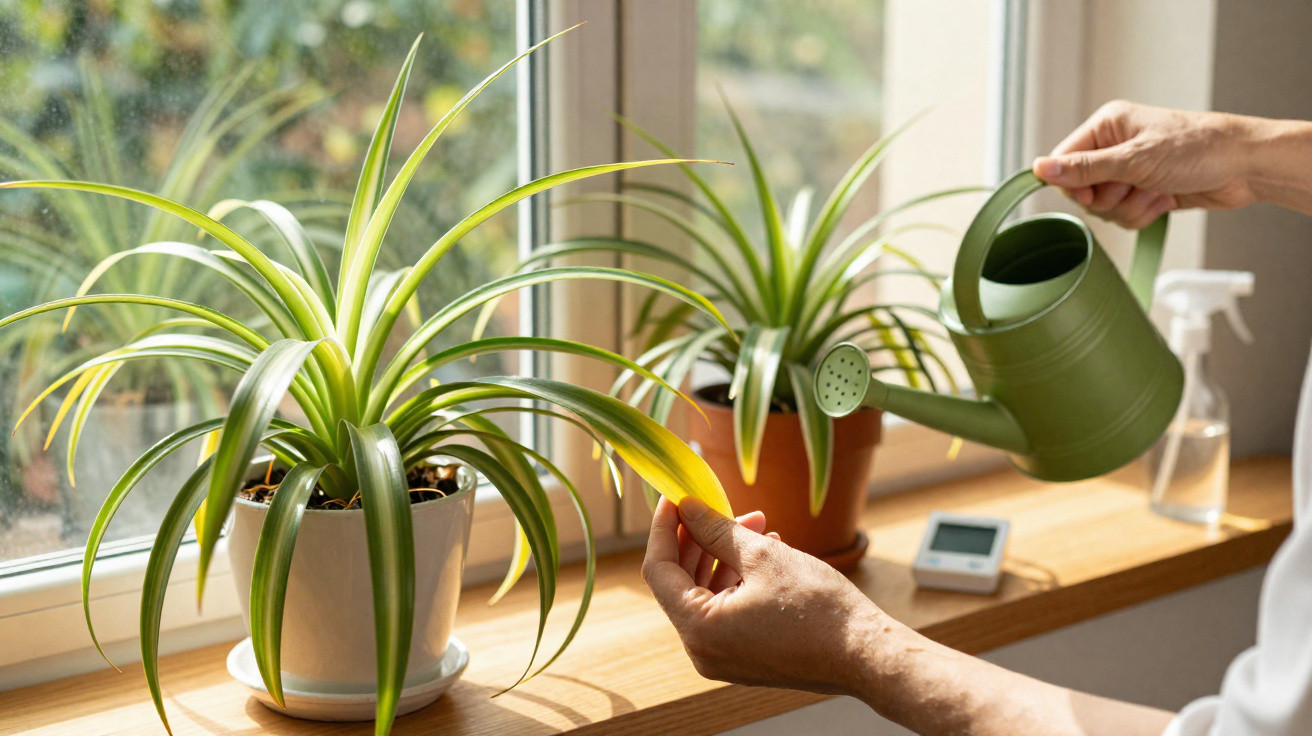
Many houseplant enthusiasts will recognise the situation: an otherwise hardy spider plant suddenly looks lopsided, some leaves snap, and others droop as though they have been bent. It is being watered and stands by a bright window, yet something is clearly wrong. These are the plant’s quiet warning signs, and they reveal surprisingly clearly whether it is receiving too much, too little or simply the wrong kind of watering.
What a healthy spider plant should look like
A thriving spider plant produces dense clumps of leaves from the centre of the pot. Its leaves are:
- rich green, often with a pale stripe down the centre or along the edges
- long, soft and flexible
- evenly arched downwards, like a small indoor fountain
Run your fingers over a healthy leaf and it should feel smooth and supple. Its central rib follows the natural curve, with no sharp bends or damaged points.
A leaf that looks genuinely “folded”, however, is a different matter: there will be a clear, hard crease, as if it has been sharply bent over. Discolouration, whether yellowish, brown or grey, often appears close to the bend, while the affected area may be soft and mushy or dry and brittle.
A bent spider plant leaf blade is not merely a cosmetic flaw, but a sign that something has gone wrong in the root ball or during watering.
Broken or bent leaves: when it is simply an accident
Leaf damage does not always point to a care mistake. First, it is worth taking a quick, realistic look at the plant’s surroundings:
- Is the pot close to the edge of a table or windowsill?
- Do children, cats or dogs often spend time nearby?
- Has the pot recently been moved or nearly fallen over?
An elbow knock, a cat jumping through the foliage, or a leaf trapped beneath the pot rim can damage individual leaves without affecting the plant as a whole. Usually, only one or two older leaves will be affected, while the rest remain vigorous and fresh.
If young, newly formed leaves in particular become misshapen, soft or even snap, the cause is almost always a care issue – very often one connected with watering.
What spider plant leaves reveal about your watering habits
Signal 1: bent, yellowish-soft leaves – too much water
Constantly wet compost is a common problem for spider plants. Although the surface may still look reasonably normal, the root ball beneath can be sitting in waterlogged conditions. Typical signs include:
- leaves that feel soft and may look partly translucent or glassy
- bent sections turning yellowish or brown
- a pot that remains heavy all the time
- compost that smells musty and feels compacted
When there is a continual excess of water, the roots do not receive enough oxygen. The fine transport channels in the leaves are damaged, so the leaf buckles at the weak point like an overly soft drinking straw.
What to do:
- pause watering and only water again when the upper layer of compost has dried out clearly; check to a depth of around 4–5 cm
- always empty any water left in the saucer
- if the compost is very dense and heavy, repot into a looser growing medium in due course
Signal 2: hard, brittle bends – too little water
The opposite problem is prolonged dryness. The compost pulls away from the edge of the pot, sometimes leaving a visible gap. The leaves lose their firmness in response and may eventually snap:
- creased areas are hard and brittle
- leaf edges become brown and dry
- older leaves die back from the tips
In this case, the leaf’s transport channels simply lack water and the plant cells collapse. Once an area has broken, it will remain damaged even if watering is corrected afterwards.
What to do:
- water the plant thoroughly from above and below until the entire root ball is moist
- do not keep the compost permanently soaking wet, but never allow it to dry out completely
- check more often in summer – dry central-heating air and sunshine draw out more water
Signal 3: soft leaves and a limp plant – rotting roots
If the leaves stay soft and lacking in strength despite adjusted watering, inspect the roots more closely. Carefully lift the plant from its pot:
- pale, firm roots: healthy
- brown, slimy, foul-smelling roots: rot
In this situation, the plant’s “supply system” is failing, and leaves bend under even slight pressure.
What to do:
- carefully cut away every mushy root with clean scissors
- allow the root ball to dry a little
- place it in fresh, free-draining compost, such as potting compost mixed with a little sand or expanded clay
- from now on, water only once the upper layer of the growing medium has dried out noticeably
The role of light, humidity and nutrients
Water is not the sole factor determining leaf strength. Insufficient light, for example, causes a spider plant to develop long, soft, thin leaves that bend more easily. If it is always positioned at the dark end of a room, it will lean strongly towards the window, overloading individual leaf blades until they break.
A bright position with indirect light, such as slightly to one side of a window, promotes stronger, more compact foliage. Intense direct midday sun, on the other hand, can scorch the tips, creating brittle patches and tears.
Very dry air from central heating also has an effect: the leaves lose more moisture from their surface, their tips dry out, and weakened sections bend more readily. A few straightforward measures can help:
- place a dish of water and pebbles beneath or beside the pot
- avoid placing the plant directly above a radiator
- occasionally mist it lightly with water that has been left to stand, but not in strong sunlight
When nutrients have been lacking for an extended period, leaves grow thinner and become less stable. Applying a moderate houseplant fertiliser every four to six weeks during the growing season supports both the tissue and the roots.
What should you do with leaves that have already broken?
A leaf that is genuinely bent or broken will not straighten again. Even if the damaged point appears to “dry over” on the surface, the internal supply line remains interrupted. The plant then wastes energy on a damaged leaf.
The better approach is to:
- use clean, sharp scissors or a small garden knife
- cut the leaf as close to the base as possible
- disinfect the tool briefly beforehand, for example with alcohol, to prevent germs spreading
The sooner damaged leaves are removed, the more energy the spider plant can direct towards healthy new shoots.
On an otherwise strong plant, fresh clusters of leaves generally emerge after a few weeks and quickly make up visually for the “bad haircut”.
How to prevent further bends and breaks
A few simple routines will protect your spider plant from leaf problems over the long term:
- Watering diary: Make a brief note of when and how much you water, so a persistent “slightly too much” does not creep in.
- Finger test rather than instinct: Push a finger 3–5 cm into the compost every time instead of judging by the surface alone.
- Pot with drainage: Containers without a hole in the base are almost always an invitation to root damage in spider plants.
- Safe position: A hanging basket or a sturdy spot away from doors, children’s chairs and cats’ usual routes prevents mechanical accidents.
- Regular checks of leaves and compost: Discolouration, a musty smell and cracks in the growing medium are early signs, before leaves start to break.
Why spider plants react so honestly – and how that helps you
The spider plant is rightly considered an undemanding houseplant. Because it displays mistakes through its leaves relatively quickly, it is an excellent “teacher” for anyone wishing to judge their watering habits more accurately.
By noticing small signals – softening tips, unusual bends or changing leaf colour – you gradually learn how overly wet and overly dry periods make themselves known. This knowledge can then be applied directly to other houseplants, particularly similarly hardy species such as peace lilies, dragon trees and ZZ plants.
It is also striking how clearly the position and air quality are reflected in the plant: when the spider plant is too dark, too warm or exposed to constant draughts, it responds with a limp form, weaker leaves and more breakages. Moving it to a more suitable place often brings a visible revival to the entire plant within just a few weeks.
In the end, those bent leaves become almost a small diagnostic tool: every break reveals what has happened over recent weeks, allowing you to adjust your watering and care routine step by step until the spider plant returns to what it does best – filling the room like a green waterfall.



Comments
No comments yet. Be the first to comment!
Leave a Comment