
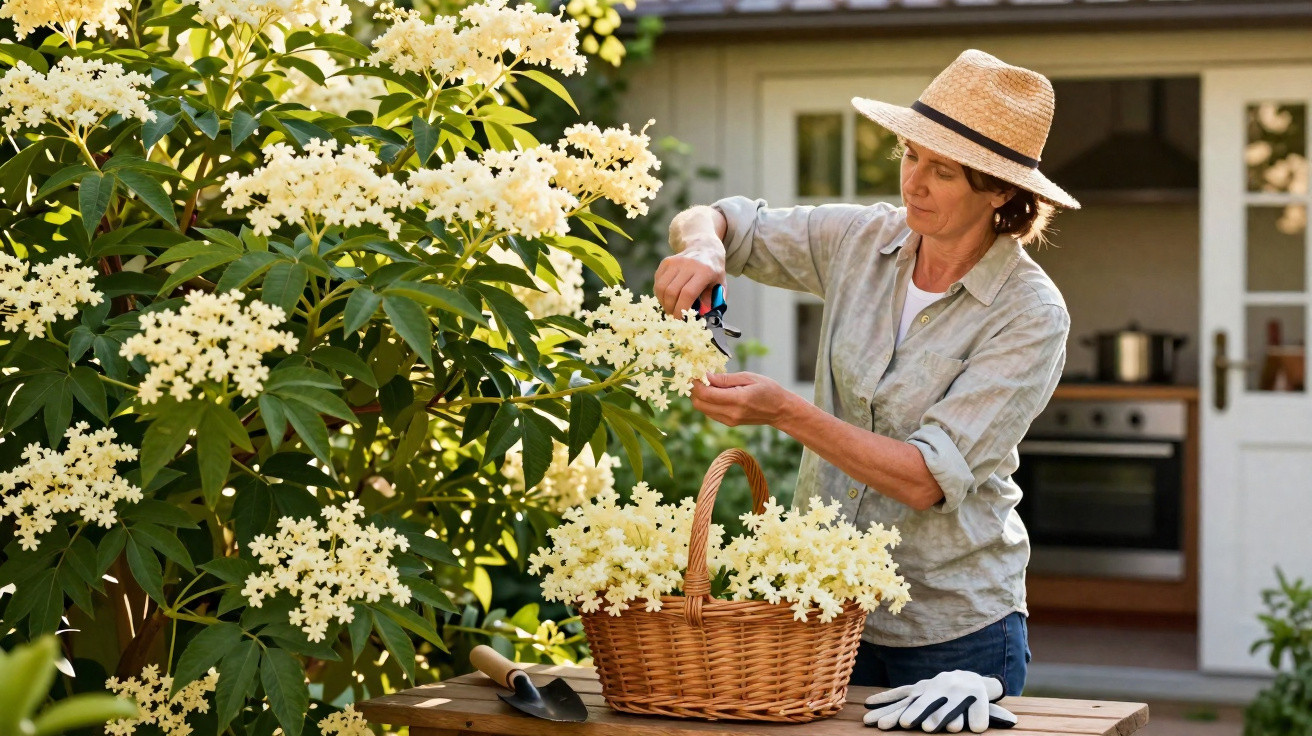
Suddenly, it lights up – and the entire garden takes on a different character.
Many amateur gardeners will have seen this native shrub along walking paths without knowing its name. During winter it looks bare and unassuming, almost like a forgotten section of hedge. Once temperatures rise, however, it becomes a creamy-white cloud with an early-summer fragrance, attracting insects and later offering plenty for the kitchen, too. Plant one now and, by next year, you could have a small natural marvel right outside your door.
Black elder: a versatile native shrub, not a dull wild plant
The subject here is black elder, botanically known as Sambucus nigra. It is found throughout Central Europe, yet it was long dismissed in gardens as being “too ordinary”. Increasingly, that is proving to have been a mistake.
Black elder is among the most valuable native shrubs for natural gardens, patios and back gardens – hardy, useful and full of life.
Depending on the variety, elder reaches around three to six metres in height and two to four metres in spread. That makes it suitable for both larger gardens and as a specimen shrub at the edge of a terraced-house plot. It is deciduous, shedding its leaves in autumn, and copes easily with temperatures down to roughly minus 20 °C.
Its most striking moment arrives in late spring, when the shrub is covered in large, flat flower heads of creamy white. Their scent is unmistakable, a little like summer captured in a bottle. For bees, hoverflies and butterflies, the flowers provide a generous feast. At the same time, the shrub takes on a bright, airy appearance, almost like a lamp glowing among the green planting.
By high summer, the flowers have developed into closely packed clusters of deep violet-black berries. As well as being decorative, they are a banquet for birds. Blackbirds, thrushes and their companions know the shrub well and can strip it of fruit quickly – so anyone planning to harvest needs to be early.
Choosing the right spot: where elder thrives
Simply putting an elder shrub quickly into a hole means missing much of its potential. The first few weeks after planting influence how vigorously it will grow later on. March to April is the ideal planting period, while the soil still holds some residual winter moisture.
Making site selection simple
- Light: Full sun to partial shade; the brighter the site, the more freely it flowers.
- Soil: Preferably nutrient-rich, initially fresh to moist, though remarkably adaptable once established.
- Space: Avoid squeezing it directly against close masonry; give it a little room instead.
Light is particularly important for varieties with yellow or purple foliage: they retain their striking colouring only when the crown receives enough sun. In full shade, the shrub soon looks dull.
How to plant elder properly
A few straightforward measures can give it a far better start:
- dig a planting hole at least twice as wide as the root ball
- mix the excavated soil with well-rotted compost
- position the shrub so that the root ball is level with the surrounding soil surface
- water thoroughly, until the hole has filled completely with water
- then add a mulch layer of bark, leaves or grass clippings
In exposed locations, it is worth using a sturdy stake for the first few years. Elder grows quickly, but young shoots can dry out in strong winds if the soil loses moisture too rapidly. Watering regularly during the first summer helps establish a strong root system.
Care: minimal effort, maximum impact
Once black elder has settled in, it remains happy with surprisingly little attention. It is regarded as a classic cottage-garden shrub that will cope with neglect, although it responds well to a little shaping.
Prune correctly rather than cutting it bare
Late winter or very early spring, before the leaves emerge, is the best time for shaping cuts. The shrub’s framework is then easy to see.
- remove old, dead wood at its base
- shorten branches that cross or grow inwards
- cut a few older, particularly thick stems close to ground level to encourage fresh young shoots
Anyone pruning hard because the shrub has become too large should not repeat this every year. Elder tolerates severe cutting back, but it will initially concentrate on producing new shoots rather than flowering abundantly. Gentle, regular maintenance pruning preserves the balance between height, plentiful flowers and screening.
From flower to kitchen: recipes and rules
Elder is not merely an ecological asset; it is also a culinary classic. Its broad flower heads provide flavour for cordial, jelly, desserts and even savoury dishes.
Anyone who picks a few flower heads in June has summer in a bottle for winter – as cordial, liqueur or jelly.
Top harvesting tips for elderflowers
- harvest on a dry, sunny day when the flowers have freshly opened
- do not use flower heads with many brown or still-closed individual flowers
- pick as far as possible from roads and heavily fertilised land
Traditional ways to use them include:
- Elderflower cordial: prepared with water, sugar and lemons, it forms the basis for spritzers and cocktails
- Fried flower heads: dip whole flower heads in batter and fry them in a pan until golden brown
- Flavoured vinegar: place several flower heads in mild vinegar and leave to infuse for several days
Use berries only after cooking
Later in the year, the branches are laden with dark berries. They can be made into purée, juice, jelly or fruit spreads. They should not be eaten raw in large quantities, especially by children. Cooking removes the problematic substances from the berries and brings out their characteristic flavour.
There is a practical additional benefit: harvesting only part of the flower heads leaves the rest for birds. In this very simple way, home preserving and bird protection can go hand in hand.
Important safety point: avoid confusion
In the wild, another species grows alongside black elder and can easily cause confusion: dwarf elder, also called danewort. It stays considerably shorter, has a more herbaceous appearance and carries its flower clusters above the foliage, whereas black elder bears its flower heads on woody shoots.
| Feature | Black elder (Sambucus nigra) | Dwarf elder (danewort) |
|---|---|---|
| Growth habit | woody shrub, up to several metres tall | herbaceous, usually under two metres |
| Location | hedgerows, woodland edges, gardens | rough ground, rubble sites, field margins |
| Flower cluster | above the foliage on woody branches | carried on an upright stem, appearing “placed on top” |
Anyone wishing to use elder in the kitchen should therefore be able to identify the shrub reliably. When in doubt, stick to plants in your own garden: a black elder you have planted yourself can be clearly identified and used for years.
Why planting an elder shrub now is worthwhile
Outside the main growing season, many gardens can look lifeless: a few standard evergreen hedges, plenty of lawn and little structure. Elder brings movement and change. In spring, its creamy-white flower heads make a clear statement; in summer, its foliage provides privacy; and in late summer, its berries feed both wildlife and people.
The shrub also suits the present moment. It does not require elaborate watering, manages in ordinary soils and supports native wildlife. Positioned at the edge of a mixed hedge, it combines especially well with hazel, Cornelian cherry or wild roses – gradually creating a lively habitat rather than a monotonous screen.
For smaller plots, more compact varieties or forms with eye-catching foliage are good choices. Deep red leaves or golden-yellow tones add colour without relying on exotic, frost-sensitive species. The result can be a modern, visually engaging garden that still makes a consistent commitment to native plants.
Anyone who includes an elder shrub at the start of the gardening year is laying the foundation for many years ahead. Over time, it grows into the garden and, come spring, ensures that it will be impossible to overlook.
Comments
No comments yet. Be the first to comment!
Leave a Comment