
Many homeowners instinctively reach for vinegar or a pressure washer when the first sunny days of spring arrive and the patio starts looking neglected. Green deposits, blackened joints and slippery paving slabs can create a strong urge for an intensive clean. However, specialists warn that this kind of “shock treatment” may cause lasting damage to both stone and joints – and point to a surprisingly straightforward alternative from the kitchen cupboard.
Why patios become so slippery after winter
Rain, frost and persistent damp take their toll on every type of surface, whether it is concrete paving, natural stone or clay pavers. Algae and moss settle in shaded spots, while dust, soil and pollen build up alongside them. The result is a dull, greenish coating that looks unattractive and can quickly become a slipping hazard.
Dense carpets of algae film are particularly likely to form in areas that receive little sunlight. The top layer of many paving materials is slightly textured anyway, as this helps provide grip underfoot. Once organic matter collects in this texture, even a brief shower can make the patio feel as slippery as a wet soapy surface.
Specialists generally advise giving a patio one thorough clean each year – gently but consistently, rather than using an aggressive “deep clean”.
The best time is towards the end of winter or at the very beginning of spring. By then, the worst frosts have passed and the surface can be cleaned without unnecessary risk. Dealing with it promptly each year stops stubborn layers of moss and dirt from becoming firmly established in the first place.
Why vinegar and pressure washers damage patio surfaces
Vinegar is widely seen as a household miracle product, but on many patios it can do precisely the opposite of good. Its acidity attacks not only lime and cement but also delicate natural stone. The damage may not be obvious straight away, yet its effects can gradually emerge over the years.
- The upper stone layer is attacked and becomes rougher.
- Jointing material gradually comes loose.
- The surface becomes more porous, allowing water to penetrate further.
- Dirt, algae and moss can take hold again more quickly.
Pressure washers carry a similar risk. Their powerful jet removes more than dirt: it can also dislodge fine particles from the surface. Joints may break away, loose paving can become less stable, and more water can gather beneath the slabs. That moisture freezes and expands in winter, causing the surface to suffer a second round of damage.
Gardening organisations and paving specialists therefore recommend using harsh chemicals and very high pressure settings only in exceptional situations. A gentler approach is entirely sufficient for ordinary dirt and can even deliver better long-term results.
Washing-up liquid: the overlooked patio cleaner in your kitchen cupboard
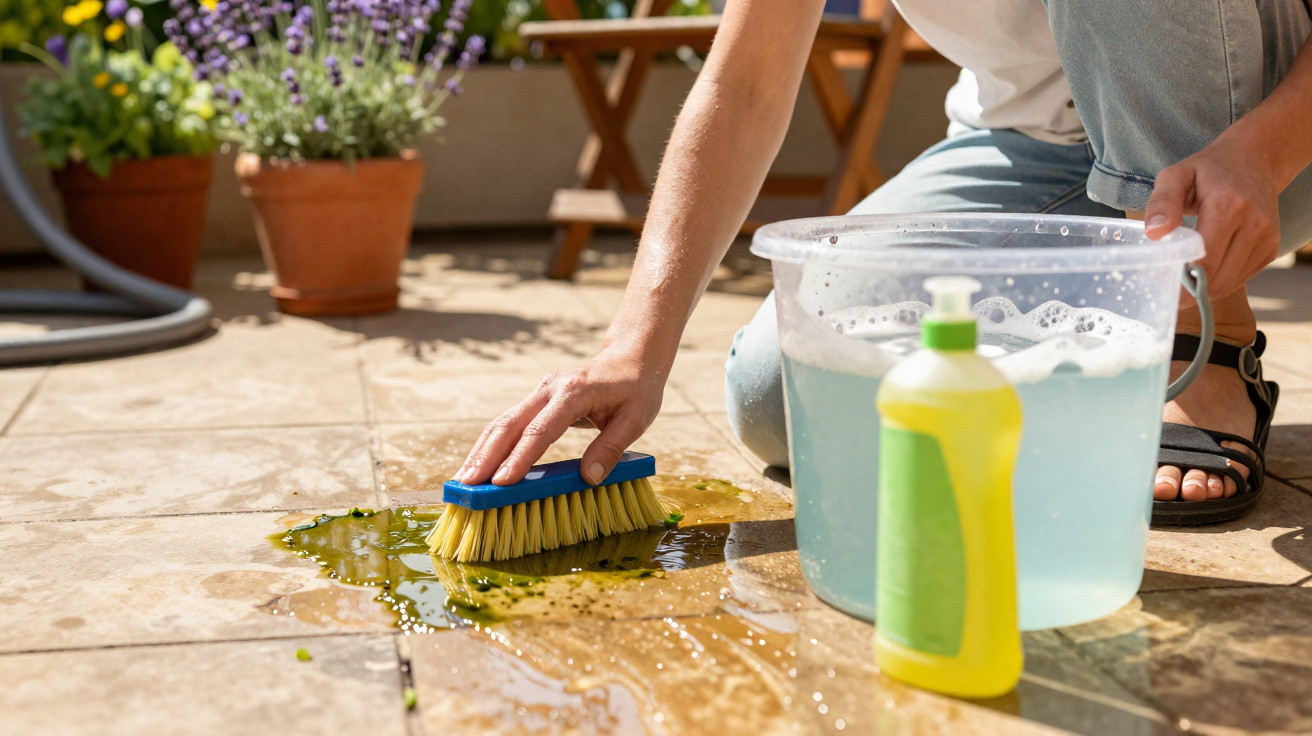
Rather than vinegar, many experts suggest a remarkably simple combination: warm water and ordinary washing-up liquid. The product is designed to tackle grease, food residue and everyday grime – the same mixture of substances that clings to patio paving.
The surfactants in washing-up liquid break down grease, dust and the slimy green film without attacking stone or joints.
Its main benefit is that washing-up liquid contains no harsh acid, so it does not harm the structure or alter the original surface. New dirt is then less able to cling to the paving later on because the material has not been unnecessarily roughened.
Step-by-step guide: cleaning a patio with washing-up liquid
This method is straightforward and costs only a few pence:
- Remove loose debris first: Sweep the area while dry, clearing away leaves, soil and coarse dirt.
- Prepare the mixture: Add a squirt of washing-up liquid to a bucket, then fill it with warm to hot water.
- Wet the surface: Pour the soapy solution over the slabs using a watering can or directly from the bucket, working outwards from one corner.
- Scrub thoroughly: Use a deck scrubber or a stiff-bristled brush, scrubbing firmly in every direction. Spend a little longer on the joints.
- Leave it briefly: Allow time for the film to loosen, but do not let the solution dry completely.
- Rinse afterwards: Rinse the area thoroughly with clean water from a bucket or garden hose.
For a larger patio, it makes sense to work in sections. This keeps the solution sufficiently wet throughout and makes it easier to see which areas have already been cleaned.
How gentle care keeps a patio cleaner for longer
The greatest advantage of this method is not limited to the immediate result after cleaning; it also becomes clear in the following weeks. Since the surface is not etched or damaged, it remains relatively smooth. Algae and dirt have less to grip onto, so the patio becomes dirty more slowly.
The joints also remain more stable. Where high-pressure water does not penetrate and aggressive cleaners do not dissolve cement-based components, voids form far less frequently. This extends the life of the whole surface, which matters when considering the cost of relaying a patio.
Anyone who cleans gently each year and carries out brief maintenance in between saves not only money, but also costly repairs to the paving.
Simple maintenance routines for the season
After the main spring clean, most patios need only a small amount of attention every few weeks:
- Sweep while dry before layers of leaves have a chance to settle.
- Prevent water from collecting beneath planters by using saucers or pot feet.
- Treat heavy soiling, such as around the barbecue or beneath the dining table, locally with a small amount of warm washing-up water.
- In shaded areas, give the surface a quick brush from time to time before the green film becomes thick.
With these habits, the paving often remains presentable throughout the season without requiring another major cleaning session each time.
Patio surfaces that are particularly sensitive
Not every patio material tolerates harsh chemicals equally well. Professionals urge particular care with the following surfaces:
- Lime-containing natural stone, such as sandstone, travertine and shell limestone: these react strongly to acids.
- Concrete slabs with a textured finish: high pressure can quickly cause chipping or fading.
- Clay pavers and bricks with open pores: these absorb liquids quickly, which can lead to frost damage.
- Older paved areas with loose joints: these risk being washed out and sinking further.
The washing-up liquid method is especially worthwhile for these surfaces. It cleans visibly without placing extra strain on materials that are already sensitive.
How to spot unsuitable cleaning products
DIY shops stock numerous “specialist cleaners” for stone, patios and paving. Yet not every product is suitable for routine use. Several warning signs on the label can help you assess them:
- References to strong acids or alkalis.
- Instructions such as “wear protective gloves and safety goggles”.
- Hazard symbols for corrosive or environmentally harmful substances.
- A recommendation for occasional use only.
These products may be useful in extreme cases, such as decades-old staining, rust or persistent oil films. For a normal spring clean, however, they are excessive in most cases.
Preventing new slip hazards and avoiding common mistakes
Anyone wanting to walk safely across their patio should keep a few simple points in mind. Small everyday changes are often enough to slow the formation of the slippery film.
- Do not place planters directly on the slabs; raise them on pot feet instead.
- After heavy rain, check where water is pooling and, where necessary, provide a gentle route for it to drain away.
- Do not leave food remnants, barbecue grease or ash on the paving.
- Avoid cleaning with large amounts of water during frost or immediately before it, as residual moisture can freeze in the joints.
If you own a pressure washer, it can be used in exceptional circumstances on a low setting and from a sufficient distance. Paving professionals nevertheless recommend reserving the stronger settings for old concrete surfaces, walls or other more robust areas, rather than vulnerable patio joints.
Ultimately, a clean, safe patio needs neither harsh chemicals nor professional machines. A bucket, warm water, a squirt of washing-up liquid and a sturdy brush can achieve more than many people expect – while protecting both the paving and your wallet.
Comments
No comments yet. Be the first to comment!
Leave a Comment