
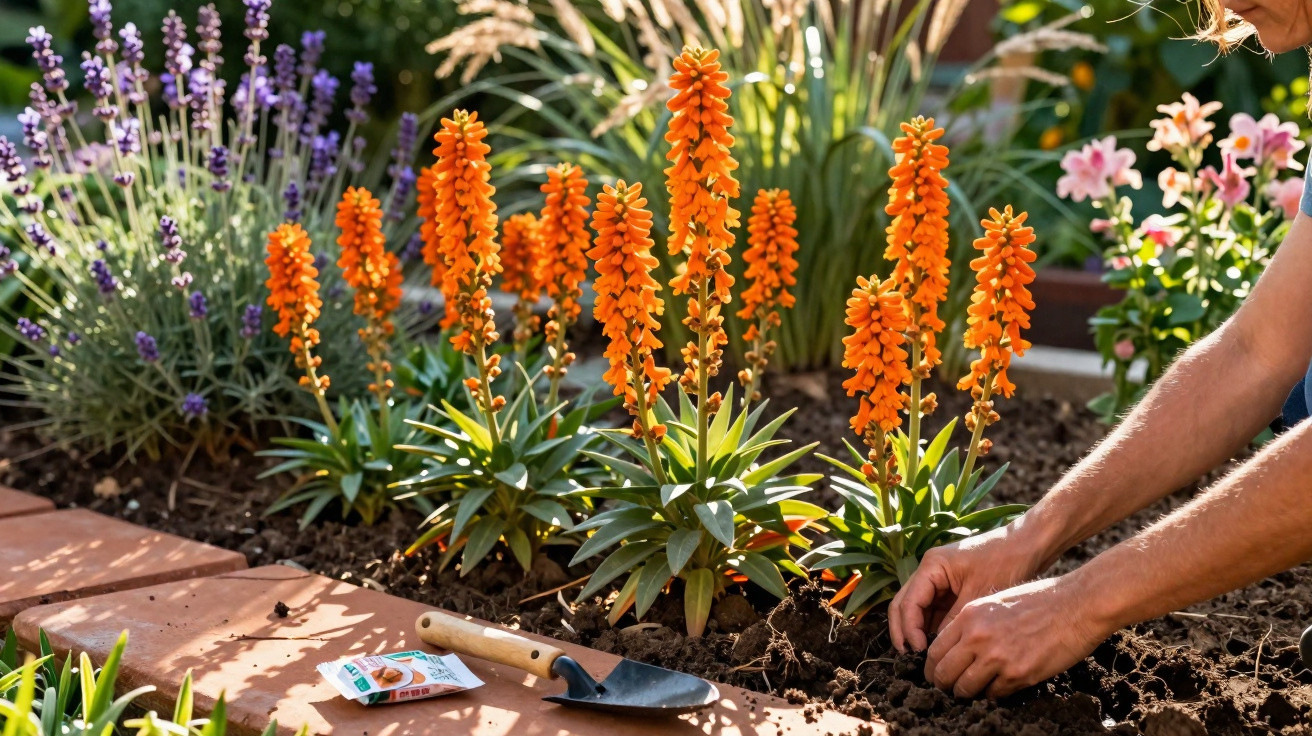
While many gardens feature the same geraniums, lavender and roses, some plants immediately draw every eye and turn an ordinary border into a stage. Leonotis leonurus, often known as Lion’s Ear, is one such plant: a South African beauty that sits somewhere between a design object and a firework display.
A perennial like a blazing chandelier
Leonotis leonurus is one of those plants that, once seen, is never forgotten. Growing in a strongly upright habit, it can easily reach 1.80 metres in summer. It rises above many familiar border companions, automatically creating a new sense of space in the garden.
Its stems are sturdy and almost rigorously vertical, carrying narrow, elongated foliage. Even before flowering, this gives it a graphic, almost architectural appearance. Its real spectacle, however, begins when the flowers emerge.
Tiered rings of vivid orange blooms make the plant look like a living chandelier.
Dense whorls of flowers appear at even intervals around each stem. Every flower is tubular, slightly hairy and coloured an intense orange reminiscent of leaping flames. From a distance, it resembles a carefully styled ring of fire climbing upwards level by level.
At peak flowering, this creates a vertical “firework display” that is impossible to overlook in a border. It attracts more than human attention, too: bees and butterflies adore its nectar-rich flowers, while nectar-feeding birds visit the plant in warm regions.
The ideal spot: sun, warmth and free-draining soil
Anyone introducing Leonotis leonurus to their garden should provide one thing above all else: maximum light. This perennial comes from South Africa’s sun-drenched regions and makes the same demands in a British garden.
The more sunshine it receives, the more flowers it produces – fewer than six hours of direct light a day is hardly worthwhile.
The soil can be nutrient-rich, but above all it must drain freely. The plant copes poorly with waterlogging, particularly in winter. A loose, sandy-loam substrate works extremely well, as does ordinary garden soil improved with sand or fine grit.
For anyone who would rather leave the hose alone, Leonotis leonurus is also remarkably capable of coping with extended dry spells once established. During summers with little rainfall, it remains noticeably more relaxed than many traditional bedding plants.
Quick check: is my garden suitable for Leonotis?
- A fully sunny position, ideally warm and sheltered from wind
- Loose, permeable soil with no winter waterlogging
- Borders that tend to be dry rather than wet in summer
- Gardens where bold colours are welcome
- Owners who do not want to water every day
If there is no suitable space in the border, Leonotis can readily be grown in a large container. Choose a generously sized pot with drainage holes and use a free-draining, slightly sandy compost mix. Container-grown plants are also easier to move to a sheltered place when frost threatens.
Planting Leonotis leonurus in spring
Spring is the best time to plant, once the soil has warmed and severe frosts are no longer expected. This allows the perennial to establish its roots quickly and build enough strength for its major summer performance.
Plant in spring and you can still enjoy a striking focal point in the border that same year.
Five straightforward rules can help amateur gardeners give it the best possible start:
- Choose a sunny site: Allow for at least six hours of full sun each day.
- Prepare the soil: Loosen compacted ground and mix in sand or fine gravel so that water can drain away freely.
- Add organic matter: Mature compost or high-quality planting compost encourages vigorous growth and flowering.
- Water moderately: Water thoroughly after planting, then irrigate only during prolonged dry periods.
- Remember winter protection: In exposed areas, apply a thick mulch over the root zone in late autumn.
In mild areas, Leonotis leonurus can tolerate temperatures down to about minus eight degrees, provided the soil remains relatively dry. In colder locations, substantial winter protection is worthwhile, or it can be grown in a container and overwintered frost-free.
Dream companions: creating a carefully styled border
The plant becomes especially exciting when combined with other species. As Leonotis leonurus grows in such a clearly vertical form, it lends structure to mixed borders and effectively provides the framework for a planting scheme.
Leonotis sets the rhythm in the border – other plants can play in the backing band.
It works particularly well in contemporary arrangements with a gently natural feel. Suitable partners include:
- Delicate ornamental grasses with airy stems, such as fountain grass
- Blue- or purple-flowering salvias, offering a cool contrast to the orange
- Bronze-coloured cannas, which heighten the exotic character
- Dark-leaved dahlias or varieties with almost black flowers
- Silver-leaved perennials that make the orange appear even more luminous
For a more minimalist design, plant Leonotis in small groups of three to five and repeat these islands through the border. This creates rhythm without looking restless. In urban gardens with crisp lines, a single specimen is often enough to enhance a patio or front garden visually.
Directing the colour mood
The overall effect can be altered dramatically through the colour choices of companion plants. Paired with plenty of blue and violet, the garden takes on a cool, elegant character. Combined with red, yellow and warm brown or bronze shades, it creates a kind of “sun border” that glows from a distance.
In a more restrained garden, Leonotis can serve as a deliberately placed splash of colour. Set among white flowers and green shrubs, it delivers that familiar “wow moment” without overwhelming the wider scheme.
Easy care with a show-stopping effect: keeping Leonotis in shape
Throughout the growing season, Leonotis leonurus proves far less demanding than its dramatic appearance suggests. Once it has made a good start in spring, the maintenance required remains limited.
- Watering: Only during sustained dry weather in summer; water container plants a little more often.
- Feeding: Apply compost or an organic slow-release fertiliser once in spring.
- Pruning: Spent tiers of flowers may be removed if a tidier appearance is preferred.
- Overwintering: In cold areas, cut back stems in late autumn and protect the base thoroughly.
Many gardeners leave the dried stems in place over winter. They add structure to the border during the bare season and offer insects somewhere to shelter. In late winter or early spring, the stems can then be cut down close to ground level so the perennial can produce fresh growth.
Who will particularly benefit from this perennial?
Leonotis leonurus is particularly suited to people who want to give their garden a distinctive but not overly showy highlight. It is an excellent fit for:
- Modern urban gardens with clean lines
- Prairie-style natural gardens with plenty of grasses
- South-facing patios and Mediterranean-inspired corners
- Front gardens where a genuine focal point is wanted
Because it attracts numerous pollinators in summer, it also has a place in wildlife-friendly gardens. Anyone who values insect-friendly planting will find this perennial an intriguing partner, combining visual impact with practical benefit.
Background knowledge and practical advice
The botanical name Leonotis combines the Greek words for “lion” and “ear”, referring to the shape of the flowers. In its native habitat, the species is part of the typical flora of dry, sunny sites. That is precisely why it performs so well during our increasingly hot summers.
In areas with harsh winters, an additional strategy can be useful: take cuttings in late summer and root them in frost-free conditions. This provides replacement plants for the following year, even if a severe winter damages older specimens. Container-grown plants can be kept through the cold season in unheated conservatories, bright stairwells or frost-free garages.
Anyone who has previously been wary of tall, bold perennials can make a cautious start with Leonotis: it looks spectacular but retains a clear form, and it does not flop apart as readily as some hefty sun-loving perennials. Particularly in terraced or row-house gardens, where every square metre matters, it can become the quiet star of the space.



Comments
No comments yet. Be the first to comment!
Leave a Comment