
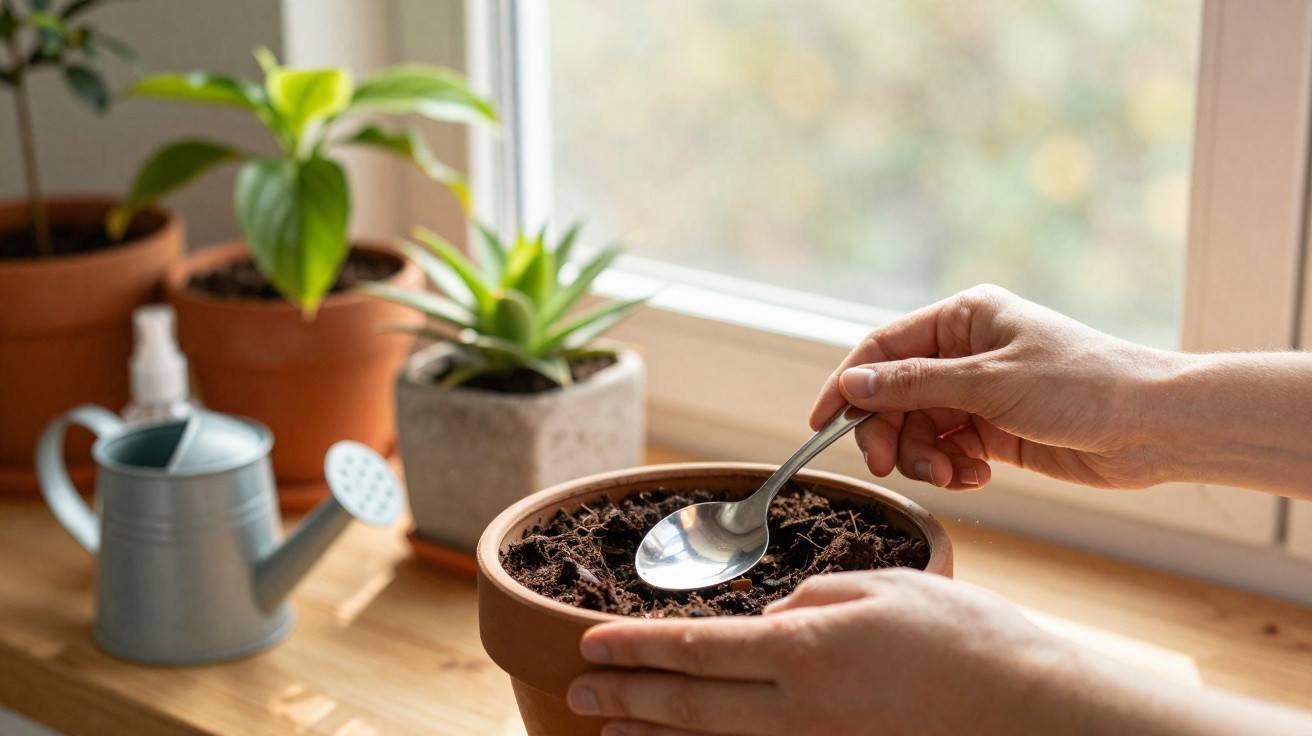
Look closely and, increasingly, you may spot an old metal spoon pressed firmly into the compost among ficus plants, geraniums and herbs. It is not a forgotten watering aid, but a tip from amateur gardeners and houseplant owners that has quietly spread through social media and neighbourly advice. Yet can a piece of metal in a pot genuinely improve plant health, or is it simply an appealing misconception?
Where the metal spoon in a plant pot idea comes from
Using metal in the garden is nothing new. Gardeners have long placed copper coins in the bottom of pots, either to deter slugs or to improve drainage. The spoon-in-the-soil approach follows the same make-do principle: everyday items are intended to turn a plant pot into a smaller, more cleverly managed ecosystem.
The technique itself is straightforward. A plain metal spoon, usually stainless steel and without paint or any coating, is inserted directly into the compost. Its handle may remain visible above the soil or be fully buried; what matters is that the metal section stays in contact with the growing medium.
Many amateur gardeners are convinced that this minor adjustment benefits container plants over time. There is currently no scientific evidence for it, however, so the method remains an experiment for curious people who enjoy testing and comparing gardening ideas.
Benefits gardeners expect from a metal spoon in a plant pot
“The basic idea is that the metal spoon gradually enriches the potting compost with tiny quantities of minerals while also confusing pests.”
A modest mineral boost for depleted potting compost
Compost in a plant pot is limited in volume, meaning that its nutrients can be used up quickly, particularly if the plant is rarely repotted. The thinking behind the spoon trick is that moisture may release minute traces of metal over time, allowing them to pass into the soil.
Supporters believe that these traces can:
- keep the compost slightly more “active”;
- make growth more even; and
- provide minimal support for plants growing in older compost.
Some people expect a small additional benefit, especially for hardy houseplants that stay in the same pot for years. From a technical perspective, stainless steel and aluminium release very little material, so any effect is likely to be subtle rather than dramatic.
A physical obstacle and light reflections for crawling pests
A second possible benefit is more tangible. Around the base of the plant, the spoon creates a type of obstruction. Some crawling creatures are thought to dislike smooth metal surfaces and sudden flashes of reflected light. On balconies in particular, where aphids, fungus gnats and small slugs can rapidly become troublesome, gardeners are often willing to try any simple solution.
A spoon may:
- make the route around the plant base more difficult for pests;
- reflect light in small, localised flashes because of its shine; and
- occasionally unsettle mice or birds when it catches the sunlight.
No one should regard this as a miracle solution. A spoon cannot replace balanced care or considered pest control. It may, though, provide a small additional obstacle without using chemicals.
How to use the spoon method correctly
Which spoon should you use?
Anyone wanting to try this technique should ideally choose an old stainless-steel tablespoon. It needs to be:
- clean and free from grease;
- unpainted and without a decorative coating; and
- free from rust and sharp edges.
Silver cutlery may look elegant to some people, but it is more expensive than necessary for everyday use and can tarnish. Colourfully painted party spoons or cheaply coated cutlery are unsuitable because particles could come away from them.
The best position in the pot
Do not place the spoon in the centre of the root ball. Positioning it close to the edge of the pot is the safest approach:
- Use your fingers or a small stick to make a narrow hole near the rim.
- Insert the spoon gently, without forcing it down.
- Push it in far enough for the bowl of the spoon to sit well within the active soil layer.
- Lightly firm the compost so that no large air pockets remain.
For very small containers, such as tiny succulent pots, the experiment is hardly worthwhile. The spoon takes up too much room and may damage the roots.
Which plants are suitable for the experiment?
Many amateur gardeners first test the spoon on robust houseplants and balcony flowers. Suitable examples include:
- ficus varieties and rubber plants;
- peace lilies, spider plants and pothos; and
- pelargoniums, petunias and marigolds in window boxes.
It is wise to be more cautious with herbs and vegetables that are harvested and eaten regularly. For these, many people prefer established nutrient sources such as compost or organic fertiliser.
What the spoon can and cannot do
The spoon method is tempting because it costs almost nothing and is easy to try. Even so, several points should be viewed realistically:
| Expected result | More realistic outcome |
|---|---|
| Significantly stronger growth | At most, slight effects that are difficult to measure |
| Strong protection from pests | A minor barrier that may be barely noticeable depending on the species |
| A replacement for fertiliser | Not a substitute for nutrients and fresh compost |
Anyone wishing to test it properly should place two plants that are as similar as possible side by side: the same species, the same pot size and the same position. One receives a metal spoon and the other does not. After several weeks, it is possible to compare growth, leaf colour and pest pressure.
Points to consider as a precaution
Metal in a plant pot is still an intervention, even if it seems minor. To avoid problems, consider a few potential risks carefully:
- Root damage: Pushing the spoon in too forcefully can tear fine roots. Always work gently.
- Lack of space: In particularly cramped pots, a spoon displaces compost and roots. It is better avoided in these cases.
- Unsuitable alloys: Cheap metal of unknown origin may contain components that do not belong in the soil.
People who repot regularly have less need for such tricks. Fresh, high-quality potting compost, appropriate watering and occasional feeding have a considerably greater influence than a spoon in the soil.
Practical additions for healthy container plants
The spoon trick works best as a small addition to an overall care routine. To keep container plants in good condition, it is worth paying attention to several basics:
- Choose a free-draining growing medium so roots are not left sitting in water.
- Avoid waterlogging consistently and empty saucers promptly.
- Move potted plants into larger containers with fresh compost every one to two years.
- Use lightly dosed liquid fertiliser for long-term houseplants.
Some gardeners combine a spoon with other straightforward measures: for instance, a little coarse sand against fungus gnats, a thin top layer of expanded clay pellets, or copper tape around the pot rim for slug-prone balcony containers. Each measure has only a limited effect on its own, but together they can produce a more coherent result.
Ultimately, the metal spoon is mainly a playful experiment with potential for minor effects. Anyone who enjoys watching plants carefully and trying something new will find it a harmless, inexpensive way to experiment-and will have a story to tell every time they look at the pot.
Comments
No comments yet. Be the first to comment!
Leave a Comment