
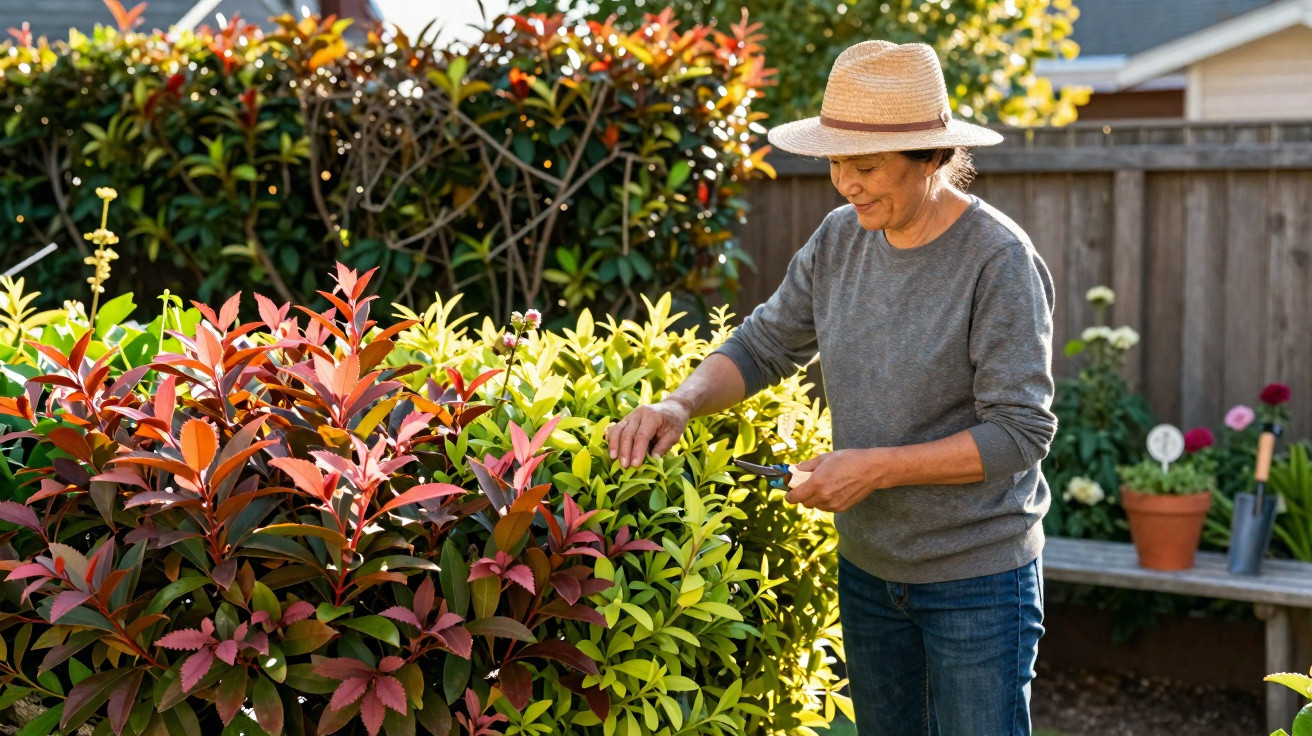
For years, Photinia was seen in countless front gardens as the miracle answer for rapidly establishing evergreen privacy hedges. The mood has now shifted: disease, bare patches and frustration over maintenance are becoming increasingly common. Rather than planting the same troublesome hedge again, specialists are recommending a different shrub for spring 2026-one that is far easier to manage and offers more visual interest than many people realise.
Why Photinia is becoming a problem plant in many places
Photinia rose to prominence thanks to its fast growth and eye-catching red new shoots. It shapes the appearance of entire streets in many housing developments. Yet this is precisely where its drawbacks are now becoming apparent: plants look sparse, pale and, in some cases, visibly unwell.
Common symptoms include:
- leaves marked by reddish-brown spots
- leaves dropping early, sometimes as soon as summer
- shoots becoming thinner and more open year after year
- hedges that are bare at the base and unstable at the top
The main cause is a fungal disease known as entomosporium leaf spot. Especially after mild winters and wet springs, it attacks the foliage, persistently weakens the shrub and leaves it more susceptible to further issues. Dense planting and leaving dead plant matter in place then create ideal conditions for fungi.
“In many gardens, Photinia is now caught in a continuing cycle of disease pressure, bare areas and emergency treatments-over the long term, a complete fresh start is worthwhile.”
If the same species is replanted after removal, often in exactly the same soil, the problem frequently begins again. This is where another shrub is coming into focus.
Pittosporum: the low-maintenance replacement for problem hedges
Garden designers are increasingly choosing Pittosporum as an alternative. This evergreen shrub is versatile in planting schemes and responds well to shaping. Its foliage stays on the plant throughout the year rather than dropping continuously.
Holds its shape with little maintenance
Pittosporum has a moderate growth rate. It does not shoot upwards excessively, yet it fills its allotted space reliably. For home gardeners, that means less time and effort spent with the shears.
- one annual shaping trim is often enough
- allow for no more than two cuts where a very precise hedge is wanted
- the shrubs generally tolerate minor pruning mistakes well
Where Photinia often becomes bare at the bottom after poor pruning, Pittosporum usually remains denser and more even. The result is a robust green privacy screen that does not need constant correction.
Foliage colour rather than troublesome leaves
Depending on the cultivar, Pittosporum offers a wide range of ornamental foliage effects. Some varieties have deep green, glossy leaves, while others feature pale-edged, slightly silvery or yellow-toned foliage. This makes it possible to create a hedge that remains lively in winter without looking overly colourful or busy.
“Anyone who liked Photinia’s red new growth gains a different kind of focal point with Pittosporum: subtle yet consistently attractive foliage colours.”
Why a mixed hedge is often the best choice
Monocultures also carry risks in gardens. When a disease specialises in one species, it can spread through entire residential areas like wildfire. This is exactly what many people are currently seeing with Photinia.
A mixed hedge spreads that risk. Different species respond differently to weather, pests and fungal diseases. Even if one plant fails, the privacy screen remains in place.
Reliable companions for Pittosporum
- Elaeagnus: tough, salt-tolerant and well suited to exposed, windy sites
- Cornus (red dogwood/cornelian cherry types): colourful winter stems and attractive autumn colour
- Hazel shrubs: a native species that matters to insects and birds and produces nuts
This creates a living “hedge mix” that delivers changing highlights throughout the year-flowers, fruit and bark colour-while also increasing biodiversity in the garden.
Step by step: replacing a Photinia hedge properly
1. Assess the existing hedge honestly
Before reaching for a spade or chainsaw, take a step back and assess the situation. If only one shrub is weakened, replacing that individual plant may be enough. However, where bare sections extend for several metres, a full restart will usually be more worthwhile than years of trying to remedy the problem.
2. Remove and dispose of the old plants
- dig out diseased shrubs with their root balls, or have the stumps ground out
- carefully collect fallen leaves, pruning waste and root fragments
- do not store this material in the garden: take it to a green-waste recycling facility or burn it where permitted
This substantially reduces fungal spores and other pathogens before the new hedge is planted.
3. Improve and prepare the soil
A successful new beginning starts below ground. Loose, well-aerated soil gives young plants the conditions they need to establish.
- loosen the soil to a depth of at least two spade-depths
- work around 10 litres of mature compost into each planting hole
- add sand or fine grit to heavy soils to prevent waterlogging
“Pittosporum does not like ‘wet feet’. Considering drainage before planting prevents many problems from the outset.”
4. Plant correctly and leave sufficient spacing
For a hedge that is dense yet well ventilated, spacing of 80 to 100 centimetres has proved effective. This allows the crowns to meet later on without completely blocking airflow.
- plant around 10 to 12 Pittosporum shrubs for every 10 metres of hedge
- for a mixed hedge, combine, for example, 6 Pittosporum, 2 Elaeagnus and 2 Cornus
- make each planting hole deep enough for the root ball to sit level with the surrounding soil surface
A 5-centimetre mulch ring of bark mulch, woodchip or leaf compost retains soil moisture and suppresses weeds. In exposed locations, a support stake can help during the first 12 months, until the roots are firmly anchored.
Everyday care: keeping the new hedge attractive for years
Once planting is complete, maintenance remains manageable. The first few years are crucial; afterwards, much of the work largely takes care of itself.
Watering, feeding and pruning
- Watering: during dry spells in the first year, give each shrub around 10 litres once or twice a week
- Feeding: apply around 50 grams of a balanced general fertiliser per linear metre in spring
- Pruning: trim lightly once a year; for a strictly formal hedge, schedule a second cut
It is important to clear away prunings and yellowing leaves regularly. This gives fungi and pests fewer opportunities to take hold.
Common mistakes that weaken a new hedge
Many issues result from well-intentioned but unsuitable actions. These include:
- planting too closely, leaving the hedge permanently too damp
- repeatedly applying fertiliser out of concern that shrubs may be “hungry”
- cutting back drastically into old wood, which puts plants under considerable stress
- replanting old problem species in the same soil without a break
“A good hedge needs air, light and calm-not constant intervention with pruning shears and a fertiliser spreader.”
What garden owners should also know
Pittosporum is suitable for more than dense, clipped hedges. Allowed to grow more freely, it becomes an attractive specimen shrub that can also be paired with ornamental grasses, roses or herbaceous perennials. In mild regions, it can even serve as a long-lasting container plant in large pots.
At the same time, a mixed hedge provides more habitat for wildlife. Flowers and fruit from Cornus, hazel and similar plants attract birds and insects. Choosing native companion shrubs supports local wildlife, a point many local authorities now include in their requirements for new-build developments.
It is still sensible to consider potential risks. In exposed areas with severe frosts, choose hardy Pittosporum varieties or provide wind protection during the first winters. On extremely chalky soils, leaves may become paler; this can be eased with slightly acidic mulch, such as conifer-derived material.
Anyone already considering a garden update can incorporate replacing the Photinia hedge into the plan. One section might become a mixed privacy hedge, another could open out with flowering shrubs, while a further area could feature a loose bed edge using low-growing Pittosporum varieties. In this way, an ongoing nuisance becomes a project that enhances the garden as a whole-just in time for the 2026 season.
Comments
No comments yet. Be the first to comment!
Leave a Comment