
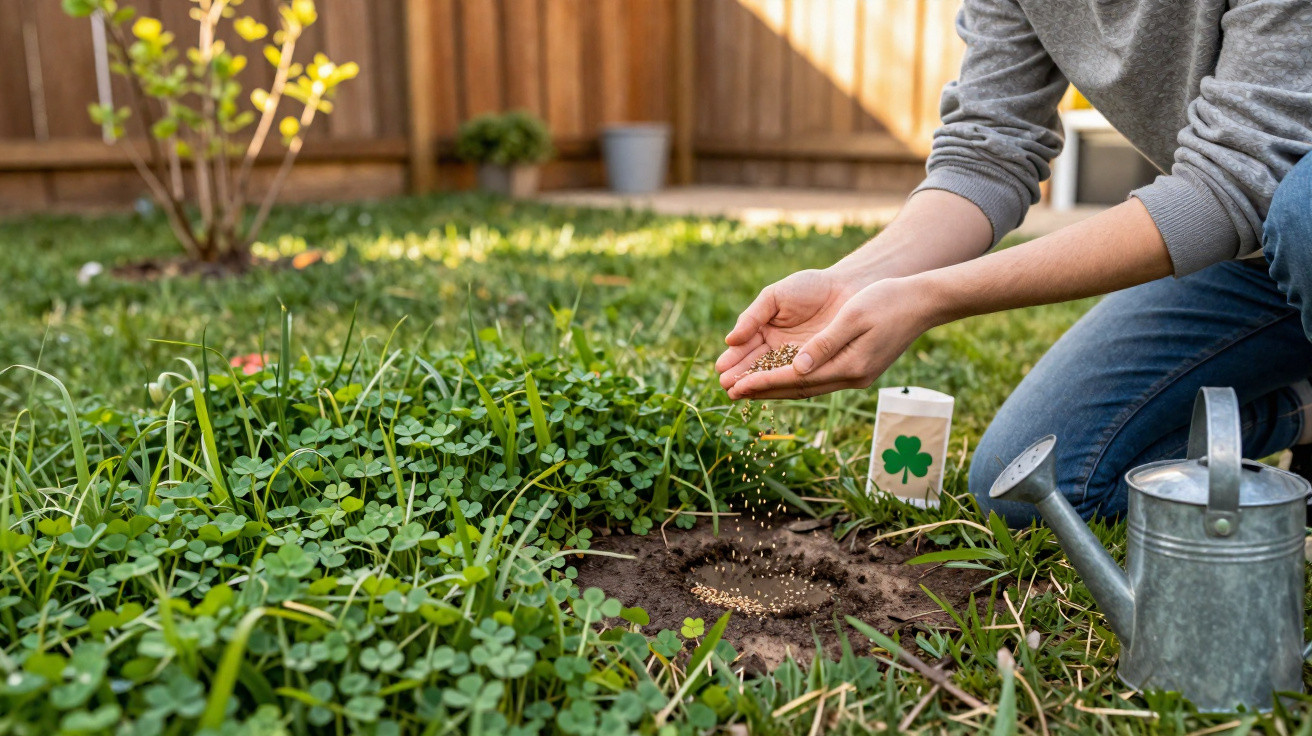
After winter, a lawn mercilessly reveals every weak point: bare patches, yellow areas and worn tracks. Rather than once again reaching for conventional lawn seed in disappointment, more and more amateur gardeners are turning to a different, remarkably resilient plant: microclover. Used correctly, it quickly fills gaps, makes the lawn more resistant to drought and can even reduce fertiliser use over time.
Why lawns are full of holes after winter
Frost, standing water, dog urine, snow mould, children playing or the paddling pool from last summer can all damage the turf. Individual grass plants die off, their roots decay and unattractive, dry patches are left behind.
Anyone who simply works new lawn seed into these areas every year will know the pattern: the gaps may close in the short term, but fresh bare spots appear with the next period of heat or drought stress. This is precisely where microclover comes in.
“Microclover works like a natural carpet repairer: it fills holes, strengthens the lawn and supplies the soil with nutrients.”
Microclover – the secret weapon against bare patches
Microclover is an especially low-growing form of the familiar white clover. It generally reaches only 3 to 8 centimetres in height and blends almost seamlessly into a lawn. Unlike a conventional clover takeover in a meadow, it does not create a “farm pasture look”, but instead forms a dense, rich green carpet.
The key characteristics of microclover
- Low growth: Small leaves and a carpet-like appearance make it less conspicuous than ordinary clover.
- Resilient under foot traffic: Ideal for areas where children play or dogs run.
- Good drought resistance: It copes with hot spells far better than grass on its own.
- Nutrient supplier: It fixes nitrogen from the air and releases it into the soil.
- Fast growth: It usually covers open areas more quickly than grasses.
Particularly in years with prolonged dry spells, clover acts as a safety buffer: grass may recede, but the clover remains green and visually fills the gaps.
How to sow microclover correctly
The ideal time to sow is early spring, as soon as night frosts are no longer expected. This gives the plant several months to establish a strong root network before high summer and drought stress arrive.
Step by step to a denser lawn
- Inspect the area: Mark all bare, yellowish or severely thin patches.
- Remove old material: Thoroughly loosen dry grass remains, moss and weeds with a rake or scarifier.
- Loosen the soil: Roughen the top 2–3 cm and break up larger clumps.
- Level the surface: Smooth it with a rake so that hollows do not form later.
- Mix the seed: Combine microclover seed with a little fine soil or lawn seed; this helps distribute everything more evenly.
- Sow: Scatter the mixture loosely over the prepared patches. Do not apply it too thickly, so seedlings receive enough light.
- Press down lightly: Gently firm the seed using a board, tread boards or flat-soled shoes to ensure soil contact.
- Water in: Water carefully without washing the seeds away.
“During the first weeks after sowing, microclover needs an evenly moist surface – not wet, but never completely dried out.”
Watering properly: avoid common mistakes
Many lawn problems are caused less by “poor seed” than by incorrect watering. Especially during establishment, a few routines determine whether the clover thrives or disappears again.
Common lawn-watering mistakes
- Watering too often but too little: Daily surface watering spoils the roots; they stay close to the surface and dry out more quickly.
- Watering at the wrong time of day: At midday, most water evaporates, while watering warm soil can encourage scorching.
- Waterlogging: Permanently wet soil promotes fungal diseases and can literally “suffocate” young seedlings.
Infrequent but thorough watering early in the morning is ideal. For new sowings, a light daily sprinkling is worthwhile for the first two to three weeks; after that, switch to less frequent, more intensive watering.
Less fertiliser, more green: how microclover improves the soil
Microclover belongs to the group known as legumes. These plants form a symbiosis with bacteria in the soil. In small nodules on their roots, these micro-organisms fix nitrogen from the air and make it available to plants.
| Effect | Benefit for the lawn |
|---|---|
| Nitrogen fixation | A natural source of nutrients directly around the roots |
| Dense root mat | Better soil stability, with less erosion and fewer holes |
| Green leaf growth | A fresh colour, even when grasses are slightly weakened |
If a lawn contains some microclover, mineral nitrogen fertiliser can often be reduced considerably. This is kinder to both your wallet and the environment, while helping to prevent the soil from becoming “overfed” in the long term.
Where microclover is especially useful – and where it is not
A lawn containing clover is particularly suited to practical and family gardens: spaces for playing, relaxing, barbecuing and everyday life. The blend of grass and clover is more forgiving of mistakes and still looks reasonably tidy when drought stress occurs.
A little restraint may be advisable in the following cases:
- Show lawns: Anyone seeking an immaculate, completely uniform grass surface may not be happy with a visible proportion of clover.
- Severe allergies: People who react strongly to clover or insect stings should speak to their doctor before sowing.
- Bees in children’s areas: Flowering clover attracts pollinators. Where many children play barefoot, keep the clover proportion slightly lower or mow before flowering.
Practical care tips for a clover-rich lawn
A lawn with microclover does not need specialist treatment, but a few details are worthwhile:
- Do not set the mowing height too low; 4–5 cm encourages dense greenery.
- Sharpen mower blades regularly so that leaves are not torn.
- In summer, mow less frequently and leave the lawn longer rather than cutting it short and harshly.
- Largely avoid widespread applications of high-nitrogen fertiliser.
If you are unsure how much clover the lawn should contain, start by treating only its troublesome areas. It is often enough to introduce microclover into typical “problem zones”, such as worn paths, play areas or sunny south-facing spots, to improve the overall appearance substantially.
What causes bare patches – and how clover helps in the long term
Bare areas are usually only the visible symptom of a deeper weakness: compacted soil, an imbalance of nutrients, too little root mass or continuous overuse. Microclover addresses several of these issues at once. It roots deeply, loosens the topsoil, supplies nutrients and protects the surface with its leaf cover.
In everyday terms, that means less frustration with brown patches, less watering stress in summer and a lawn that does not immediately flag after every hot weekend. Those who invest a little effort in spring and sow microclover will save themselves many frustrating hours with a watering can and reseeding during high summer.




Comments
No comments yet. Be the first to comment!
Leave a Comment