
The hose lies lazily across the grass, the sun beats down, and the only sound is the gentle gurgle of water running into the beds. Your neighbour is watering for the third time this week, the lawn seems to be steaming, and you start wondering how much longer this can continue as water prices rise. In the vegetable plot, the soil is cracking while the tomatoes hang heavily, yet within a few hours the ground looks dusty again. Something clearly is not working. We pour valuable drinking water onto the soil, and some of it simply disappears deep below ground before plants have any chance to use it. At the same time, older gardeners tell you they “used to manage with half as much”. It sounds like a fairy tale. Doesn’t it? The truth is closer than you might think.
Why traditional watering routines waste so much water
Anyone walking through an allotment site in high summer sees the same scene again and again. Here, a lawn sprinkler sends half its water onto the path. There, a watering can is emptied across a bed like a small waterfall. It looks pleasing for a moment, with everything glistening with moisture. Yet most of that water has evaporated or drained far down into the ground within an hour. We give plants a shower instead of properly supplying them.
A hobby gardener from Brandenburg told me that, after the last drought summer, she simply could not keep up any longer. She spent two hours watering every evening, while her water bill soared. When she compared her usage figures with the previous year, the difference was almost 30 cubic metres – for a small plot. Meanwhile, the beds looked tired, the tomatoes split, and the herbs still wilted at midday. Only after burying a simple system in the soil did she halve her water use over the course of the season. In the second year, she saved almost sixty per cent. Without sacrificing any yield.
It may initially sound rather like magic, but it is simply physics. Surface watering only reaches the top few centimetres of soil – precisely where the sun is most intense. The water quickly evaporates, and plants effectively “learn” to keep their roots in this shallow comfort zone. When water is delivered slowly at depth instead, roots are prompted to grow deeper. Moisture remains stored there for much longer. The plant becomes more resilient and needs less water supplied from above. Put simply, what matters is not how much water you use, but where and how it enters the soil.
The underground watering method: ollas, bottles and more
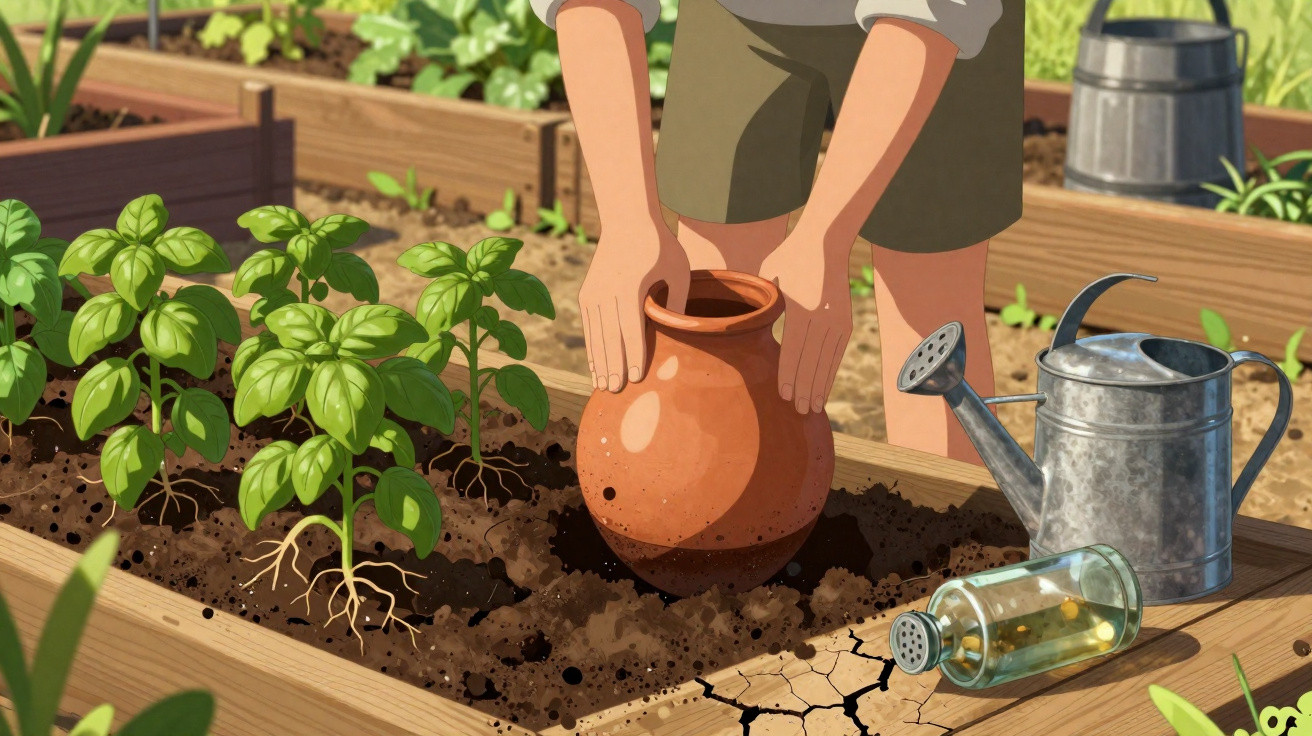
The method that can save up to sixty per cent of water is almost absurdly straightforward: water is delivered below ground to the roots, rather than poured over the surface. The traditional system is called an “olla” – an unglazed clay pot used for centuries in Mexico, India and Mediterranean regions. It is buried in the soil up to its neck, filled with water, and the clay gradually releases moisture into the surrounding earth. Plants take only what they genuinely need. No spraying and no lengthy evening hose sessions.
If you are now imagining expensive specialist containers from a garden centre, take a breath. You can begin with basic materials. Empty plastic bottles, old terracotta pots and even pierced buckets can all work as a starting point. Only one thing matters: the water must reach the root zone directly and seep out gradually rather than arriving in a rush. We all know that moment when impatience gets the better of us and we pour water on “properly” after all. Let’s be honest: nobody waters as carefully every day as gardening guides suggest. That is why we need a method that takes some of the work off our hands.
So how does it work in practical terms? Picture a pot or bottle placed in the soil. Water seeps out through tiny pores in clay or small holes in plastic only when the surrounding soil is drier than the container’s contents. The plant draws up moisture, the soil dries slightly, the clay responds and more water flows out. During rain, the reverse applies: the soil is saturated, there is no pressure difference, and the water largely remains inside the vessel. The system regulates itself remarkably well – without a display or app, using only gravity and diffusion. This simplicity is exactly what makes the method so dependable during heatwaves.
How to use the underground watering method
To get started, all you need is one bed and a willingness to get your hands into the soil. If you want to buy olla pots, choose unglazed clay vessels roughly the size of a medium flowerpot, with a closable lid. Bury them so that only the neck remains visible. Leave around 30–50 centimetres between them, depending on the plants and soil. With tomatoes, one pot is often enough for two or three plants. Refill the pot every two to four days rather than wetting the soil surface. After a fortnight, you will notice that the soil feels more evenly moist without becoming waterlogged.
If you prefer a DIY approach, use 1.5-litre plastic bottles. Cut off the base and make a few small holes in the lower third. Place the bottle in the ground beside the plant with its opening facing upwards, deep enough for the holes to sit within the root area. Cover the top with a piece of fabric or an old pot lid to stop mosquitoes and leaves from falling in. Old terracotta pots can work too, provided you seal the drainage hole and use a saucer as a lid. The principle remains unchanged: slow, targeted water delivery rather than a flood.
The most common mistakes come from impatience or guilt. Many people water the bed from above as well “just to be safe” because the surface looks so dry. That is exactly how the effect is undermined. The aim is to encourage the plant to send its roots deeper. Surface moisture spoils it again. Another familiar problem is placing too many containers in a small area, leaving everything soaking wet and causing roots to rot. Dare to do less. Your tomatoes do not need to sit in a permanently wet bath. There is one plain sentence worth remembering: more water does not automatically mean more life.
“Since I buried the clay pots, I no longer walk through the garden in summer with a stopwatch and a watering can,” says Karin, 62, who has kept her city garden in Cologne going through increasingly dry summers for years. “I fill all the containers in the morning, and it takes ten minutes. The rest of the day is mine again.”
- Allow one container for every 30–50 cm of bed length; position them slightly closer together in very dry sandy soil.
- Refill them only in the morning or late evening, so evaporation from the necks of the pots remains low.
- Mulch the surface around the containers with grass cuttings, leaves or straw to retain moisture in the soil for longer.
- Check once a month that the containers are not blocked or taken over by roots.
- Combining the method with rainwater pays off twice: less mains water is needed, and it is gentler on many plants.
What this simple idea changes about the way we see water
Once you have seen how little water can suddenly be enough, you view your own garden differently. The routine is no longer simply “make everything wet in the evening”; instead, it becomes a quieter kind of dialogue with the soil. You realise that a well-supplied bed does not shine at the surface – it breathes at depth. After a few weeks with underground containers, those anxious glances at the weather forecast start to disappear. The constant question, “Is it enough?”, becomes less pressing. In its place comes a new familiarity with your soil, the roots and timescales longer than a single watering session.
Interestingly, the method does not merely create practical independence; it also changes our sense of responsibility. Water is no longer an invisible flow from the tap that we simply use when the lawn cries out. Every refill of a pot becomes a small decision. You can see how long it lasts and how the plants respond. This direct feedback is missing when we simply create rain from above. Perhaps that is the quiet, unglamorous value of this old technique. It does not force us to be perfect. It simply helps us use less water without having to think about it constantly. That is what makes it so suitable for everyday life – in back yards, on balconies, on allotments and, increasingly, in professional vegetable-growing operations.
| Key point | Detail | Benefit for the reader |
|---|---|---|
| Underground watering rather than surface irrigation | Clay pots (ollas) or bottles slowly release water directly in the root zone | Less evaporation and water savings of up to 60% with the same or better plant development |
| Simple DIY implementation | Reuse plastic bottles or old terracotta pots without major investment | A solution that can be put into practice immediately, even on a limited budget |
| Deeper roots, more resilient plants | Plants “learn” to use moisture at depth instead of relying on the surface | Less stress in hot spells, more stable harvests and less daily watering work |
FAQ:
- How much water can I realistically save with the olla method? Reports from practical use and small trials in dry regions generally found savings of between 40 and 60 per cent compared with conventional watering from above. The hotter and windier your location, the greater the effect.
- Does this work in pots and on balconies too? Yes, especially there. In large containers, you can use small clay cones or mini bottles. This reduces the constant drying-out of potting compost without requiring you to top up water several times a day.
- Do I need to water my plants normally as well? During the initial settling-in period of the first one to two weeks, a little additional watering can be useful. Afterwards, regularly filling the containers is usually enough – provided their number and size suit the plant.
- What happens to buried containers in winter? Clay pots can crack in hard frost if they are filled with water. Either remove them before winter or leave them empty in the soil. Plastic bottles are less sensitive, but may become brittle over time and will eventually need replacing.
- Is the method suitable for large gardens or fields as well? For very large areas, professional drip-irrigation systems are often more efficient. In intensively planted beds, permaculture zones, raised beds or smaller vegetable areas, however, underground watering can save a surprising amount of work and water even in a large garden.
Comments
No comments yet. Be the first to comment!
Leave a Comment