
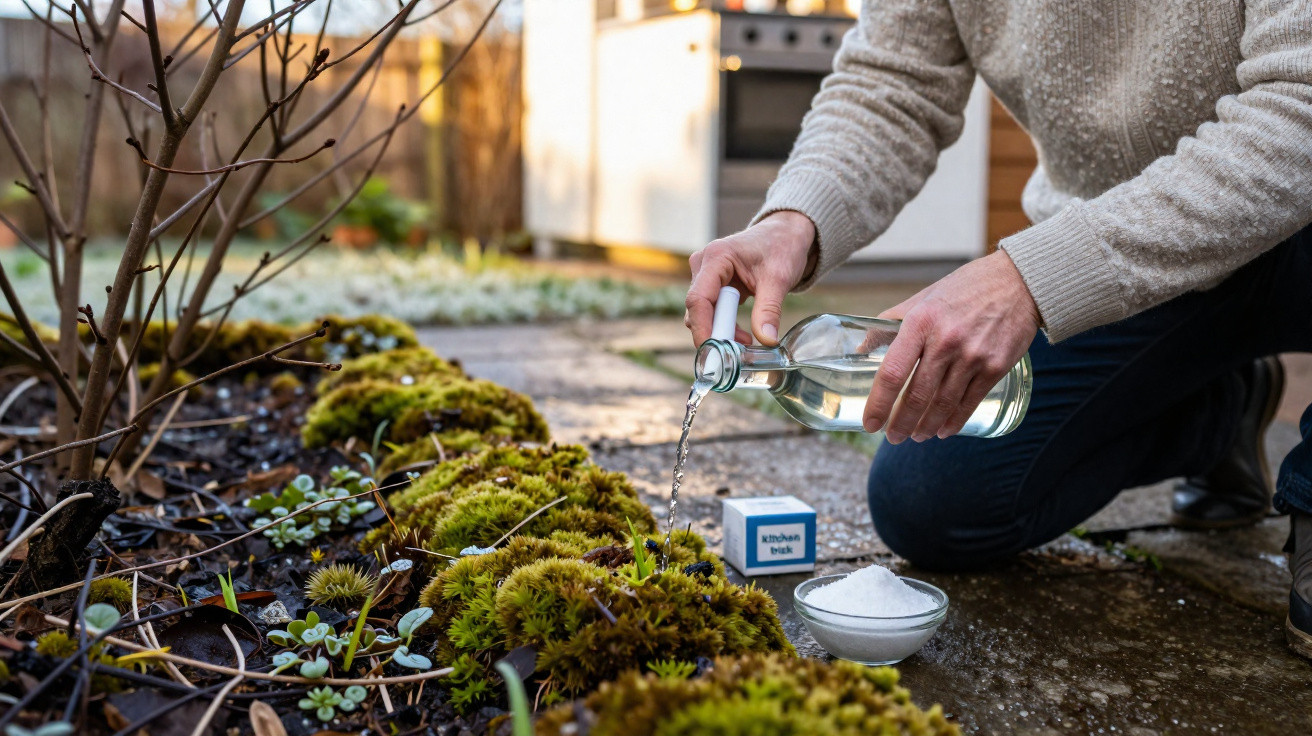
Many property owners leave the green growth in joints between paving stones, slabs and across the patio untouched for months. Come spring, they then spend hours on their knees scraping out moss and using a pressure washer – only for the area to look much the same again a few weeks later. Professionals take a different approach: they make use of the winter months and rely on an ingredient found in almost every kitchen.
Why moss and weeds are vulnerable in winter
In December, the garden appears to be in deep hibernation. Beds are bare and shrubs have shed most of their leaves. Between paving slabs, however, it is a different story. Roots, spores and seeds can shelter remarkably well from cold weather and frost inside narrow joints. As soon as the first milder days arrive, they begin growing rapidly, turning joints into slippery miniature flowerbeds.
This is precisely why tackling them in midwinter can pay off. In January or February, plants are weakened and their metabolism is slower. Any disruption affects them far more than it would during peak growth. Acting at this stage interrupts the cycle before moss and weeds can properly take hold.
Many people reach for hot water or vinegar. Both have drawbacks: boiling water can encourage micro-cracks in frozen or heavily saturated slabs, while vinegar often leaves roots and seeds alive. A simple household mineral salt can be considerably more effective.
The overlooked kitchen powder for moss
This product is ordinary bicarbonate of soda, often sold as “baking soda” or “food-grade soda”. It is a mineral salt that does not poison plants like a conventional chemical weedkiller; instead, it dries them out.
“Bicarbonate of soda draws water from the cells of moss and weeds, weakens the roots and at the same time disrupts germination conditions in the joints.”
The powder creates an imbalance on the plant surface and around the roots: water moves out of the cells, causing the plant to dry out from within. At the same time, the pH level of the jointing material rises slightly. Many mosses and common paving-joint weeds dislike this, so they germinate less successfully or do not emerge at all.
Winter offers a particular advantage: there is plenty of moisture, whether from dew, mist or light drizzle. The mineral dissolves gradually and can seep deep into the gaps, without any laborious scrubbing afterwards.
How the dry winter treatment works
Professionals start with a straightforward dry application. It is particularly suitable where a patio has only light green growth or where the aim is prevention.
Step-by-step guide to drying out moss and weeds
- Clear away coarse debris: Sweep leaves and loose dirt from the surface with a broom; the joints do not need to be perfectly clean.
- Measure the bicarbonate of soda: Allow around one small handful, approximately 20 grams, for each linear metre of joint.
- Spread the powder: Scatter the bicarbonate of soda loosely over the joints, ensuring it does not land on flowerbeds or the lawn.
- Work it in with a brush: Use a deck scrubber or stiff brush to press the powder specifically into the joints, so it comes into contact with soil and roots.
- Do not rinse afterwards: Do not add water. Natural winter moisture will dissolve it and “carry” it down into the joint.
Over the following days, the salt dissolves little by little. It seeps downwards, reaches remaining roots and suppresses them while they are weakened. Ideally, the joints will be almost clear by spring, leaving only loose material to sweep away.
Liquid treatment for heavily greened surfaces
If the patio is already heavily covered in moss, dry application alone is often insufficient. In that case, a water-based solution provides an additional effect, particularly when the aim is to remove visible moss cushions and dense clumps of grass from the joints.
Mixture for a natural “liquid treatment”
For a bucket or larger watering can, the following mixture is suitable:
- approximately 950 millilitres of water, hand-warm but not boiling
- 2 to 3 tablespoons of bicarbonate of soda, stirred thoroughly until no crystals remain visible
Pour this solution into a watering can fitted with a rose or a pressure sprayer. Choose a dry day with no rain forecast and as little wind as possible. This ensures the mixture reaches where it is intended to work: directly on the moss cushions and in the joints.
When poured or sprayed precisely, the green growth often turns yellowish and then brown over the next one to two days. The small plants break apart more easily, and a firm sweep with a broom will usually loosen them. Stubborn patches can be treated again with a second, targeted application.
Keeping the soil healthy and the garden undamaged
Useful though this mineral salt is, excessive quantities can place stress on soil, especially if large areas are treated regularly. A few basic rules help prevent damage in the garden.
| Area | Recommendation |
|---|---|
| Patios & paved paths | Suitable, but apply sparingly and precisely in the joints |
| Flowerbeds, vegetable plots | Best avoided, as the roots of edible plants may be damaged |
| Lawn edges | Use only in joints between stones or slabs; do not let it run onto grass |
| Frequency | Once or twice a year is usually entirely sufficient |
Anyone living on a slope, or with surfaces where water drains heavily towards beds, should monitor carefully where the run-off goes. If a concentrated solution regularly reaches a vegetable bed, the soil life there may suffer.
Common mistakes that reduce the effect
The same errors occur repeatedly in everyday use, making the treatment less effective than it could be. Three examples are:
- Applying too thick a layer: Scattering piles several centimetres deep wastes material and is more likely to burden the soil, without producing noticeably better results.
- Rinsing straight away: Washing the area with plenty of water immediately afterwards often flushes the salt from the joint before it has had time to work.
- Treating before heavy rain: If a downpour is forecast shortly after application, the solution spreads uncontrollably and becomes heavily diluted.
A calm, relatively dry winter day and a little patience are more effective. The treatment works over hours and days, rather than minutes.
Combining the method with other useful measures
Bicarbonate of soda does not replace good joint maintenance, but it can make that task much easier. Those who also use mechanical methods in spring or summer will keep surfaces cleaner for longer. A few practical measures include:
- Re-sanding joints every year, ideally using weed-suppressing jointing material.
- Planning new paths with the narrowest possible joints from the outset.
- Arranging drainage so that permanently damp areas cannot develop.
With this approach, many surfaces need treatment only rarely. In particular, in shaded locations where moss naturally prefers to grow, combining good drainage, occasional sweeping and a targeted winter treatment is helpful.
Risks, limitations and sensible alternatives
Pet owners should bear in mind that larger amounts of freshly scattered powder may cause stomach problems if dogs or cats lick it. Once it has been brushed into the joints and exposed to moisture for several hours, this risk falls significantly, but it is still worth keeping a watchful eye on pets.
For very old natural stone slabs or delicate surfaces, test the product on a small area first. In rare cases, residues can leave slight discolouration around the joints, especially where salts or fertilisers have already been introduced.
Anyone wishing to avoid kitchen ingredients altogether can continue with conventional methods such as a joint scraper, wire brush or paving-joint brush. Hot-water equipment without chemicals is also used, although it creates more noise and requires substantial energy.
Ultimately, winter treatment with bicarbonate of soda is appealing for one simple reason: it shifts the main workload from the busy spring weeks to the quieter, cooler part of the year – while an inconspicuous white grain quietly does much of the work in the joints.
Comments
No comments yet. Be the first to comment!
Leave a Comment