
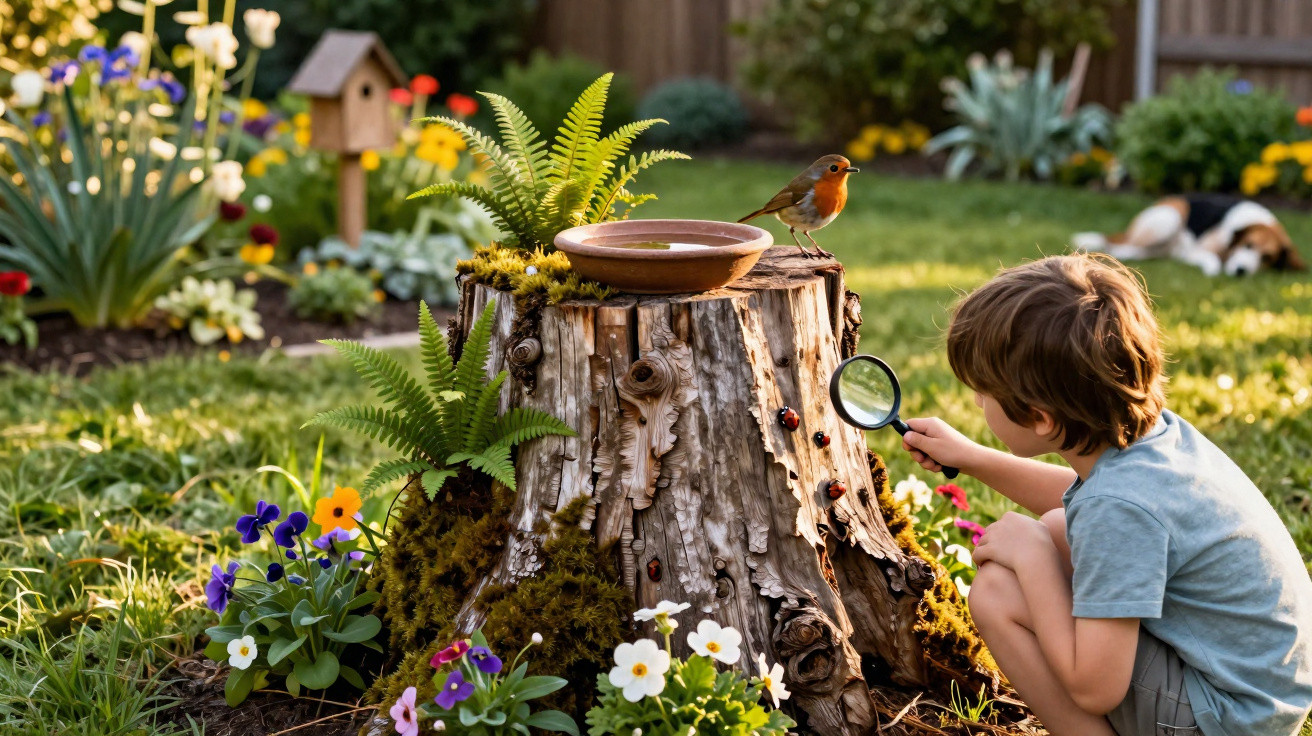
In many gardens, a grey tree stump protrudes from the lawn, a reminder of the felled tree that interrupts the look of a perfectly mown grass surface. For a long time, it was seen simply as an eyesore to be removed as quickly as possible. Experts in wildlife-friendly gardening are now strongly challenging that view, and in many cases recommend deliberately leaving the stump in place.
Why the ‘get rid of it’ instinct towards a tree stump is outdated
For decades, private gardening was shaped by a straightforward belief: anything that appeared dead belonged on the compost heap or in the garden-waste bin. A tree stump fitted that idea perfectly. It gets in the way of the lawnmower, children may trip over it, fungi can appear on its surface, and it makes the whole garden seem untidy. This is especially true for people who design their gardens as an ‘outdoor living room’, complete with a patio, pool or ruler-straight borders, where a stump can feel out of place.
As a result, stump grinders, mini diggers and chemical products intended to break down roots gradually became increasingly popular. Many contractors offer complete packages: fell the tree, dispose of the trunk, grind out the stump and level the ground. Although this sounds convenient, it comes at a financial and environmental cost.
More and more garden experts see a tree stump not as a problem, but as a hidden benefit – much like a mini nature reserve right outside the front door.
Even traditional guides for homeowners and gardeners now point out that a stump can be left without concern, provided it does not obstruct paths and the tree was not previously affected by a contagious disease.
Tree stump as a habitat: dead wood teeming with life
What initially looks like ‘dead matter’ soon becomes, inside, a dense network of fungi, bacteria, beetles and other tiny organisms. Specialists call it dead wood, and regard it as one of the most important drivers of a thriving garden ecosystem.
How the stump improves soil over time
A great deal happens out of sight while the stump slowly decomposes:
- Fungi and microorganisms break the wood down into ever-smaller components.
- Beetle larvae, woodlice and springtails use the softening wood as shelter and a feeding site.
- Earthworms pull fragments into deeper soil layers and mix them with the earth.
- Nutrients such as nitrogen and potassium are released little by little.
By the end of the process, the site is left with exceptionally loose, nutrient-rich soil. Anyone creating a border there later will benefit from a substantially improved soil structure, without artificial fertiliser or peat-based products from the garden centre.
A feeding ground and shelter for insects, birds and small animals
A decomposing stump is not merely ‘compost in slow motion’; it is also a fully fledged food source. Beetle larvae and other wood-dwelling creatures attract birds such as woodpeckers and tits, which probe the timber for insects. Hedgehogs and lizards search its crevices for spiders and woodlice.
Leaving fallen fruit, such as apples, pears or plums, on the ground provides an additional benefit. On warm late-summer days, butterflies feed on the fermenting juice. The area around the stump can therefore quickly become a small stage for watching nature.
A seemingly ugly block of wood can become a favourite spot for butterflies, beetles, birds and children who watch it all with curiosity.
When appearance is a concern: turn the stump into a design feature
For many garden owners, the stump itself is not the main issue; rather, it is its ‘unfinished’ appearance, as though someone had completed only 80 percent of the job. This is precisely where creative approaches can turn an apparent problem area into an attractive feature.
Ideas for putting a tree stump to good use
With a little imagination, the remains of the tree can become useful furniture or a small artistic project. Popular options include:
- Natural seating: Smooth the top and, if desired, oil it to create a rustic stool.
- A small table surface: Larger stumps work well as side tables next to a garden chair.
- Mini flower bed: Saw or drill out a hollow, fill it with soil and plant it with mat-forming perennials or herbs.
- Garden art: Skilled DIY enthusiasts or specialist woodcarvers can shape figures, animals or abstract forms from the wood.
- Support for climbers: Plant a climbing rose or clematis at the base; within a few years, the stump will disappear beneath a covering of flowers.
Those who do not feel confident making an artistic cut themselves can now find specialist wood sculptors who turn old trunks into sculptures. The wood remains on site, adds structure to the garden and still offers animals a place to retreat.
When a tree stump really has to go
Despite all its benefits, there are circumstances in which a stump should not remain. In some cases, safety or health considerations take priority. Professional contractors generally identify only a few clear criteria:
| Situation | Recommendation |
|---|---|
| Directly beside a frequently used path or play area | Removal is sensible to prevent a trip hazard |
| A patio, carport, pool or extension is planned | Have the stump professionally removed before building work begins |
| The tree was affected by a contagious disease | Remove the stump and root area to prevent it spreading |
| Very close to the house, with potential risk to utilities or foundations | Ask a specialist company to assess whether roots could cause problems |
Many experts advise against chemical treatments. They can contaminate the soil and groundwater, and may also damage plants that are meant to remain. Having professionals use a stump grinder or excavator is safer, as they will also take pipes and cables into account.
The question is not ‘stump or no stump?’, but: does it genuinely get in the way – or can it stay and do its work?
How more dead wood changes garden maintenance
People who choose to tolerate tree stumps deliberately often change other habits too. Their view of leaves, dead branches and dried perennial stems shifts: they begin to look less like waste and more like building blocks of a functioning garden.
A few straightforward principles fit this approach and are easy to incorporate into everyday gardening:
- Leave leaves beneath hedges and shrubs, clearing only paths and lawns.
- Stack a few dead branches into a loose pile in one corner.
- Cut back faded perennials only in late winter rather than during autumn.
- Do not dig up every rotten root immediately; allow it to decay naturally.
These measures require hardly any extra time, can even reduce the workload, and give insects, birds and small mammals valuable places to shelter. At the same time, they create a garden that may be less ‘sterilely tidy’, but is more lively and varied.
Practical advice for gardens used by families and pets
Anyone with children or dogs in the garden will often consider obstacles particularly carefully from a safety perspective. In these cases, a stump can be made safer in a targeted way:
- Mark its edge, for example with a low fence, a ring of stones or dense planting.
- Cut the top flat and sand it smooth so that nobody catches themselves on it.
- Position or use the area so that heavily used play spaces remain clear.
Children in particular often enjoy using tree stumps as climbing features or a ‘stage’ during play. With some supervision, the stump can become a permanent part of the play area rather than something to banish.
Why leaving a tree stump fits the growing trend
More and more people want a garden that not only looks attractive, but also provides something for wildlife and does not rely on an excessive use of chemicals. Insect hotels, wildflower strips and native hedges have now become almost standard features. Against this background, a strict rejection of dead wood increasingly seems outdated.
A tree stump left in place fits this trend perfectly: it creates no ongoing costs, needs no maintenance and, incidentally, provides better soil, greater biodiversity and fascinating opportunities to observe nature. When incorporated thoughtfully, it does not even require compromises in design; on the contrary, it often creates a distinctive detail that cannot be bought from any catalogue.
Comments
No comments yet. Be the first to comment!
Leave a Comment