
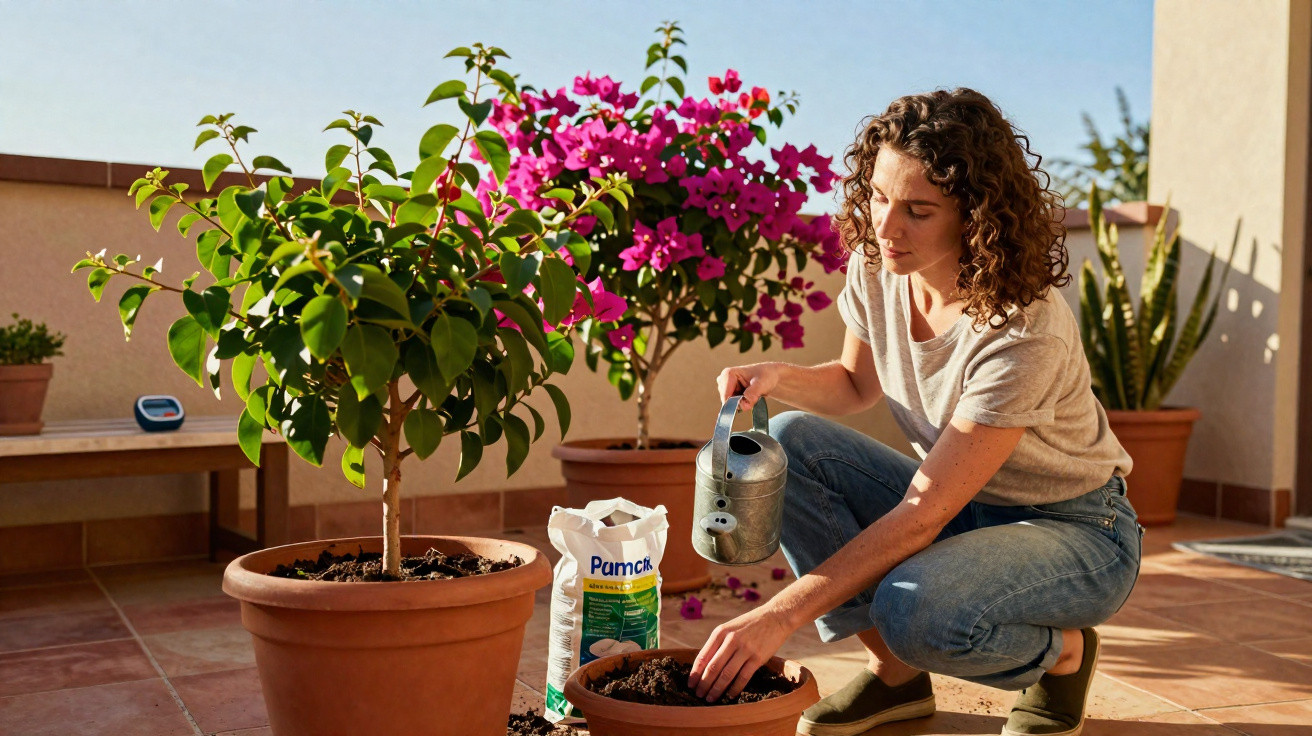
The plant looks healthy, shoots upwards at speed and its pot is always well watered. Yet it stubbornly stays green. Gardeners often call this a “green monster”. The cause is usually not an exotic plant pest, but a simple care habit that effectively puts the brakes on flowering.
When a bougainvillea produces only leaves
A bougainvillea that fails to flower is far from unusual. On balconies and patios across central Europe, it is common to see vigorous green climbers without their characteristic colourful bracts. The conditions are often pleasant, but not truly suitable.
For this heat-loving climbing plant to flower, several key requirements must be met:
- At least six hours of direct sun daily – partial shade is rarely enough.
- Temperatures of between 20 and 30 degrees during the growing period.
- No frost: it should be brought indoors below 5 degrees, while damage can occur at around 0 degrees.
- A warm, sheltered position, ideally against a south- or south-west-facing wall.
Placing the plant in partial shade, keeping it permanently moist as though it were a houseplant and, to be safe, leaving it sitting in water often unintentionally prevents the very thing people want most: the colourful bracts that many mistake for flowers.
The soil is crucial: a sun-lover that prefers dryness
In its native habitat, this climber does not grow in damp woodland shade, but in relatively dry regions where rainfall is usually brief and heavy. The aim is to recreate those conditions in a pot as closely as possible.
The ideal growing medium is:
- light and free-draining,
- unable to retain standing water,
- placed in a pot with drainage holes,
- allowed to dry out noticeably between watering sessions.
A root ball that stays wet all the time tells the bougainvillea: “Grow!”, but not “Flower!”
The decisive difference between rich green foliage and glowing bracts comes down to one factor that many amateur gardeners misjudge: the balance between water and nutrients.
Too much water and fertiliser means no flowers
A typical situation is this: it is high summer, the plant is on the patio and temperatures reach 30 degrees. Worried that it might dry out, the owner waters it almost every day and gives it a dose of general-purpose fertiliser each week. It sounds caring, but to a bougainvillea it signals continuous effort: grow, grow, grow.
The results are easy to spot:
- long shoots that appear soft,
- dense, deep-green foliage,
- few or no colourful bracts.
Botanically, this makes sense. A plentiful water supply and a fertiliser high in nitrogen primarily encourage vegetative growth – leaves and shoots. The plant may look exceptionally healthy, but invests little energy in producing flower clusters.
When the root ball is instead allowed to dry out noticeably for a time, the plant perceives this as mild stress. That stress prompts it to shift more strongly towards reproduction – and this is when the decorative bracts are encouraged to develop.
The controlled-dryness method for bougainvillea
Professionals use a clear approach for this climbing plant, and it can also be applied successfully on a balcony or patio. Before adjusting watering and fertiliser, the basics need to be right:
- A position in full sun, sheltered from wind where possible.
- Loose, free-draining compost, ideally containing sand or expanded clay.
- A pot with drainage holes and no saucer that remains full.
- Moderate fertilising, preferably with a potassium-rich product.
During the main season, a fertiliser with plenty of potassium and a moderate nitrogen content is sufficient to support flower formation without sending leaf growth into overdrive. Fertilising should then stop from around mid-September, so the plant does not produce another flush of soft, immature foliage unnecessarily.
Potassium supports sturdy shoots and more abundant flowering; too much nitrogen only produces leaves.
How to water properly in summer
What matters is the sequence of a dry spell followed by a thorough watering. A common rule of thumb is:
- Let the top section of the growing medium – around three to four centimetres – dry out.
- Then water deeply, until water runs from the drainage holes.
- Empty the saucer after roughly 30 minutes, preventing waterlogging.
Repeat this pattern of “like after a brief summer downpour” throughout the season. Alternating between mild drought stress and a generous supply of water often stimulates visibly stronger flowering.
Winter rest: almost dry and relatively cool
From November to March, a bougainvillea needs a form of dormant period. It is best kept:
- in bright conditions,
- at roughly 10 to 15 degrees,
- with very limited watering.
The plant can remain almost dry at this time. Keeping it going in a warm living room with regular watering and fertiliser is more likely to weaken it over time and disrupt the clear distinction between its resting and flowering phases.
How to tell when it is time to water
There is no need for technical measuring equipment. For many gardeners, a straightforward finger test is enough:
- Push a finger around two to three centimetres into the compost.
- If that area feels dry, water the plant.
- If the compost still feels cool and damp, wait.
Slightly drooping leaves can be an early sign that the plant needs water. Discolouration, brittle leaves or leaves that curl, however, indicate considerable stress and should be avoided.
The skill is to allow slight dryness without letting the bougainvillea dry out to the point of complete exhaustion.
Common mistakes that prevent flowering
Several frequent care mistakes can undermine even an ideally sunny location:
- Automatic watering systems or continual watering: The root ball stays consistently damp, dry-period signals are absent and flowering is delayed.
- A saucer full of water: Waterlogging causes root rot, leaving the plant weak and reluctant to flower.
- An oversized pot: The plant first puts its energy into roots before producing visible flowers.
- Pruning at the wrong time: Hard pruning shortly before the main flowering period removes many potential flowering shoots.
When pruning, lightly shorten stems immediately after flowering, while more substantial cutting back is better left until late winter. This gives new shoots time to mature before the warm season and form flower clusters.
Why the “stress trick” works
From a plant-physiology perspective, bougainvillea responds to environmental conditions with something like a list of priorities. When water and nutrients are continuously abundant, it directs its energy towards growth and leaf mass. Only when conditions appear a little scarcer does producing striking bracts to attract pollinators become worthwhile.
Controlled drought stimulus is therefore not cruel; it simply imitates the plant’s natural environment. Many other garden and balcony plants react in a similar way, including certain cacti and Mediterranean herbs. Anyone who understands this principle can apply it to other species as well.
Practical additions for more abundant flowers
In summers with very heavy rainfall, a covered spot can make it easier to control the root ball. Large containers in particular benefit, as they often remain wet for a long time after a downpour. A loose growing medium containing coarse materials such as expanded clay, lava grit or coarse sand prevents water from collecting.
Anyone with several container plants can vary their watering approach: thirsty plants such as hydrangeas need water more often, while drought-tolerant plants such as bougainvillea need it less frequently but in larger amounts. This avoids care mistakes simply because every pot is watered at the same time.
In the longer term, it is worth checking the fertiliser being used. Products with a high nitrogen content make sense for lawn fertiliser, but act as a brake on reluctant-to-flower climbing container plants. Specialist flowering-plant fertilisers or a balanced product with an emphasis on potassium usually deliver better results – provided the watering strategy is right.
Comments
No comments yet. Be the first to comment!
Leave a Comment