
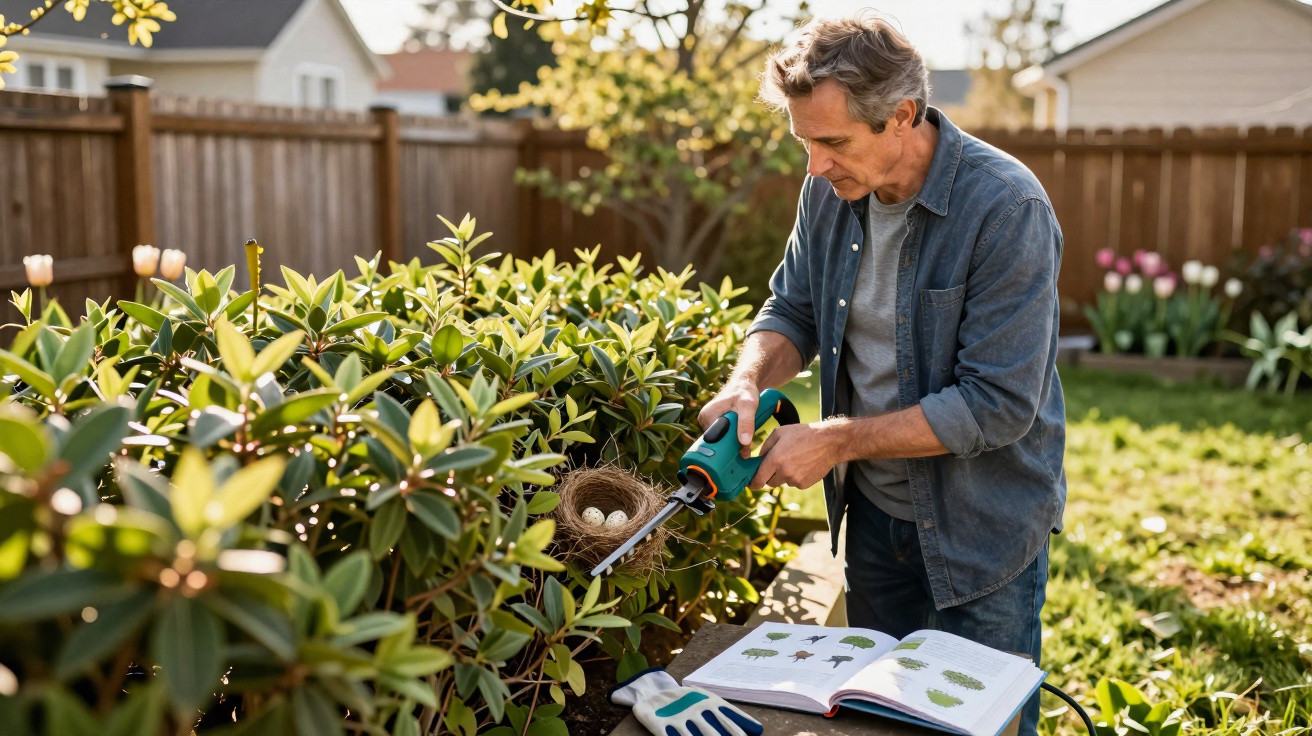
Many amateur gardeners face the same question in March: can the hedge still be trimmed now, or could it harm wildlife and even lead to trouble?
Every year, the wish for a tidy garden clashes with the need to protect birds and other wild animals. Using hedge trimmers at the wrong time can disturb nesting birds and disrupt an entire miniature ecosystem. At the same time, varying dates and restrictions often cause confusion. Understanding the rules, recommendations and suitable timing makes it easier to plan calmly and in a wildlife-friendly way.
Why spring is such a sensitive time for hedges
As soon as the first warmer days arrive, hedges quickly become sought-after nurseries. Many songbirds build nests within the dense foliage, while others shelter on the ground close to the roots. This is precisely when many garden owners begin to tidy everything up.
A severe cutback at this stage does more than destroy nests. Parent birds may lose their young, and many will not attempt another brood or will move to less suitable sites. Experts have warned for years that bird populations in Europe have fallen sharply, in some cases by a quarter within just a few decades. Species living in agricultural landscapes have been hit particularly hard, with losses approaching 60 per cent.
Hedges are far more than simple property boundaries. They act as vital corridors in the landscape:
- Birds use them to nest, rest and find food.
- Grasshoppers, beetles and butterflies depend on them for shelter.
- Hedgehogs, amphibians and small mammals find cover there.
- Bats use hedge lines for orientation while hunting.
Cutting a hedge right back during the peak breeding period breaks up this interconnected habitat. Gentle maintenance at the appropriate time, by contrast, can keep a garden attractive while preserving valuable living space.
“In spring, a hedge is not simply greenery; it is a densely populated block of flats for birds and many other animals.”
Legal position: who can cut when, and who should wait
In the case on which this information is based, the detailed requirements come from agricultural policy: farms receiving public support are subject to clear closed periods. Across German-speaking countries, it is worth considering two aspects: legal prohibitions and ecological recommendations.
The difference between farming and private gardens
Agricultural businesses tied to certain subsidy schemes often have to meet strict conditions. The key point is that hedges may not be cut, or may only be cut to a very limited extent, during a specified period in spring and summer. Breaches can lead to reduced or reclaimed payments and, in individual cases, even fines.
Private individuals and many local authorities, on the other hand, are generally governed by broader nature conservation requirements. The usual principle is that major work on shrubs and trees is prohibited during the breeding season, while limited, careful maintenance may be permitted provided no nests are destroyed. The precise wording varies between countries and regions.
Nature conservation authorities also commonly issue firm guidance that goes beyond the minimum legal position. Their advice is often, in effect, to pause hedge maintenance from the second half of March until the end of July, so that birds and other animals are left undisturbed.
| Group | Typical period with major restrictions | Consequence of breaches |
|---|---|---|
| Agriculture receiving support payments | Spring to high summer, for example mid-March to mid-August | Reduced payments, fines and sometimes criminal proceedings |
| Private gardens | Breeding season, usually spring to summer | Fines may be possible if nests are destroyed or strictly protected species are disturbed |
| Local authorities and businesses | As for private gardens, sometimes with additional requirements | Fines and contractual consequences for commissioned work |
An important practical point is that the absence of an explicit criminal ban does not automatically mean that every cut is unproblematic. Anyone disturbing animals or destroying their habitats may still breach general nature conservation rules.
“Legally, cutting from mid-March may still be possible in some gardens – ecologically, it is a poor time in most cases.”
Good practice: when a hedge is genuinely best trimmed
For a garden that is both wildlife-friendly and well maintained, timing matters above all else. There are two periods when hedge trimming can usually be carried out with relatively little concern.
The best times for hedge trimming
- Late winter: January to February, on frost-free days. As most birds have not started nesting, more substantial reduction work can be done then.
- Late summer: After the breeding season has ended, broadly from the middle or end of August. By then, young birds have fledged and many animals have moved into other shelters.
During these periods, garden owners can also make larger adjustments: narrowing hedges that have become too wide, thinning overgrown sections or removing dead branches.
How to check a hedge before cutting
Anyone who has to cut close to the sensitive period for organisational reasons should proceed with extreme care. This straightforward checklist can help:
- View the hedge from both sides and from above, keeping some distance.
- Watch for flight activity: do birds repeatedly return to the same spot?
- Carefully part dense growth by hand and look for nests.
- Check the ground level too, as some species nest very low down or even in grass.
If you find a nest or young animals, the basic rule is clear: stop cutting and leave the affected area alone until the young have fledged.
Trim gently rather than cutting back hard
The way a hedge is cut is just as important as the timing. A completely clipped hedge may look neat, but to wildlife it resembles a bare concrete wall.
What considerate hedge maintenance involves
- Work in smaller stages: Make minor adjustments regularly rather than removing everything drastically every few years.
- Leave sections untouched: On long hedges, keep some stretches uncut to retain places of refuge.
- Maintain sufficient height: Avoid cutting too low, so birds still have cover and protection from cats.
- Leave some cuttings behind: Put part of the material in a deadwood pile at the edge of the garden, which is ideal for hedgehogs and insects.
It is also worth paying attention to the tools used for trimming. Sharp blades produce clean cuts and are kinder to the plants. Blunt tools crush shoots, increasing the risk of fungal disease and rot.
“A reasonably ‘imperfect’ hedge usually supports far more life than a severely clipped green wall.”
Which plants make a hedge particularly valuable
Not all hedges offer the same ecological value. Although thuja and cherry laurel remain green throughout the year, they provide comparatively little for wildlife. Native shrubs with flowers and berries are very different.
Anyone redesigning a hedge over time or planting a new one can deliberately choose a mixed hedge. Typical species include:
- Hornbeam – dense, hardy and easy to trim.
- Hawthorn and blackthorn – flowering and thorny, making them ideal for birds.
- Lesser celandine, elder and wild rose – provide berries and rose hips.
- Privet (choose non-toxic varieties) – popular with insects and birds.
These hedges provide flowers, nectar, insect food and fruit throughout the year. Choosing local species supports precisely the animals already found in the surrounding area.
What to do if a nest appears while trimming
It is a familiar situation: the hedge trimmers are already in use, and suddenly a nest is exposed. At that point, it is important to change course quickly.
- Stop cutting immediately.
- Keep a safe distance, ideally leaving a “protective ring” of uncut branches around the nest.
- Mark the location, for example with a ribbon or stick, so nobody accidentally continues cutting there.
- Observe quietly to see whether the adult birds continue returning. They usually adapt quickly to the changed surroundings.
If you are unsure, contact your local council, a nature conservation authority or a bird protection organisation. Many can readily advise on whether the area should remain undisturbed for longer or whether small adjustments may be possible later.
Why it is worth seeing hedges differently
Trimming hedges has long been about more than appearance. As the climate changes, gardens are becoming increasingly important refuges for species that barely have space left in farmland. One hedge will not save a species from extinction, but it can form an important link in a wider chain of habitats.
By deliberately cutting a hedge only at suitable times, you not only protect birds and hedgehogs. You benefit as well: more insects mean more pollinators for fruit trees, while a dense hedge slows the wind, retains moisture and makes the garden air noticeably more pleasant on hot days.
In everyday life, one simple idea helps: a hedge is not merely a garden boundary, but a living strip between the house and the wider landscape. Giving it time to develop and intervening at the right moments will usually bring longer-lasting enjoyment – while also making a quiet contribution against the gradual loss of species on your doorstep.




Comments
No comments yet. Be the first to comment!
Leave a Comment