
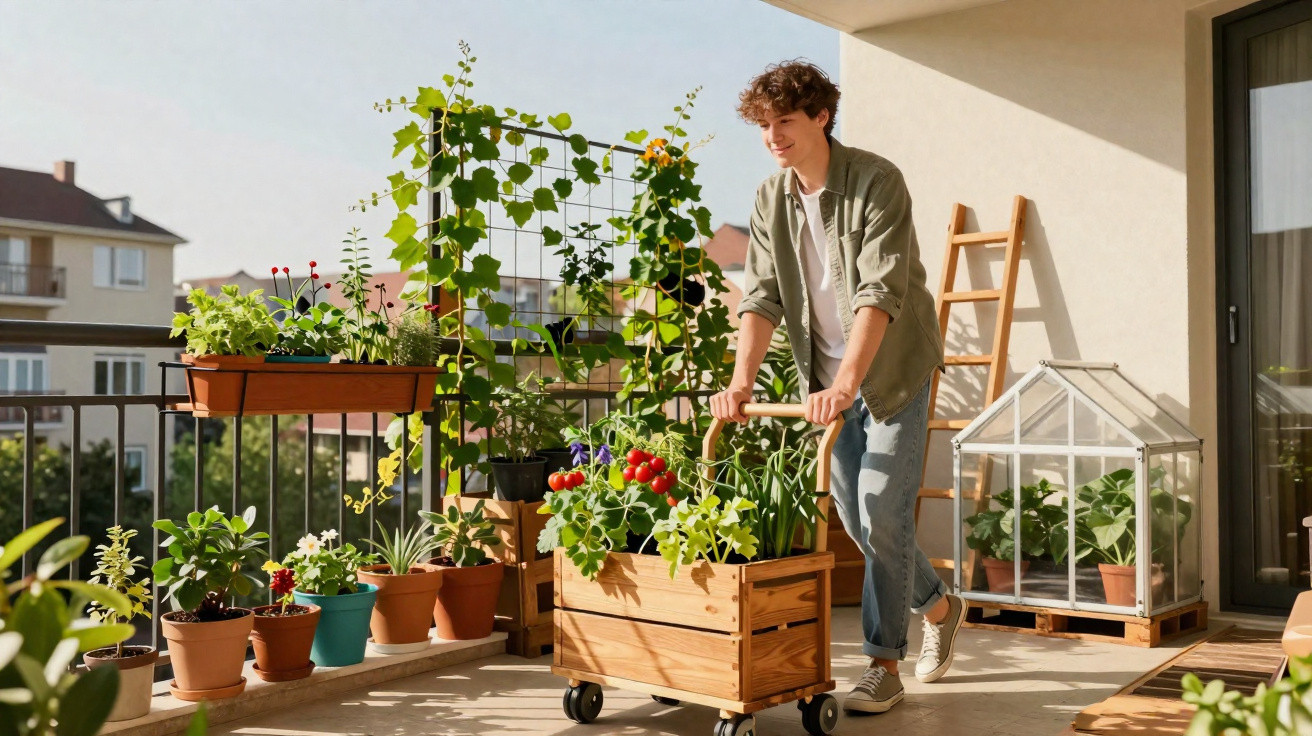
Yet, with the right strategy, there is another way.
Tenancy agreement, strict rules, no drilling, no digging – and still a lush green home? If you move regularly, you do not need to give up your planting beds each time. With a smartly designed ‘garden to take with you’, containers, raised beds and small structures can be arranged so that they can be loaded into a van in just a few moves and continue growing at your next home.
Mobile rental garden: the basic principle
A mobile rental garden is made up almost entirely of pots, planters, window boxes, raised beds and freestanding frames. Nothing is planted permanently in the ground, and nothing is screwed into walls or fences. Everything stands, slots in or leans in place – and can be removed again.
The benefit is obvious: when you move out, your landlord will find the garden in good order. At the same time, the space remains adaptable. If you realise that the tomatoes are sitting in shade, simply wheel them a few metres into the sun.
Checks before the first spade goes in – without a spade
- Read the tenancy agreement: are changes to the outdoor area permitted?
- Check the load capacity: how much weight can the balcony actually support?
- Take photographs: recording the original condition offers protection at the handover.
- Choose lightweight materials: plastic, aluminium, thin-walled terracotta pots and wood.
- Put everything on wheels: wheeled plant caddies and pallets reduce the effort involved in moving.
“A mobile garden treats every pot, frame and bed as an item of moving luggage from the outset – rather than as a fixed part of the property.”
Five portable planting ideas that move with you
If you do not want to start from scratch, use these five tried-and-tested planting concepts as a guide. They work equally well on a tiny balcony and alongside a rented lawn.
1. A moving pot border along a fence or patio
Place containers close together to create a movable bed edging. Set the taller statement plants at the back of a narrow strip of gravel or grit, with trailing plants at the front.
- at the back: ornamental grasses, lavender, a small olive tree or columnar fruit trees
- middle row: sage, hardy geraniums and miniature roses
- at the front: trailing verbena, ivy and dichondra
Ideally, place the largest pots on wheeled plant caddies. This allows the entire border to be shifted elsewhere with only a few pushes – or moved straight towards the front door when it is time to relocate.
2. Green privacy screening with a freestanding trellis
To visually separate a patio, use a trellis that does not require screwed-on brackets. It stands independently, with two long planters weighing down its base, and soon supports a dense wall of foliage.
Annual climbers are particularly suitable, as they grow rapidly within a single season:
- nasturtiums
- sweet peas
- morning glories
The lower planters can hold strawberries, low-growing herbs or ground-cover plants. When moving, the trellis can usually be folded flat, while the planted boxes remain intact and simply travel in the boot.
3. A mobile herb ladder for the kitchen and balcony
An old wooden ladder or purpose-made plant shelf makes an ideal tiered herb station. Small pots sit on the individual steps and can be rearranged whenever needed.
Practical layout:
| Level | Plants |
|---|---|
| top | Sun-loving herbs such as basil, thyme and rosemary |
| middle | Chives and parsley |
| bottom | Mint (preferably on its own) and cut-and-come-again salads |
Simply lean the ladder against the wall, using a felt or rubber mat to protect the floor. At moving time, carry the whole structure to the van almost like a piece of furniture – remove the pots briefly, lift the ladder and you are done.
4. Small PVC greenhouses that can be dismantled
Anyone who enjoys raising plants and experimenting can create a portable mini-greenhouse corner. These lightweight structures with plastic covers can stand on a patio or lawn and provide several shelf levels.
They are well suited to:
- young tomato, pepper and chilli plants
- summer-flower seedlings
- tender herbs in spring
The cover creates a small sheltered climate, yet can be removed in only a few steps. Pull apart the frame, fold the cover and clear the shelves – the dismantled greenhouse moves with you, while the pots travel separately.
5. A lightweight raised bed on wheels or a pallet
For anyone who loves growing vegetables, a mobile raised bed is worthwhile. The best option is a relatively shallow rectangular box made from wood or plastic, positioned on a wheeled pallet or designed to be lifted using a pallet truck.
A mixture of garden soil, compost and lighter materials such as coconut coir or expanded clay is sufficient for filling it. Dividing it visually into four sections is practical:
- herb area
- salads and radishes
- compact tomato varieties with basil
- flowering plants for insects
Before moving, you can remove some of the soil to reduce the weight. If you have strong helpers or a sack truck, leave everything in the box and wheel the whole bed into the van.
Keeping a mobile garden easy to maintain
A transportable garden needs the same regular care as a fixed one: watering, feeding, pruning and pest checks. The key difference is its weight and ease of handling.
Reduce weight and mix the soil cleverly
Pots filled with heavy garden soil are almost impossible to shift. A more sensible mix contains:
- around two-thirds potting compost or garden soil
- one part compost for nutrients
- loosening materials such as expanded clay, perlite or coconut coir
This keeps containers lighter while also improving moisture retention. Watering will be needed a little more often, but watering globes or drip hoses can help manage this.
Plan ahead in good time before moving
As soon as a move is confirmed, take the garden into account during the final weeks:
- Do not begin major repotting jobs in the final stage.
- Arrange pots by size to make packing easier.
- Loosely tie up delicate stems with garden twine.
- Water lightly the day before, so the soil does not crumble away but the plants are not dripping wet.
- Have equipment such as a sack truck, sturdy trolley or furniture dollies ready.
“Anyone who sees their garden as a collection of movable modules does not have to say goodbye at the compost heap when they move out – the plants simply move home too.”
Style, order and a few extra tricks
A transportable garden can still look stylish. Many renters choose two core materials, such as terracotta and pale wood, or black plastic and galvanised metal. Repeating a colour scheme in flowers and foliage also makes the outdoor area feel intentional rather than thrown together.
Useful additional ideas:
- Screw handles onto wooden crates to make them carry like suitcases.
- Use lightweight plastic saucers to protect the floor and save weight.
- Make labels or simple layout sketches so the garden can be recreated more quickly at the new home.
Those who take the idea a step further consider every new purchase carefully: can the planter be carried alone if necessary? Will the frame fit through the door? Can the raised bed be emptied or wheeled away without falling apart? Over time, this creates a planting system that works at every address.
A mobile rental garden is not only suitable for people planning to move. It also benefits anyone who likes rearranging furniture on a whim, testing sunny and shady spots, or bringing everything close to the house at the first frost. A few pots, a herb ladder, a trellis and a raised bed gradually become a small, transportable habitat that follows its owner from one address to the next – rather than being left behind in the yard when they move out.


Comments
No comments yet. Be the first to comment!
Leave a Comment