
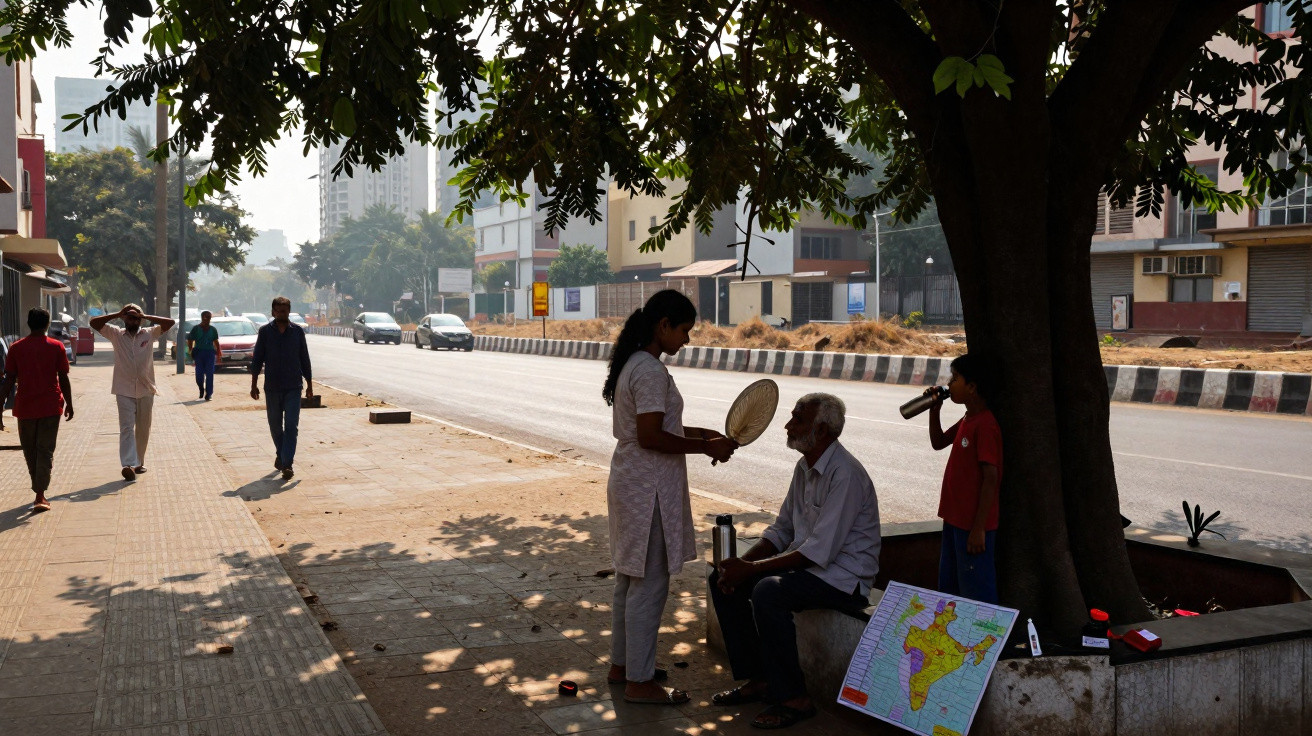
Tree shade is among the most effective defences available to cities facing extreme heat. It is inexpensive, delivers benefits straight away, and makes streets noticeably more tolerable for people who must spend time on them.
However, a new study suggests that broad tree-planting targets - those concerned only with expanding green cover - may overlook an important issue.
In certain circumstances, urban greening schemes could even make humid conditions feel hotter.
Researchers at the Indian Institute of Technology Gandhinagar (IITGN) carried out the research.
Their team analysed 138 Indian cities from 2003 to 2020, covering tropical savanna, semi-arid steppe and humid subtropical climates.
How people experience heat
Most research into urban heat examines land surface temperature: the temperature reached by the ground.
Instead, this study reconstructed the Heat Index, which combines air temperature and humidity to represent the way heat is genuinely felt by the human body.
On a humid day, a temperature of 35°C may feel like 45°C. Land surface temperature by itself cannot reveal this.
Factors shaping the Heat Index
The researchers produced Heat Index maps at one-kilometre resolution for each of the 138 cities.
Using satellite data, they assessed vegetation in three ways: greenness, leaf density and the physiological activity of the canopy.
The team also treated night-time light data as an indicator of urban density. It then used explainable AI techniques to determine which variables raised or lowered the Heat Index, as well as the thresholds at which they became critical.
Trees lower urban temperatures through two processes: shade and evapotranspiration. Shade is simple: the canopy prevents direct sunlight from reaching the ground, keeping both surfaces and people underneath cooler.
Evapotranspiration occurs when trees release moisture into the atmosphere; in dry conditions, that moisture evaporates and takes heat away.
When moisture becomes trapped
Yet the advantages of evapotranspiration depend strongly on the setting. In dry air, the moisture released by trees evaporates readily, producing a powerful cooling effect.
In humid, heavily built-up neighbourhoods, however, that moisture may remain trapped close to the ground instead of dispersing.
The atmosphere remains warm and oppressive. As a result, the Heat Index may rise even while shade brings immediate relief at the surface.
This pattern appeared throughout the dataset. Once greenness and leaf density exceeded particular thresholds, vegetation cover and canopy structure were linked with a lower Heat Index.
By contrast, high canopy physiological activity - trees actively releasing substantial amounts of moisture - was associated with a higher Heat Index in some circumstances, especially in compact, humid urban areas.
“The question is not whether cities should green. They should. The question is what kind of green, where, and how much,” said study lead author Angara Borah from IITGN.
“In dry cities, vegetation can provide strong cooling benefits. In humid and compact neighborhoods, planners also need to think about airflow and moisture build-up.”
Why universal tree-planting targets fail
The study’s wider argument is that viewing green cover as a single figure to be maximised is too crude an approach.
A city that meets its tree-planting target by adding high-moisture canopy to dense, humid neighbourhoods could discover that residents are no cooler - or, in terms of perceived heat, are worse off than they were before.
“Greening is essential for climate adaptation, and shade gives people immediate relief,” said senior author Udit Bhatia.
“Our results show that one-size-fits-all plantation targets miss part of the problem. Cities need greening strategies that are designed for shade, moisture, and ventilation together.”
This requires treating shade trees, parks, roadside planting, open spaces and ventilation corridors as elements of one connected system, rather than separate measures.
Within dense, humid neighbourhoods, specific details become crucial: the species selected, spacing between tree canopies, pruning practices, and street orientation to support air movement.
Each of these factors affects the amount of moisture that gathers and the speed at which it can disperse.
Greening strategies for vulnerable people
The equity implications are substantial and should be made clear.
Those most exposed to hazardous heat in Indian cities - as in cities worldwide - are usually people who live and work in dense, poorly ventilated neighbourhoods, with little access to air conditioning or alternative cooling measures.
These are the very places where poorly designed greening may deliver less relief than expected, or may even increase heat stress.
Designing the right greening strategy for these neighbourhoods is not merely a technical detail.
It determines whether an intervention genuinely benefits the most vulnerable people, rather than simply appearing successful on a policy dashboard while failing to reach them.
A framework for urban greening
The researchers stress that the study operates at a city-scale resolution of one kilometre.
It does not yet offer recommendations for individual streets, species choice or particular planting arrangements.
Providing that degree of precision will require linking city-scale trends to more detailed street-level and plant-level information - a task the team identifies as the logical next stage.
What the research does offer is a framework for considering urban greening that is far more useful than one overall coverage target.
Cities facing a hotter future
As conditions become hotter and more humid, the cities that achieve the most effective cooling will be those that carefully plan their green infrastructure.
Shade, moisture management and airflow must operate together, rather than being pursued as separate remedies.
Those choices also need to reflect the climate and physical form of every individual neighbourhood.
Cities require more trees, but they also require suitable trees in suitable locations, planned as a coordinated system rather than isolated additions.
That is a more difficult goal to define than a percentage of green cover but, for people enduring summer heat in densely populated city neighbourhoods, it is far more significant.
The study was published in the journal Nature Communications.

Comments
No comments yet. Be the first to comment!
Leave a Comment