
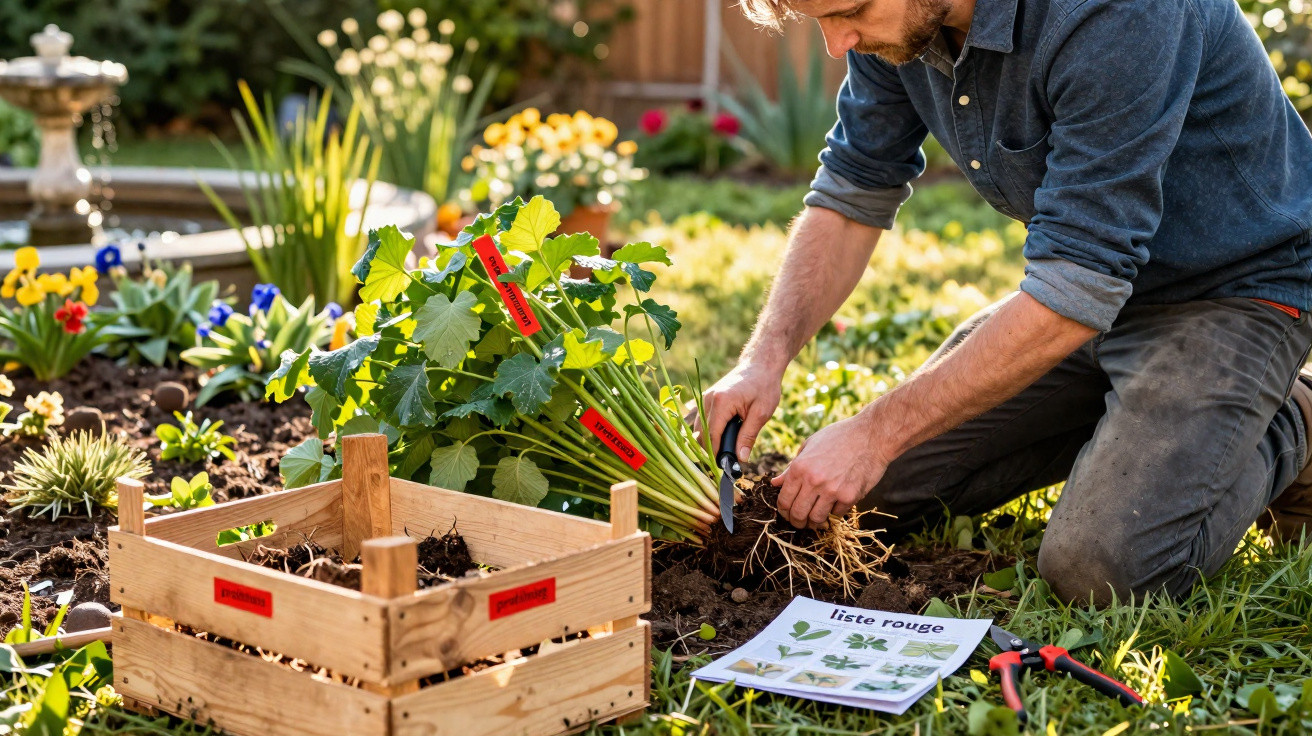
Many of these prohibited species appear harmless at first glance: attractive flowers, an exotic appearance and exceptional hardiness. That is precisely the issue. France is now applying the brakes by placing several popular ornamental and pond plants on its invasive-species red list. Anyone with a garden, or even just a small pond, should be aware of these new requirements – and, when in doubt, take a closer look at exactly what is growing there.
Why France is banning certain plants from gardens
Since 1 January 2026, France has applied tighter EU rules on so-called invasive alien species. The aim is to stop species that spread without control, displace habitats and create health risks.
Many of these plants originally arrived in gardens and parks as ornamentals. They grow rapidly, need little maintenance and look decorative. However, they can easily escape into the wild – through wind-borne seeds, garden cuttings placed in green-waste bins, or garden ponds that overflow into streams.
“What looks attractive in a garden can dominate entire wetlands, woodland edges or riverbanks within a few years – completely smothering native species.”
The bans cover sale, planting, transport and exchange. Retailers must remove them from their ranges, while private individuals may no longer establish or pass on new plants. Prevention is clearly the priority: the most expensive conservation measures are often those taken too late.
Official list: these invasive plants are banned in France
France follows the EU list of invasive plants while adding national priorities. Some species have already been prohibited since 2025, with further additions made in 2026. The following are the key problem plants that no longer belong in private gardens.
| Plant name (English/French) | Scientific name | Typical problem |
|---|---|---|
| Pampas grass / Herbe de la pampa | Cortaderia selloana | Displaces dry grassland and forms dense clumps |
| Common ragweed / Ambroisie à feuilles d’armoise | Ambrosia artemisiifolia | Causes severe pollen allergies and spreads across derelict land |
| Butterfly bush / Buddleia de David | Buddleja davidii | Colonises railway embankments, walls and riverbanks |
| Water primrose (yellow Ludwigia) | Ludwigia peploides, L. grandiflora | Forms mats over water and suffocates aquatic life |
| American pokeweed / Raisin d’Amérique | Phytolacca americana | Has toxic berries and displaces plants at woodland edges and in gardens |
| Tree of heaven / Ailante glanduleux | Ailanthus altissima | Establishes itself extensively in towns and forests |
| Paper mulberry / Mûrier à papier | Broussonetia papyrifera | Alters woodland stands and spreads very readily |
| Himalayan balsam / Balsamine de l’Himalaya | Impatiens glandulifera | Dominates stream banks and displaces native perennials |
| Groundsel tree / Séneçon en arbre | Baccharis halimifolia | Threatens salt marshes and coastal habitats |
| Japanese knotweed / Renouée du Japon | Reynoutria japonica | Damages walls and overruns entire areas |
Several problematic aquatic plants, particularly popular for ponds and aquariums, are also included:
- New Zealand pygmyweed (Crassula helmsii)
- Carolina fanwort (Cabomba caroliniana)
- Water hyacinth / Jacinthe d’eau (Eichhornia crassipes)
- Water lettuce / Laitue d’eau (Pistia stratiotes)
- Parrot’s feather / Myriophylle du Brésil (Myriophyllum aquaticum)
All these species share one characteristic: they can create dense growth in a short time, depriving other organisms of light and nutrients and leaving uniform areas with little space for diversity.
What to do if prohibited species are already growing in the garden
Anyone who already has one of these plants in a flower bed, beside a fence or in a pond is not automatically facing prosecution. French rules distinguish between possession and spread.
“Simply having the plant in a garden is tolerated – but any active or negligent further spread breaches the law.”
In practical terms, this means the following for garden owners in France:
- The plants must not be newly planted or relocated.
- They must not be sold, given away or exchanged – either privately or through classified adverts.
- Cuttings and seeds must not deliberately reach other gardens or the natural environment.
- When cutting plants back, all material must be collected carefully and disposed of with residual waste or at municipal collection points, rather than composted.
Nevertheless, many local authorities and environmental bodies advise removing invasive species over the medium term. Anyone doing so should take a systematic approach. Japanese knotweed, for instance, can regrow from even tiny fragments of root. In many cases, only a combination of digging out, repeated cutting back and long-term monitoring will work.
Recommended garden alternatives to invasive plants
To prevent gardens from becoming dull, specialists recommend native or at least non-problematic species. Decorative but ecologically compatible alternatives include:
- Instead of pampas grass: Chinese silver grass (Miscanthus sinensis) or giant feather grass (Stipa gigantea).
- Instead of butterfly bush: native willows, alder buckthorn or dog rose – all genuine insect magnets.
- Instead of ragweed: purple coneflower (Echinacea), golden marguerite or yarrow.
- For ponds: marsh marigold, water-plantain, cattails in moderate quantities or native water-starwort species.
Switching to these plants not only reduces the risk of fines, but also supports bees, butterflies and other beneficial wildlife – a clear gain for the whole garden.
What penalties could apply?
French legislation takes the issue seriously: anyone who continues to sell, send or deliberately spread invasive species despite the ban may face severe penalties.
- A fine of up to €150,000
- Up to three years’ imprisonment in serious cases
In everyday enforcement, inspections mainly focus on retailers, nurseries and professional landscapers. In the case of private individuals, authorities generally act on reports, for example where major spread is noticed around watercourses or in protected areas. The responsible bodies include the French nature conservation authority and regional environmental directorates.
Why invasive plants can also pose health risks
This is not solely a nature-conservation issue. Some species directly affect people. Common ragweed is regarded as one of Europe’s most aggressive triggers of pollen allergy. Even a small number of plants nearby can greatly increase pollen concentrations.
Other species, such as American pokeweed, produce toxic berries that can look especially tempting to children. Eating them can cause gastrointestinal symptoms and even severe poisoning.
“Invasive plants can alter landscapes, worsen allergies and turn gardens into hidden danger zones at the same time.”
Health prevention is therefore also important to many French municipalities. Less ragweed ultimately means fewer allergy medicines, fewer doctor’s appointments and fewer absences from schools and workplaces.
What Germany, Austria and Switzerland can learn from this
The French rules have consequences beyond the country’s borders. The species concerned do not recognise national boundaries: their seeds travel through the air, are moved with soil or spread along rivers. People living in German-speaking regions near the French border often experience these dynamics directly.
Several plants banned in France are also monitored or already regulated in Germany, Austria and Switzerland, including ragweed, Himalayan balsam and Japanese knotweed. Gardens are considered a key hub for the spread of these species in all three countries.
For amateur gardeners, the implication is straightforward: when next buying from a nursery, it is worth asking critical questions. Where did the plant originate? Is it considered problematic in a neighbouring country? Are alternatives recommended?
Practical scenario: how one garden pond can become a serious problem
A typical example illustrates how quickly the situation can escalate. A family in eastern France creates an ornamental pond and adds water hyacinths and water lettuce because they were inexpensive to buy and attractively cover the water surface. Heavy rain washes parts of the pond into a neighbouring stream. Within a few years, the floating plants cover several hundred metres of the watercourse.
Fish can find hardly any oxygen, anglers complain, and water levels fall locally because evaporation and the plants’ water uptake increase sharply. Eventually, the local authority has to clear the site using heavy machinery, with costs running into tens of thousands. France’s new rules are intended to prevent exactly these scenarios.
Terms that are often misunderstood
Discussions about these bans regularly involve terms that are often confused:
- Neophytes: plants introduced after 1492, the date of Europe’s discovery of America, without necessarily being harmful.
- Invasive: only a small proportion of neophytes. Invasive species reproduce extensively, alter habitats or damage health and the economy.
- Alien species: species originating from another continent or biogeographical region.
An exotic plant in a garden is therefore not automatically a problem. It only becomes a concern for authorities when it spreads aggressively in the wild.
How several invasive species can reinforce one another
Cumulative effects are a frequently underestimated danger. When Himalayan balsam and Japanese knotweed occur together on a riverbank, they reinforce each other. The balsam quickly colonises open patches, while the knotweed pushes its rhizomes into the gaps. Together, they displace a wide range of native plants.
Such combinations change not only vegetation, but also bank stability, water flow and habitats for insects, birds and small mammals. Taking action early in a private garden removes an important piece from this domino effect.
For France, the prohibited-species list sets a clear direction: future garden design should work with nature rather than against it. The home garden therefore becomes more than a private pleasure; it is a small but effective component of modern environmental policy.

Comments
No comments yet. Be the first to comment!
Leave a Comment