
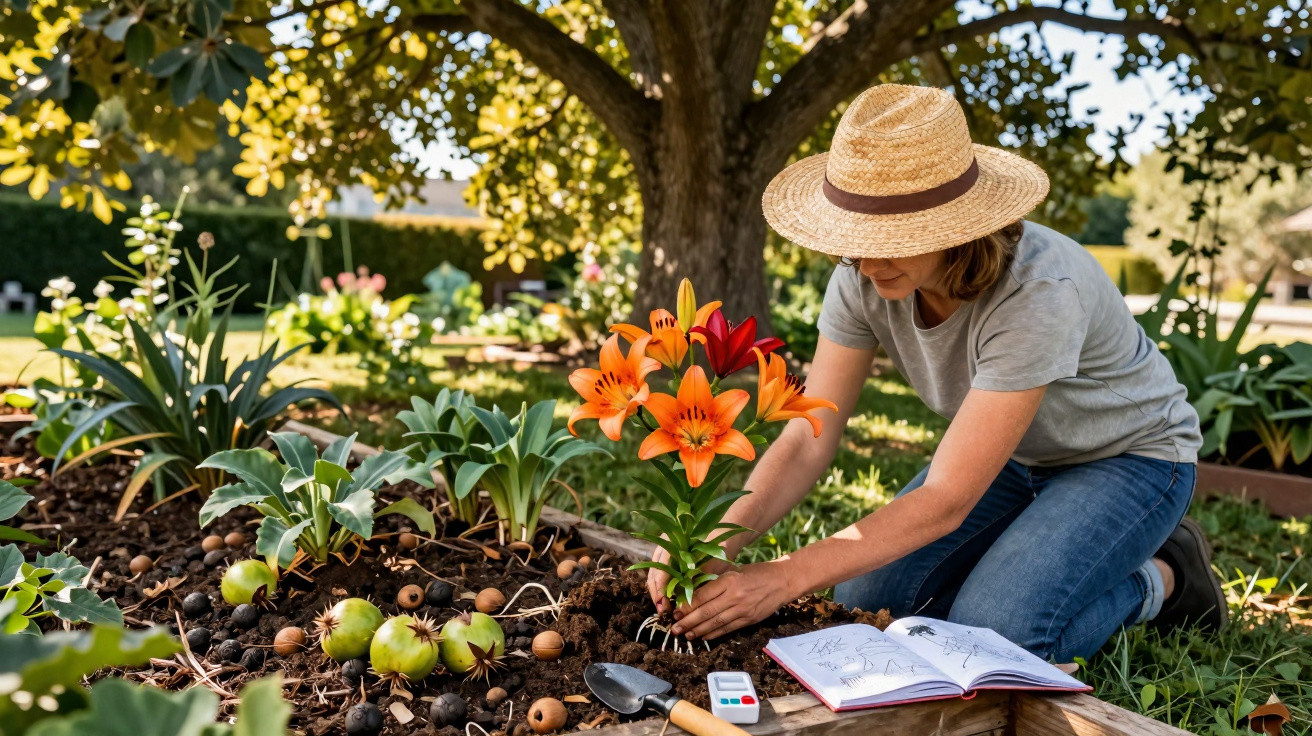
Many amateur gardeners avoid black walnut and walnut trees because the toxin they release into the soil can ruin entire beds. Anyone who loves colourful perennials is often left wondering what can still be planted safely beneath them. One question comes up particularly often: can Asiatic lilies survive permanently in juglone-contaminated soil, or will they quietly die off?
The walnut toxin juglone explained
Black walnut trees release juglone into their surroundings through their roots, leaves and husks. The compound acts rather like a chemical weapon against competing plants. It accumulates in the soil chiefly around the tree’s root zone, usually up to 15 to 18 metres from the trunk, with the greatest concentration directly beneath the canopy.
When a sensitive plant absorbs juglone through its roots, it commonly develops the following symptoms:
- initial wilting despite adequate watering
- leaves turning yellow and later brown
- growth coming to a halt
- finally, death within a few days or weeks
The strength of juglone’s effect is influenced by several conditions: the season, soil moisture, soil type, pH level and the activity of soil microorganisms. Levels in the soil are highest during the tree’s growing season, when it is producing abundant new roots and leaves. Fallen leaves and green husks also continue to release juglone as they decompose, often for months afterwards.
| Plant tolerance level | Typical signs | Likelihood of survival |
|---|---|---|
| Highly tolerant | no visible damage | 95–100 % |
| Moderately tolerant | slight yellowing, weaker growth | 60–80 % |
| Sensitive | severe wilting, leaf drop | 10–30 % |
| Highly sensitive | rapid complete failure | 0–5 % |
“Juglone can make even hardy garden plants wilt – but not every species reacts in the same way. This is exactly where Asiatic lilies come in.”
How Asiatic lilies respond to juglone
There is good news for lily enthusiasts: Asiatic lilies are regarded as notably tolerant of juglone. Many long-term garden observations and practical reports show that they grow and flower reliably within the root zone of black walnut trees.
These lilies are cultivated forms derived from several Asian wild species. Their root systems apparently cope better with juglone than those of many other ornamental plants. In gardens where sensitive perennials repeatedly fail beneath walnut trees, Asiatic lilies often remain healthy, produce buds and form long-lasting clumps.
Specialists generally suggest two main explanations for this tolerance:
- Certain enzymes within the plant cells may break juglone down into harmless substances.
- The cell membranes in the roots may allow only limited quantities of juglone to enter.
Both mechanisms are likely to work together. In practical terms, this clearly places Asiatic lilies among the juglone-tolerant species.
“Gardeners report time and again that, beneath walnut trees where other perennials wither miserably, Asiatic lilies flower in full colour year after year.”
Planting Asiatic lilies within the walnut tree’s influence
Although these lilies tolerate juglone well, they still require suitable growing conditions. Following a few basic rules can significantly improve the chances of success.
Choosing the best position
Space between walnut roots is highly contested. Asiatic lilies prefer:
- at least several hours of sunshine, ideally in the morning or before midday
- loose, well-drained soil with no waterlogging
- a position away from intense root competition immediately beside the trunk
A sensible compromise is to plant around the edge of the canopy drip line, where some summer light still reaches the ground and the soil is not completely filled with roots.
Planting and aftercare
The following measures help Asiatic lilies establish beneath juglone-contaminated trees:
- Plant bulbs 15 to 20 centimetres deep, depending on their size.
- Work compost into the soil to improve its structure and nutrient supply.
- Ensure effective drainage, for example by incorporating sandy material.
- Cover with organic mulch, but do not use fresh walnut leaves or husks.
- Water regularly during the first year so that the bulbs can root in well.
Fresh walnut leaves and green husks should not be added to the beds. As they rot, they release particularly high levels of juglone and unnecessarily increase contamination in the root zone.
Plants that work well with Asiatic lilies beneath walnut trees
Anyone designing a bed beneath a black walnut needs several juglone-tolerant companions rather than relying on a single species. Asiatic lilies can be combined in visually appealing and ecologically useful ways.
Suitable bulb and tuber companions
Several other bulbous plants are also considered juglone-tolerant and can extend flowering interest across the season:
- Daffodils: emerge very early in the year, before the walnut tree is fully in leaf
- Ornamental alliums (Allium): add structure and spherical flowers in late spring
- Asiatic lilies: provide strong colour in high summer
This creates a fairly continuous display of flowers, even in a location regarded as difficult.
Asiatic lilies and pollinators
Many gardeners wonder how appealing these lilies are to insects. Their intensely bright blooms do attract bees, bumblebees and some butterflies, although not as strongly as traditional wildflower perennials. Beneath a walnut tree, every dependable source of flowers is valuable to pollinators because many more sensitive species simply fail there.
“Where juglone restricts biodiversity, Asiatic lilies become one of the few dependable nectar stops in the shade of trees.”
A strategy for a stable walnut bed
When planning an entire garden area around a black walnut, it is best to think in terms of plant communities. Fruit trees, herbs and perennials can generally be combined, but juglone changes which plants are suitable. Experience from other forms of mixed planting can be useful here: plants that are naturally resilient in competitive conditions often cope better beneath walnut trees too.
A gradual approach is worthwhile in practice. Begin with proven juglone-tolerant plants such as Asiatic lilies in places where they perform well. Then test further candidates step by step. Trying one or two new species each year will gradually build a personal, site-specific list of “safe candidates”.
Why juglone does not act the same everywhere
An important consideration when planning a garden is that two walnut trees can have completely different effects on their surroundings. Juglone breaks down more quickly in sandy, well-aerated soils, whereas it remains active for longer in heavy, damp ground. A vigorous, fast-growing tree also releases more of the compound than an old, ailing one.
Anyone starting to grow Asiatic lilies beneath walnut trees should observe them closely during their first few years. If they show only minor differences in growth compared with lilies elsewhere in the garden, that is a clear indication that the site is suitable in the long term.
Practical risks and opportunities for amateur gardeners
The experiment of growing “lilies beneath walnut trees” is not entirely risk-free. Strong root competition, extreme dryness or permanently heavy soil can weaken plants despite their tolerance of juglone. Additional stresses may then be enough to hold the lilies back.
On the other hand, their proven tolerance offers an exciting opportunity: areas that many people see as “dead space” beneath a tree can be turned into flowering beds with manageable effort. By taking a structured approach - improving the soil, planting bulbs correctly and avoiding walnut leaves as mulch - a problem area can become one of the garden’s most interesting features.





Comments
No comments yet. Be the first to comment!
Leave a Comment