
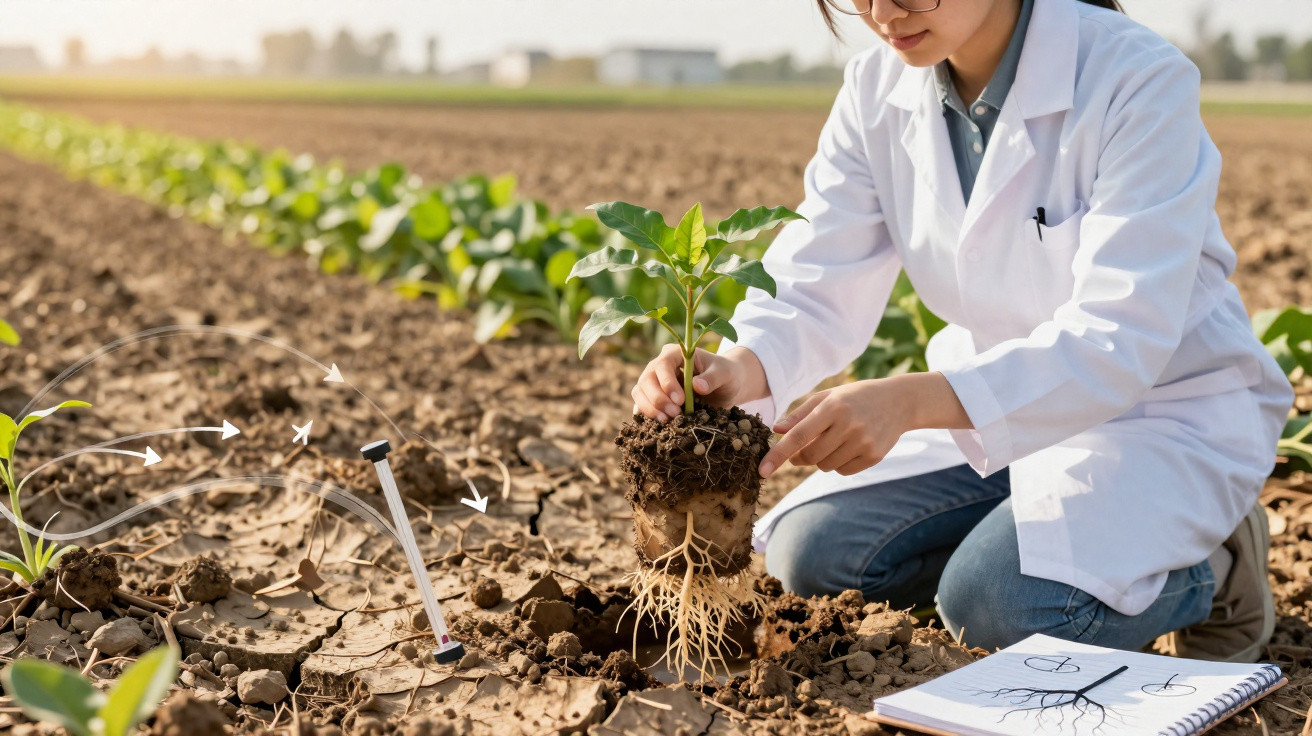
Plants may look peaceful and motionless, yet water is continually moving within them. It passes out of the soil, through the roots and stems, before arriving at leaves above the ground.
This process also occurs in tall trees, with water travelling many metres upwards against gravity. It is driven by negative water potential, a pulling force that sustains the upward movement of water.
Plants cannot continue drawing water indefinitely, however. As the soil becomes dry, the movement first slows and eventually ceases.
Scientists have spent years investigating what sets this boundary. Does the plant itself stop functioning, or is another factor responsible?
The hidden challenge of dry soil
Soil water is not freely available. It adheres within minute gaps between soil particles, called pores. Functioning like very narrow tubes, these pores retain water through capillary forces.
“When soil dries, capillary and viscous forces in the pores increase – and plants find it harder to draw water from the soil,” said Andrea Carminati, professor of soil physics at ETH Zurich.
Measurements have identified a distinct tipping point. When soil water potential falls below -1.5 megapascals, plants are unable to remove water quickly enough to satisfy their requirements. At that stage, the supply route can no longer meet demand.
Stomata: tiny valves with major consequences
In their leaves, plants regulate water loss using minute pores known as stomata, which work as adjustable valves.
When they are open, carbon dioxide can enter while water vapour escapes. That exchange is vital to photosynthesis.
“Stomata are super sensitive,” said Tim Brodribb, professor of plant physiology at the University of Tasmania.
Shutting these valves allows plants to retain water, particularly in dry conditions. However, there is a trade-off: reduced carbon dioxide intake means the leaf makes less sugar and plant growth slows.
Managing the trade-off between lost water and gained carbon is therefore an everyday challenge.
“Ultimately, the behavior of these tiny valves determines how much carbon from the atmosphere enters the land plant biomass,” said Brodribb.
The true limit lies beyond the plant
The research overturns a widely held assumption. Previously, many researchers thought plants themselves determined the maximum amount of water they could absorb, and agricultural work was guided by that view.
Plant breeders sought to develop crops capable of holding more dissolved substances in their cells. Their aim was to increase crops’ capacity to pull water from dry soil. Although this work involved substantial investment, it did not deliver the expected results.
“Our results explain this failure: the limiting factor lies not in the plants but in the soil,” said Brodribb.
This result reshapes scientific thinking on drought resistance. Enhancing plant characteristics alone may be insufficient where the soil prevents plants from reaching available water.
Examining the plant water system more closely
Plants already possess robust internal mechanisms for coping with tension. Water travels through fine tubes in trunks and stems, whose reinforced cell walls stop them from buckling under pressure.
“This enables them to withstand the tension in the vascular system and not collapse,” said Brodribb.
Within leaf cells, dissolved substances generate osmotic pressure, helping the cells retain their structure even when under stress.
Together, these characteristics indicate that plants are well prepared to control water internally. Instead, the main restriction seems to be external: the soil.
Bringing soil physics and plant science together
The study unites two disciplines that commonly work independently. Soil physics describes water’s behaviour below ground, whereas plant physiology examines plant responses.
“The soil physicist community has made great progress in determining the best time to irrigate,” said Carminati.
Combining these viewpoints enabled the researchers to link processes in the ground to events in the leaves.
“The physics of capillarity not only predicts the extent to which soil pores empty but also what occurs high up in the leaves,” said Carminati.
Working together also altered each researcher’s route into the question: one worked upwards from the soil, while the other worked downwards from the leaves.
“Our analysis using model calculations of water potential is a very fundamental step in understanding how plants function,” said Brodribb.
Implications for the future
Knowing why plants cease taking up water is important for agriculture, forestry and climate science. With drought becoming more frequent, identifying the real constraint can support better decisions.
It indicates that managing soil conditions could be as significant as improving plant traits. Soil structure, water retention and irrigation scheduling may have a greater influence than previously anticipated.
When plants stop drinking, they are not failing; they are reacting to a physical obstacle in the soil. This subtle change in perspective redirects where scientists seek answers.
The complete study appeared in the journal Science.





Comments
No comments yet. Be the first to comment!
Leave a Comment