
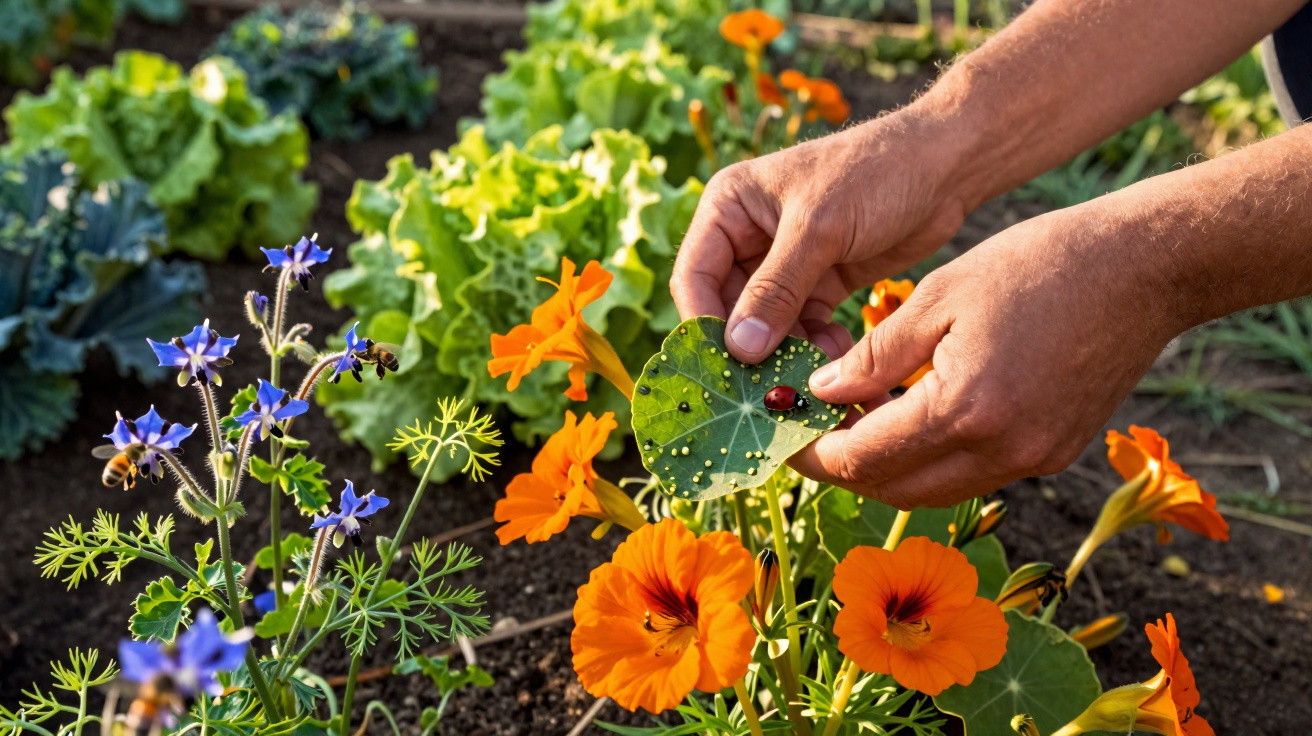
Most amateur gardeners only notice an infestation once lettuces, beans or roses are already sticky and looking unwell. At that point, it is tempting to reach for chemical pesticides straight away. Yet a handful of carefully sown plants can turn the situation around – all in a single weekend.
Aphids are active now – and multiply rapidly
Aphids may appear harmless, but they are exceptionally fast breeders in a vegetable patch. Over its brief lifetime, one female produces 40 to 100 offspring, often without mating. Within only a few days, these young aphids can reproduce themselves. Numbers can therefore build up very quickly.
The effects are immediately visible on plants: young leaves curl and turn yellow, shoots remain stunted, and the entire plant loses vigour. The sticky honeydew excreted by aphids coats leaves and stems like a film. Sooty moulds then settle on this residue, slowing photosynthesis. Aphids can also transfer viruses from one plant to another.
“Those who break the cycle early save themselves from battling whole aphid armies in summer, while also protecting beneficial insects, children and soil life.”
In spring and early summer especially, aphids find an abundant food supply: fresh, soft growth and over-fertilised plants with particularly sugary, nitrogen-rich sap. This is precisely the time when a small adjustment to the planting plan pays off.
The strategy: a living shield instead of chemical sprays
The principle is straightforward and effective: rather than growing vegetables as isolated plants, combine species that support one another. The aim is to create a bed that is inhospitable to pests but highly appealing to beneficial insects.
This requires three types of plant:
- Trap plants, which attract aphids like a magnet
- Beneficial-insect magnets, which bring in ladybirds, hoverflies and lacewings
- Structural plants, providing flowers, nectar and shelter over a longer period
Nasturtiums, dill and borage can provide this exact trio when sown over one weekend. Three packets of seed are enough to make a noticeable difference as the season progresses.
Nasturtiums: the willing sacrificial plant in the vegetable bed
Nasturtiums are among the most useful companion plants for beds. They need little care, grow quickly and are particularly attractive to many aphid species – far more so than many vegetables.
How to sow nasturtiums correctly
- Sow directly outdoors from around mid-April, once the soil has warmed up.
- Sow 2–3 cm deep, leaving roughly 30 cm between each seed.
- Germination takes around 10–14 days; keep the soil evenly moist.
- Choose a sunny or partially shaded site that is not overly fertile.
A position along the edge of the vegetable garden, or directly among vulnerable crops such as cabbage, broad beans, tomatoes or roses, is ideal. Aphids preferentially gather on the tender shoots and flower stems of nasturtiums.
“Important: do not remove nasturtiums as soon as they are covered in aphids – that is exactly when they are performing their role as buffer plants.”
If individual shoots become extremely crowded, cut them off selectively and dispose of them with household waste, or submerge them in water. This reduces pressure in the bed without sacrificing the whole plant.
Dill: a buffet for ladybirds and hoverflies
Dill performs the opposite role within this protective system: it does not draw in aphids, but their predators. Its delicate yellow flower umbels act as a refuelling station for ladybirds, hoverflies and lacewings, supplying nectar and pollen while their larvae later hunt aphids.
Sowing dill successfully
- Sow in rows spaced 20–30 cm apart, or scatter the seed broadly.
- Sow only 1–2 mm deep, so the seeds are barely covered with soil.
- Germination takes 7–14 days if the soil is kept evenly moist.
- Thin seedlings later to 15–20 cm apart, allowing the plants to grow sturdily.
In a sunny bed, dill generally reaches 60–90 cm tall. This makes it well suited to growing behind lower crops or as an airy backdrop among carrots, onions and lettuces. Sowing short rows every two to three weeks ensures flowers and beneficial-insect visitors over a long period.
Borage: a bee magnet and landing place for helpful insects
Borage completes the three-plant combination. It offers plentiful nectar for bees and bumblebees, brightens the bed with blue star-shaped flowers and also serves as a structural plant in which beneficial insects can shelter.
How to use borage effectively against aphids
- Sow directly into the bed after the last frosts.
- Sow about 1 cm deep, leaving 30–40 cm between plants.
- Germination takes 8–12 days.
- Provide a sunny position with humus-rich soil that does not dry out too much.
Borage works well among strawberries, tomatoes, courgettes or cabbage. Its flowers attract pollinators and, indirectly, further beneficial insects that together help to stabilise the ecological balance in the bed.
Arranging the bed: a living protective belt
Each of the three plants is useful when planted separately, but they become particularly powerful in combination. One practical method is to establish small “beneficial-insect islands” throughout the garden.
“A mini-bed of nasturtiums, dill and borage every 4–5 metres – and the whole vegetable garden benefits.”
One possible layout is:
- Place one or two dill plants in the centre of the bed as an “observation platform” for beneficial insects.
- Plant one borage beside them, using its flowers to attract additional bees and bumblebees.
- Set two or three nasturtiums around the edge as aphid trap plants.
This three-part combination can be repeated in several locations, for example at the ends of vegetable beds, at the corners of a tomato greenhouse or beside rows of cabbage. Gradually, it forms a network of small biodiversity centres.
Tips for preventing fewer aphids from the outset
Alongside these three plants, a slightly different approach to garden care can help:
- Fertilise moderately: Fertilisers high in nitrogen encourage soft, juicy foliage – a feast for aphids.
- Monitor watering: Widely fluctuating moisture levels stress plants and leave them more susceptible.
- Choose variety over monoculture: A wide mix of crops makes it harder for pests to establish themselves in large numbers.
- Leave foliage and corners undisturbed: A few wilder areas provide winter shelter and hiding places for ladybirds and other beneficial insects.
How beneficial insects really work – a look behind the scenes
Many people underestimate just how effective aphids’ natural enemies can be. During its development, a single ladybird larva eats several hundred aphids. The inconspicuous larvae of hoverflies also clear entire colonies. Lacewing larvae are known as “aphid lions” – they seize prey with strong jaws and suck it dry.
For these helpers to be present at the right time, they need flowers, water and shelter throughout the season. This is where dill and borage play their part. Nasturtiums provide the “bait”, drawing aphids away from vegetable rows while also giving beneficial insects a richly stocked hunting ground.
What to do if there is a severe infestation despite protective plants
Even so, a serious infestation can still occur. In that case, it is possible to intervene gently without destroying the overall balance. A strong spray of water will wash many aphids off the plant. For sensitive crops, use a homemade soft-soap solution sparingly and only in affected areas, so beneficial insects are not harmed unnecessarily.
Adding one or two more perennials, such as calendula or fennel, further strengthens the effect of the three main plants. The result is a garden that responds much more robustly to pests – not perfectly sterile, but resilient.
“The aim is not a garden entirely free of aphids, but a living system in which damage remains limited and plants can still grow strongly.”
Anyone who invests a little time this weekend in seeds, a watering can and a thoughtful layout will lay the foundations for a summer in which pesticide sprays are needed far less often – while the vegetable garden becomes more colourful, more alive with buzzing insects and more resilient.

Comments
No comments yet. Be the first to comment!
Leave a Comment