
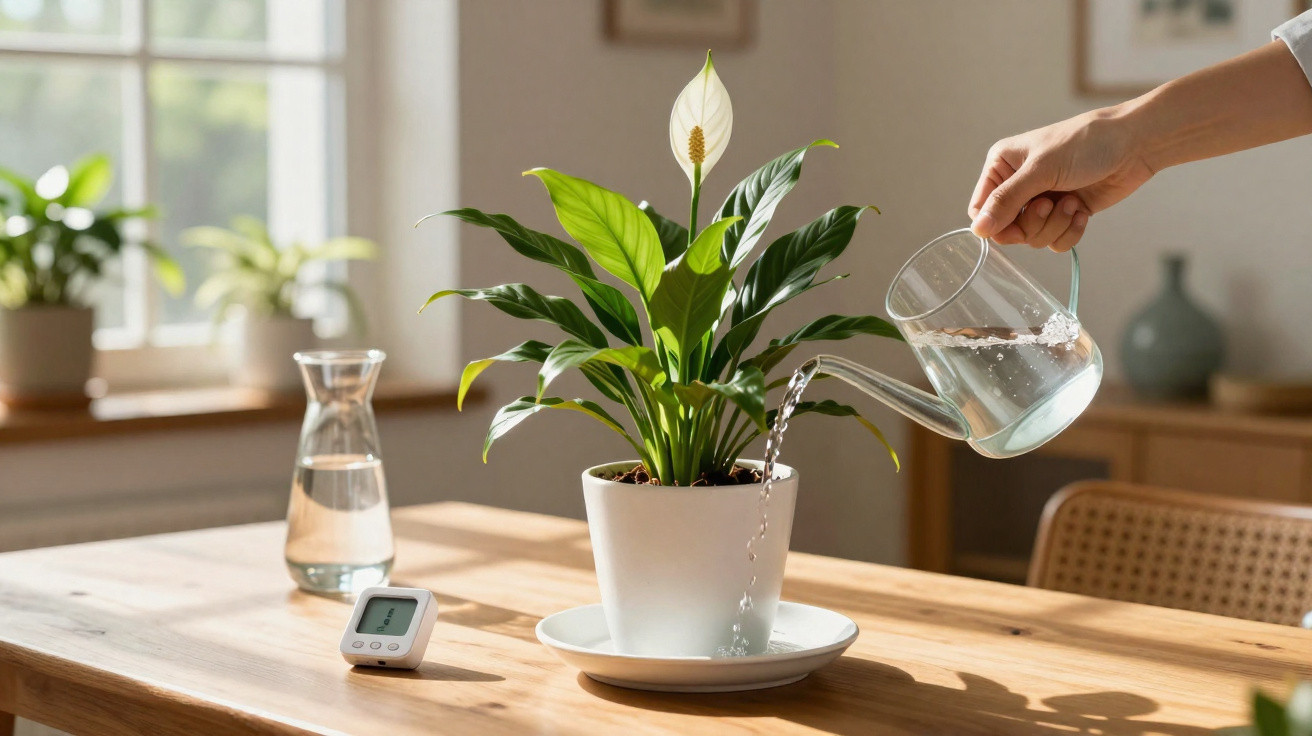
A simple watering trick can change that.
Anyone who owns a peace lily (Spathiphyllum) will recognise the situation: the plant looks healthy and its leaves are deep green, yet the familiar white bracts fail to appear. Often, neither fertiliser nor its position is to blame, but an overlooked habit: watering incorrectly. Professional gardeners have relied on a particularly easy technique for years, and it can encourage noticeably more flowers within just a few weeks.
Why peace lilies are so sensitive to water
Native to tropical forests, the peace lily grows beneath the cover of taller plants. Its root area is kept consistently slightly moist there, but never waterlogged. This precise balance is often missing on indoor windowsills.
Rather than following a fixed watering timetable, this plant needs a flexible approach. Humidity and temperatures indoors are always changing. In a warm, dry top-floor flat, the compost dries out far more quickly than it does in a cool hallway in an older building. Watering every Saturday, therefore, rarely gets it right.
The key check is remarkably straightforward: the finger test.
- Push a finger roughly two to three centimetres into the compost.
- If the compost feels slightly damp and clings together without being soaking wet: water moderately.
- If the top one to two centimetres are dry but the compost beneath is still damp: wait a little longer.
- If it is dry and crumbly throughout: the plant needs water.
Peace lilies cope surprisingly well with brief dry spells. When thirsty, their leaves start to droop slightly, giving a clear warning before irreversible damage occurs.
Consistently slightly moist, but never waterlogged, compost is the basis for strong roots and reliable flowering.
The professional trick: watering a peace lily from below rather than above
The real difference-maker for flowering is how water reaches the roots. Instead of watering from above and repeatedly flooding the growing medium, experienced houseplant gardeners use what is known as bottom watering.
How bottom watering works
- Fill a bucket, bowl or sink with water that is lukewarm rather than ice-cold.
- Place the peace lily pot in it, keeping the top rim of the pot dry.
- Leave it for 10 to 15 minutes, allowing the root ball to draw up water through the drainage holes.
- Remove the pot from the water and let it drain thoroughly.
- Tip away any excess water from the decorative pot or saucer.
With this technique, the plant effectively “decides” how much water it absorbs. It lowers the risk of drowning the roots, which is a common cause of brown leaf tips, yellow leaves and a lack of flowers.
Watering from below supports healthy root growth – and only a strong root zone can supply enough energy for new flowers.
Many amateur gardeners find that watering from below once or twice a week is already enough to turn a plant that produces only foliage into one that flowers much more readily.
The right water quality makes a difference
Water quality matters at least as much as quantity. Peace lilies are sensitive to heavily limescale-rich tap water. Common signs include:
- brown tips on the leaves
- older leaves turning yellowish
- stunted flowers or no flowers at all
The best options are:
- rainwater
- filtered water
- tap water left to stand for at least 24 hours, allowing chlorine to evaporate
Anyone living in an area with very hard water will do their peace lily a great favour by replacing at least every other watering with softer water.
How care changes with the seasons
Peace lilies are happiest at temperatures of around 18 to 29 degrees. Within this range, they use relatively large amounts of water, particularly in bright but indirect light. Direct sunshine scorches the leaves, while insufficient light restricts flower production.
Spring and summer: the growing and flowering period
During the brighter months, the plant grows quickly and, in favourable conditions, repeatedly develops new white bracts. A slightly more attentive routine pays off at this time:
- carry out the finger test regularly, often every two to three days
- water from below once or twice a week, depending on the indoor climate
- mist the leaves occasionally with soft water to raise humidity
Slightly drooping leaves are an early warning of insufficient water. A thorough soak from below will usually restore them within a few hours.
Autumn and winter: a resting period with less thirst
As the days become darker, the plant’s metabolism slows. In cooler rooms, the compost stays damp considerably longer. Continuing to water as often as in summer can quickly lead to waterlogging.
Typical signs of overwatering are:
- yellowish, mushy leaves
- brown edges despite damp compost
- a musty smell coming from the pot
At this stage, watering only every seven to ten days is often sufficient – always guided by the finger test, never by the calendar. This allows the plant to build up energy before growing vigorously again in spring.
From a mass of green leaves to a flowering powerhouse
Anyone who has watered their peace lily only occasionally from above for years will need some patience. Before it can produce flowers consistently, the plant must first develop a healthy root system. Switching to bottom watering, alongside softer water and an adjusted routine, gradually changes its growth.
Consistent, gentle care directs energy away from foliage alone and towards a compact plant that flowers readily.
After several weeks, denser and more robust foliage is often the first visible change. New flower stems follow, appearing stronger and lasting longer. If the plant receives enough light, it can keep producing new flowers for many months, rather than only briefly in spring.
Common care mistakes and how to avoid them
Reviewing the most frequent pitfalls can help you assess your own routine.
| Problem | Likely cause | Solution |
|---|---|---|
| Leaves only, no flowers | too little light, irregular watering, water that is too hard | choose a brighter position, water from below, use softer water |
| Drooping leaves | acute lack of water | place the pot in water for 10–15 minutes, then allow it to drain |
| Brown tips | too much limescale or fertiliser, dry heated air | use softer water, fertilise less, increase humidity |
| Yellow leaves, soggy compost | constantly wet root ball, waterlogging | water less often, check drainage, remove excess water |
Why a watering routine achieves more than any specialist fertiliser
When a peace lily does not form white bracts, many people reach too quickly for flowering fertilisers. Without suitable watering habits, however, their effect often comes to nothing. The plant responds first to its water balance, light and temperature – and only then to nutrients.
A modest application of liquid houseplant fertiliser in spring and summer is usually entirely sufficient, provided the roots are not permanently sitting in wet compost. The professional advice is therefore: change the watering routine first, then consider fertilising later.
Plants kept in particularly dry homes benefit especially strongly, such as new-build properties with underfloor heating. Here, the combination of watering from below, softer water and occasional leaf misting is worthwhile. Together, these steps recreate an environment that comes at least closer to the tropical forest understorey.
Those who follow this approach consistently often see the peace lily in an entirely new light: no longer simply hardy greenery in the background, but a dependable flowering plant that shapes the room with elegant white bracts – without complicated care schedules, only a well-considered watering ritual.


Comments
No comments yet. Be the first to comment!
Leave a Comment