
Leaf edges drying out, scarcely any new shoots, and despite diligent watering, the Japanese maple looks tired. Anyone with such an ornamental feature in the garden or in a container will know this disappointment. Yet the answer is not expensive specialist compost or fertiliser, but one straightforward measure for the soil around the trunk – carried out just as spring begins.
Why March is the key month for Japanese maples
Japanese maples (Acer palmatum) originally come from open woodland, where the ground is never bare. There, they grow in a deep layer of fallen leaves, fine bark and humus. In many German gardens, however, the tree is planted in full sun, surrounded by lawn or in sparse soil. The consequences are felt immediately by its roots.
These ornamental trees have very shallow roots, often sitting just a few centimetres below the surface. They are particularly sensitive to:
- late spring night frosts
- sudden heat and intense sunshine
- alternating wet and dry conditions
- compaction caused by foot traffic or heavy soil
The result is stressed roots, little new growth, a thin canopy, and leaves that turn brown at the edges or appear exhausted as early as summer.
Protecting the root area of a Japanese maple in March lays the foundation for healthier growth and denser foliage.
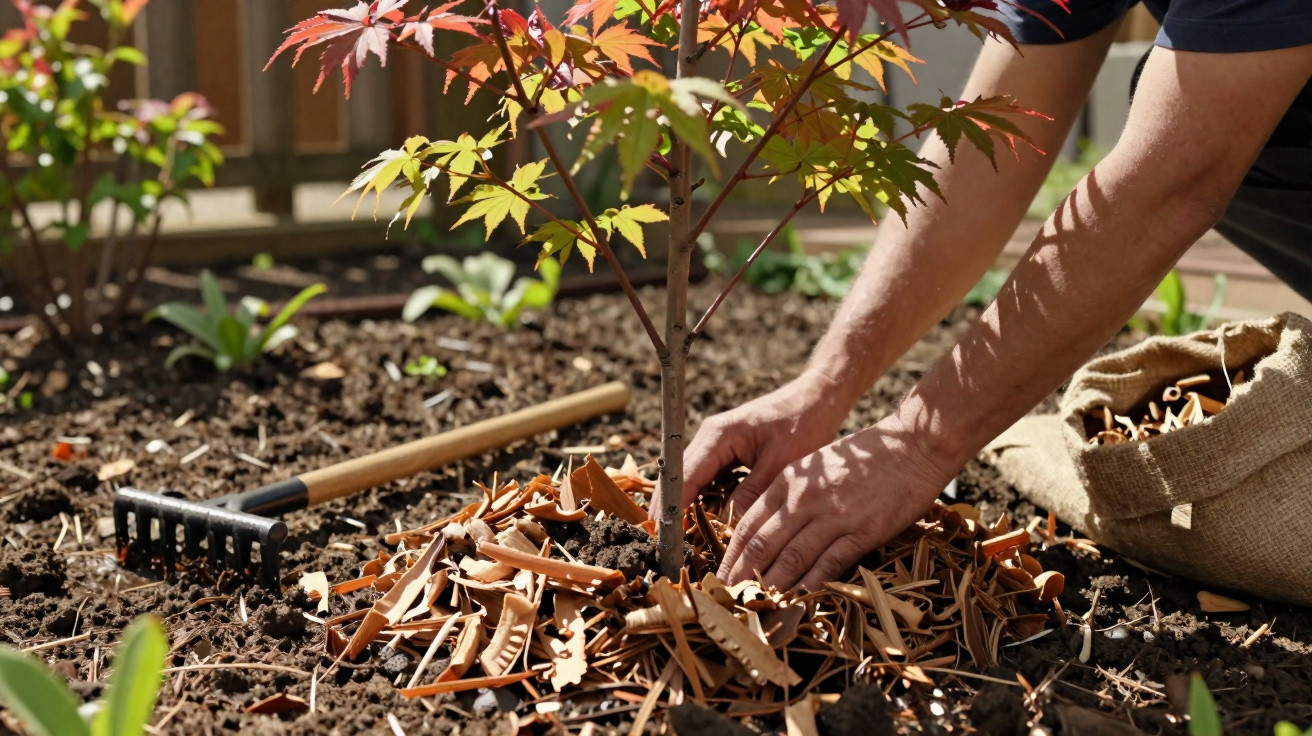
The effective solution is unremarkable: apply a purposeful layer of organic covering – mulch – around the base of the tree. It recreates the natural woodland floor and shields the roots from extreme fluctuations.
Mulching in March: a simple care plan for healthy roots
Step 1: Clear and loosen the soil
Start preparation as soon as the ground has thawed in March and is no longer soaking wet:
- Carefully pull out weeds by hand within the area covered by the canopy.
- Loosen the soil only very lightly – to a maximum depth of 2 to 3 centimetres – using a hand cultivator or a wooden stick.
- Never use a spade, as this could damage the fine roots.
Even this gentle roughening improves air exchange around the roots and helps water soak in more effectively afterwards.
Step 2: Choose suitable mulch
Japanese maples favour mildly acidic, humus-rich conditions similar to those found in deciduous woodland. Suitable materials include:
- composted pine bark
- well-rotted, dry leaf mould, such as beech or oak leaf mould
- mature garden compost applied in a thin layer
- finely shredded, seasoned woody material (woodchip)
Experts generally advise against using the following in the root area of maples:
- dark stones or grit in full sun, as these heat the soil excessively
- heaps of fresh grass cuttings, which rot easily and attract slugs
- plastic sheeting or fleece that seals the soil surface airtight
Step 3: Apply the mulch correctly
Once you have selected the material, it is time for the crucial step:
- Use the area beneath the canopy as a guide, as this is roughly how far the fine roots extend.
- Spread an even layer around 5 to 8 centimetres deep.
- Leave a clear ring of around 10 centimetres around the trunk.
Important: the base of the trunk must not disappear beneath the material. The slightly swollen base, known as the root flare, needs to remain visible. If mulch is piled over it, it stays permanently damp, creating ideal conditions for fungal disease and rot.
Perfect mulch lies loosely like a carpet on a woodland floor – never as a piled-up mound directly against the trunk.
What a mulch layer does for water, nutrients and climate
One task in March can significantly alter the microclimate around the tree. The layer acts both as a protective cover and a buffer:
- It keeps the soil moist for longer without encouraging waterlogging.
- It moderates sharp temperature peaks on hot days.
- It stops sunlight from drying out the uppermost roots.
- It suppresses weeds that would otherwise compete with the maple for water and nutrients.
Over time, the organic layer breaks down. Microorganisms convert it into humus, which supplies nutrients to the roots. The soil becomes looser, more crumbly and more alive – much like the ground in a natural deciduous forest.
Watering correctly: helping mulched Japanese maples benefit fully
Mulch does not replace watering; it makes watering more efficient. During normal spring and summer weeks, many tree nurseries recommend the following for established Japanese maples planted in the ground:
- water thoroughly around twice a week
- water less frequently but generously, rather than giving constant small amounts
During prolonged dry spells, watering may need to increase to three or four times a week, depending on the location, soil type and weather. Mulch then ensures that more of the water reaches the roots instead of evaporating from the surface.
Anyone who mulches the soil beneath a maple does not necessarily need more water – but uses the available water far more effectively.
Special case: containers – mulch yes, waterlogging no
Japanese maples in pots respond even more sensitively to changing conditions. A thinner layer is enough here:
- A mulch layer of 3 to 5 centimetres is entirely sufficient in a container.
- Remove excess water from the saucer after every watering.
- Never allow the pot to stand in water permanently.
Towards late summer, you can gradually reduce the amount of water slightly, without allowing the rootball to dry out completely. This supports leaf colouring and helps the tree prepare for its dormant period.
Common Japanese maple problems – and how mulch helps
Many issues garden owners notice in their Japanese maples are directly or indirectly linked to the root zone. Here are several common examples:
| Problem | Cause in the root area | How mulch counteracts it |
|---|---|---|
| Brown leaf edges in summer | Heat stress, drought, shallow roots overheating | Cools the soil and retains moisture for longer |
| Hardly any new shoots | Ongoing stress, nutrient deficiency, compacted soil | Encourages humus formation and improves soil structure |
| Leaves are small and sparse | Weak root system, uneven water supply | Stabilises moisture levels and reduces fluctuations |
| Fungal growth at the trunk base | Mulch or soil directly against the trunk, permanent dampness | A clear ring around the trunk prevents rot |
More than appearance: why the “woodland floor trick” works long term
Renewing the mulch around your maple every year in early spring gradually builds a stable soil structure. Earthworms and other soil organisms process the material and slowly draw it into deeper layers. This allows the tree to root into an area with better aeration and more even water retention.
It also creates more scope for garden design. Beneath a mulched maple, there is no need to maintain a lawn that would struggle in the shade anyway. Instead, it becomes a small, calm area that visually evokes a Japanese garden. If you wish, you can plant shade-loving companions such as hostas, ferns or low grasses there – the only essential point is to keep the base of the trunk clear.
For many owners, this single step works almost like a switch: the tree produces stronger new growth, looks less stressed in summer and displays its characteristic intense colours in autumn. The approach is particularly well suited to periods of frequent heatwaves, when sensitive trees must cope with every extreme weather event.
One further point is often underestimated: mulching replaces aggressive work in the root area. Regularly using a scarifier, rotary cultivator or spade close to the trunk can cause enormous damage to the fine roots. A calm, protected zone with permanent ground cover removes this stress from the maple – turning a problem plant in the garden back into an eye-catching feature that appears a little stronger each year.

Comments
No comments yet. Be the first to comment!
Leave a Comment