
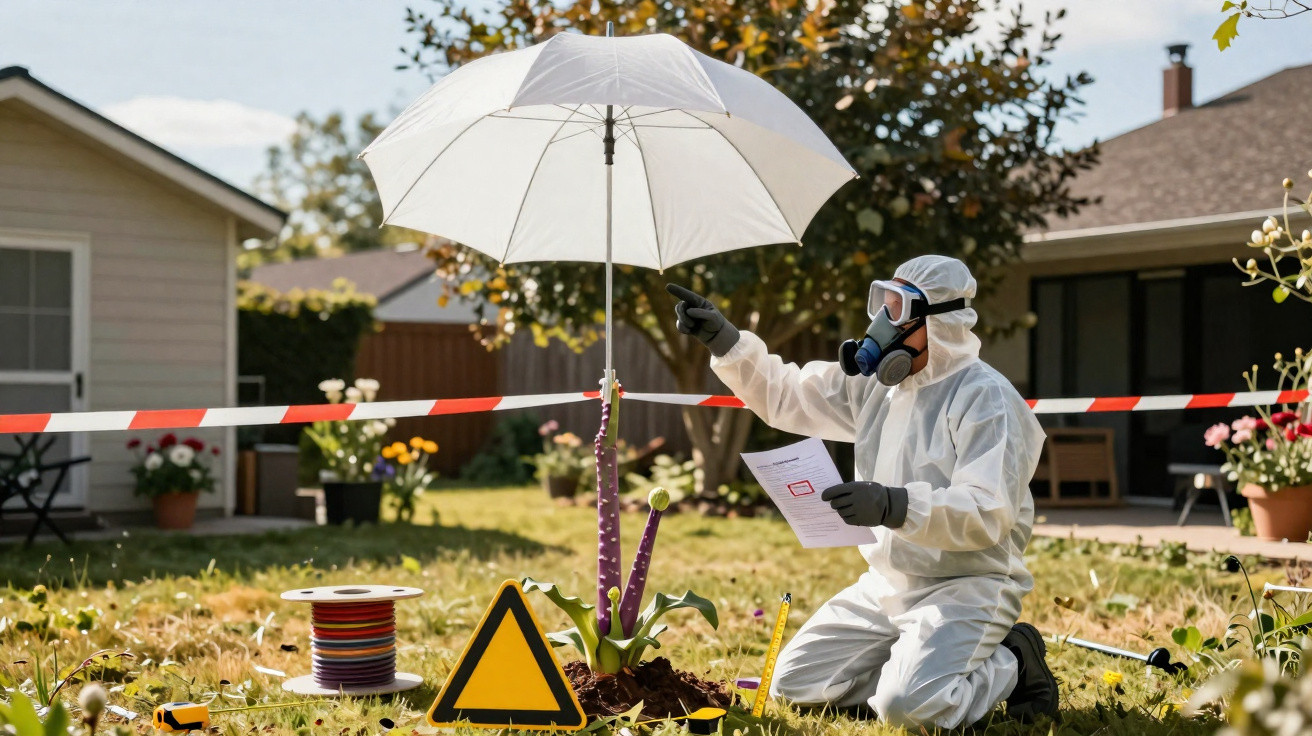
Planting it to decorate your garden could amount to an offence punishable by three years’ imprisonment. The Sosnowsky’s hogweed, admired for its striking appearance and monumental stature, appears on the European Union’s blacklist and is completely prohibited in France. It may look appealing, but it can cause serious harm both legally and to human health.
Sosnowsky’s hogweed (Heracleum sosnowskyi) was first recorded during the Second World War, in 1944, by Soviet botanist Ida Panovna Mandenova, who discovered it in the Caucasus Mountains of Georgia. She named it after her doctoral supervisor, researcher Dmitri Sosnowsky. This perennial herbaceous plant is a giant umbellifer in the Apiaceae family; it is distantly related to wild carrot, but on an XXL scale.
Reaching between three and five metres in height, it has a long, rigid stem mottled with purple that can be 10 cm across. At its tip are huge white umbels and deeply divided leaves measuring up to one metre long. Its distinctive profile and imposing yet elegant appearance have made it popular with gardening enthusiasts attracted by its ornamental potential.
Sosnowsky’s hogweed: an illegal ornamental plant in France
However, as Le Figaro notes, “you simply may not possess it, plant it, cultivate it, sell it or deliberately introduce it into a natural environment” in France. Listed in the decree of 14 February 2018, which is intended to prevent the arrival and spread of invasive plants, it is one of the 14 prohibited species in Annex I-1 concerning “vascular plants”. French law imposes severe penalties for breaches: three years in prison and a €150,000 fine. This is an unusually serious criminal penalty for someone merely seeking to brighten the back of their garden with an exotic feature. For a simple ornamental plant, the punishment is substantial, but its history explains why the rules are so strict.
Sosnowsky’s hogweed: a toxic plant born from a state mistake
Native to Asia and the Caucasus, Sosnowsky’s hogweed gradually made its way into gardens and natural spaces from the 19th century to the middle of the 20th century. Yet it was a decision made in Moscow in 1947 that accelerated its spread. At the time, the USSR was emerging devastated from the war: millions had died, many major cities lay in ruins, livestock herds had been decimated, and the animals that remained lacked feed. Kolkhozes, the Soviet Union’s collective farms, needed a cheap, high-yield fodder plant capable of growing in poor soils to replace the barley, oats and rye that had become desperately scarce after the conflict.
They chose H. sosnowskyi, which had not yet been cultivated but appeared to offer the ideal answer to the food crisis. Extremely hardy, it can grow in any type of ground, withstands frost, develops very quickly, and has a protein yield comparable with maize silage or lucerne. On paper, it was the perfect candidate to feed dairy cattle, pigs and sheep while reviving the agricultural economy.
It was introduced to central and northern Russia in 1947, initially as an experiment at the Polar-Alpine Botanical Garden in Kirovsk, before being promoted on a large scale from 1948. Throughout the 1950s and 1960s, it spread across farmland in European Russia, Ukraine, Belarus and the Baltic states. Two cultivars, “Uspekh” and “Severzhanin”, were even selected to maximise its yield.
It proved to be a very bad idea. Animals fed on hogweed suffered severe skin burns after coming into contact with its sap, while their milk was unpleasant. Its intense bitterness was caused by contamination with the plant’s toxic compounds, furocoumarins, which not only affected the flavour but also seriously harmed the animals’ fertility and calves’ health.
Toxic sap and the spread of “Stalin’s revenge”
These substances are equally alarming for human skin, with one feature that makes them especially hazardous: the plant initially seems harmless. Its sap is clear and painless on contact, causing no immediate reaction. Inflammation only begins after exposure to the Sun’s UV rays, sometimes several hours later. Blisters the size of a potato may develop on the affected area, along with marks that can remain for several years. Contact with the eyes can have devastating consequences and, in the most severe cases, result in complete blindness.
Although the Soviet regime abandoned the crop, the damage had already been done. By the end of the 1980s, taking advantage of the disruption accompanying the collapse of the Soviet bloc, the plant escaped cultivated plots and spread into wasteland, embankments, woodland edges and riverbanks. Eastern Europe has since been overwhelmed by the species, which acquired a particularly grim nickname in former Soviet bloc countries: “Stalin’s revenge” (“Zemsta Stalina”).
This is why it is included on the list of invasive alien species of concern to the European Union, established under Regulation No. 1143/2014, as well as in the French decree of 2018. Nor is it the only one affected: its two relatives, Heracleum mantegazzianum (giant hogweed) and Heracleum persicum (Persian hogweed), are subject to the same restrictions. These are three species from the same genus, introduced to Europe as ornamental plants, all of which became unmanageable because of their exceptional capacity to reproduce.
What should you do if Sosnowsky’s hogweed is in your garden?
First, make sure that it really is Sosnowsky’s hogweed, as it can easily be mistaken for other species such as common hogweed (Heracleum sphondylium) or wild angelica (Angelica sylvestris). If you are not confident in your botanical knowledge, technology can help. AI models such as Gemini, Claude or ChatGPT may assist with identification if you send them photographs.
Be careful, however: they can still make mistakes, so it is always best to compare information from several sources. The PlantNet app, available free from the Google Play Store and App Store, is much more reliable than general-purpose AI models at examining details of an umbel or stem and can help remove any doubt.
If it is indeed Sosnowsky’s hogweed, do not attempt to touch it or cut it down with secateurs as you might nettles. If you feel able to deal with it yourself, protective equipment is essential: a fully waterproof coverall, enclosed safety goggles and thick gloves.
To remove it, opt for pulling it up or cutting below the root crown, at a depth of 20–25 cm, ideally in late April or early May, when the plant is still young and has not rooted deeply. Preferably work in overcast weather, and avoid using a brushcutter at all costs, as it can spray droplets of sap everywhere. If the plant has already produced umbels, place them in a sealed bag for incineration, without exception. Do not expect a single intervention to solve the problem: seeds buried in the ground can germinate for nearly ten years.
For this reason, do not hesitate to contact your local council to arrange safe eradication. Some councils provide free interventions in partnership with specialist networks such as FREDON (Regional Federation for Protection Against Harmful Organisms). Eradication campaigns are carried out regularly, allowing specialist teams to visit your property after you have reported the plant’s presence. Unfortunately, this does not apply in every French department; in that case, you will need to contact a company specialising in the removal of invasive species. To find out whether this public service is available to you, visit the FREDON France website or the French Biodiversity Office portal to contact environmental officers or locate local support organisations. A call to the local council is better than a visit to a dermatologist, or worse, a judge.

Comments
No comments yet. Be the first to comment!
Leave a Comment