
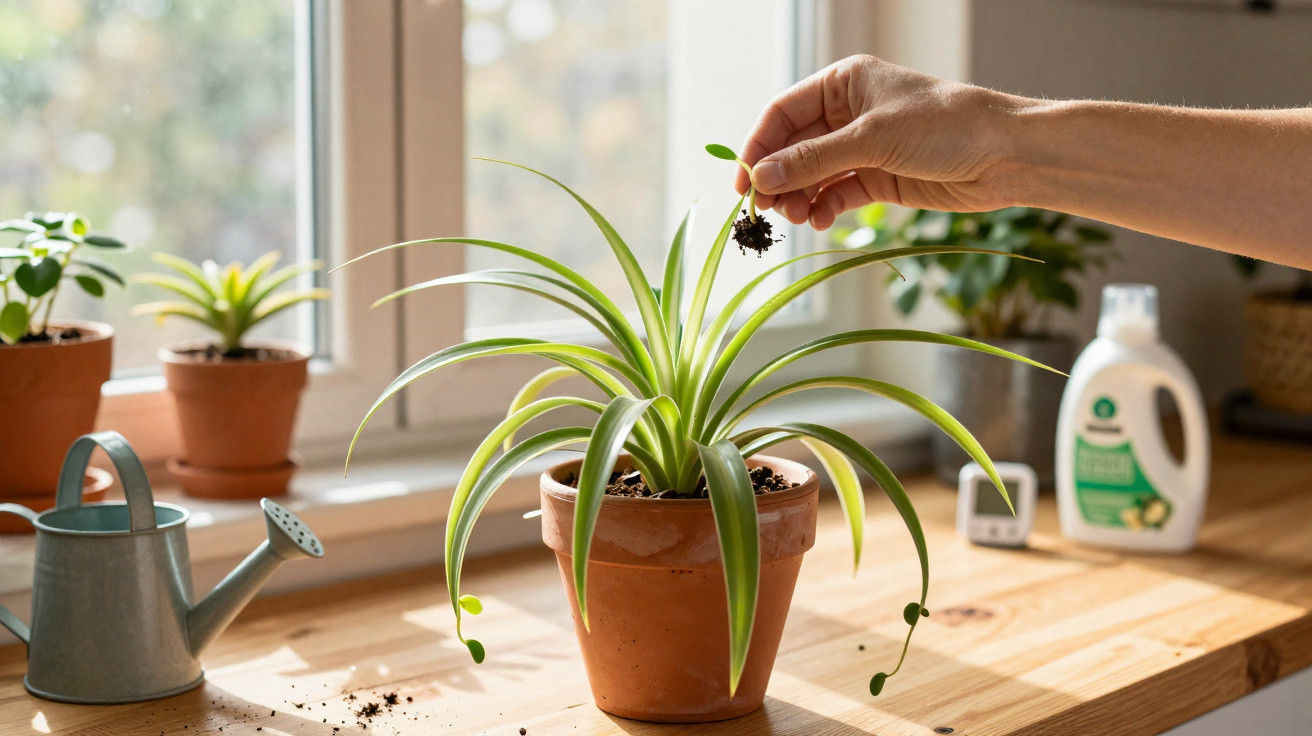
With a few well-chosen adjustments to its care routine, you can reliably encourage it to reproduce.
Many houseplant enthusiasts dream of a lush hanging basket draped with cascading miniature plants. Then they look at their own pot of Chlorophytum comosum: rich green foliage, certainly – but none of those much-loved strings of baby plants. This can be disappointing, although the situation is often far less serious than it appears.
Why your spider plant is not producing offshoots yet
The spider plant’s “babies” are tiny young plants, known as plantlets. They form on long, arching shoots, or stolons, which emerge after inconspicuous flowers with tiny white blooms. If these shoots do not appear, this is rarely because anything is wrong with the plant itself; in most cases, the growing conditions are responsible.
A common misconception is that there are “male” and “female” spider plants, and that only one type can produce baby plants. Botanically, this is incorrect: the plant has bisexual flowers and is able to reproduce both sexually and asexually. Its capacity to produce new plants is therefore always present.
Most spider plants without offshoots are simply too young, kept in conditions that are too dim, or growing too comfortably in a large pot with plenty of nutrients.
In many living rooms, Chlorophytum comosum will survive in almost any setting, remaining green and sturdy – but without flowers, stolons or baby plants. In this situation, the plant is effectively in “comfort mode”: it produces leaves, builds up reserves and looks healthy, but has no reason to invest energy in reproduction.
Three key adjustments for a spider plant full of baby plants
Three conditions determine whether your plant switches into reproductive mode:
- bright but indirect light
- a relatively snug pot with a thoroughly rooted root ball
- clearly defined dark nights, with fewer than 12 hours of light each day
1. Light: choose a bright spot, but avoid harsh direct sun
A spider plant needs ample light without being scorched by direct sunshine. A suitable position is:
- directly in front of an east- or west-facing window
- or set slightly back from a south-facing window with light shading
In a shady corner, the plant will continue to survive and put out new leaves, but it remains in “survival mode”. Research into day length indicates that plantlet production is closely connected to the duration of light exposure. If, for several weeks, the plant receives:
- strong but indirect light
- and fewer than roughly 12 hours of daylight in total each day
it is much more likely to begin flowering and producing offshoots. Light is therefore more than a decorative feature: it is the main trigger for reproduction.
2. Pot size: slightly tight is better than overly spacious
Chlorophytum comosum prefers to be a little pot-bound. Over time, its fleshy roots will fill the entire pot. This sends the plant a clear internal message: “Space is becoming limited, so now it is worthwhile producing offspring.”
If you move your spider plant into a much larger pot and feed it frequently, you will often achieve the opposite of what you want. Instead of creating flowers and baby plants, it directs its energy towards leaf production and root growth.
Only repot when the root ball visibly fills the pot – and move up by no more than one pot size.
The root ball should be dense yet healthy, with pale, firm roots and no rot or musty patches. The tuberous roots hold water and nutrients, and are even considered rich in plant fibre and minerals. The stronger this reserve, the more energy the plant has for an entire “nursery cloud” of stolons.
3. Keep nights genuinely dark
The third factor is often overlooked: night-time darkness. Baby plant formation depends not only on light, but also on the dark period. For at least three weeks, aim for the following:
- bright conditions by the window during the day
- as little artificial light as possible nearby in the evening
- no continual flickering from the television, ceiling lights or LED strips late into the night
Keeping the plant in a living room directly beneath a ceiling light that remains on late artificially extends its “day”. It can then receive well over 12 hours of light, which slows the formation of stolons.
A practical three-week plan for plenty of offshoots
A simple care routine can encourage a healthy spider plant to produce baby plants with relative reliability.
Step 1: Check its condition
Start with a quick assessment:
- Age: If the plant is less than a year old, it will usually just need more time.
- Roots: If the root ball comes out of the pot easily and is densely filled with roots, the timing is favourable.
- Growing medium: Use loose, airy compost with a slightly acidic to neutral pH value, around 6.0 to 6.5.
The plant does not tolerate waterlogging particularly well. Empty the saucer regularly if water remains in it. Room temperatures of around 15 to 25°C are well within its comfortable range.
Step 2: Adjust the spider plant’s position and light
Place the plant directly by a bright window for at least three weeks, without a curtain between it and the light, provided the sun is not blazing in intensely. At the same time, make a conscious effort to reduce light in the evening:
- until the afternoon: provide as much indirect daylight as possible
- from early evening: use only subdued light or choose another light source elsewhere in the room
- at night: ensure noticeable darkness, with no continuous lighting directly above the plant
This combination of brightness and a shorter day length is the most important trigger for flowers, followed by stolons.
Step 3: Manage watering and feeding carefully
Water only once the upper layer of compost, roughly one centimetre deep, has dried out. During warmer months, this may be necessary every few days, while in winter it will be less frequent. The plant copes better with an occasional missed watering than with constantly wet compost.
During the growing season, a mild houseplant fertiliser every few weeks is sufficient. Excess nutrients encourage leaf growth rather than offshoot production. In this case, less genuinely means more offspring.
By watering moderately and feeding sparingly, you create the mild “stress” the plant uses as a signal to reproduce – without harming it.
What to do when the first baby plants appear
In favourable conditions, curved flower stems carrying small white flowers appear first. Soon afterwards, the first miniature plants develop along them. You then have several options:
- Pot them up directly: Cut off the baby plant and place it in a small pot of moist compost.
- Root them in water: Stand the baby plant in a glass of water until roots form, then pot it up.
- Let them root while still attached: Put a pot of compost beneath the still-connected baby plant, rest it on the surface, and cut it free only once it has developed its own roots.
The final method puts the least strain on the parent plant because the young plant continues to receive support initially. It is an especially suitable option for very small or delicate baby plants.
Common mistakes that prevent spider plant offshoots
Even with plenty of effort, people who do not get baby plants often encounter the same pitfalls:
- placing the plant several metres away from a window
- leaving a ceiling light on in the room until late at night
- using a large pot that is only half-filled with roots and contains lots of fresh, nutrient-rich compost
- watering frequently “as a precaution”, without allowing the top layer of compost to dry
Reviewing these points will quickly help you identify the adjustments that matter most.
How to understand your spider plant’s signals more clearly
Watching the plant closely over time makes it easier to tell when it is content, overwhelmed, or “in the mood for offspring”. Long, paler leaves indicate insufficient light, while brown leaf tips usually point to air that is too dry, salts in the compost, or irregular watering.
If the plant is otherwise healthy, receives bright light, has a well-rooted pot and experiences dark nights, patience may be all that is needed. Spider plants follow their own rhythm, and this can take longer during cooler parts of the year. Anyone who respects that rhythm and keeps the three crucial signals – light, pot size and darkness – in view will almost always be rewarded with a curtain of green baby plants.
Comments
No comments yet. Be the first to comment!
Leave a Comment