
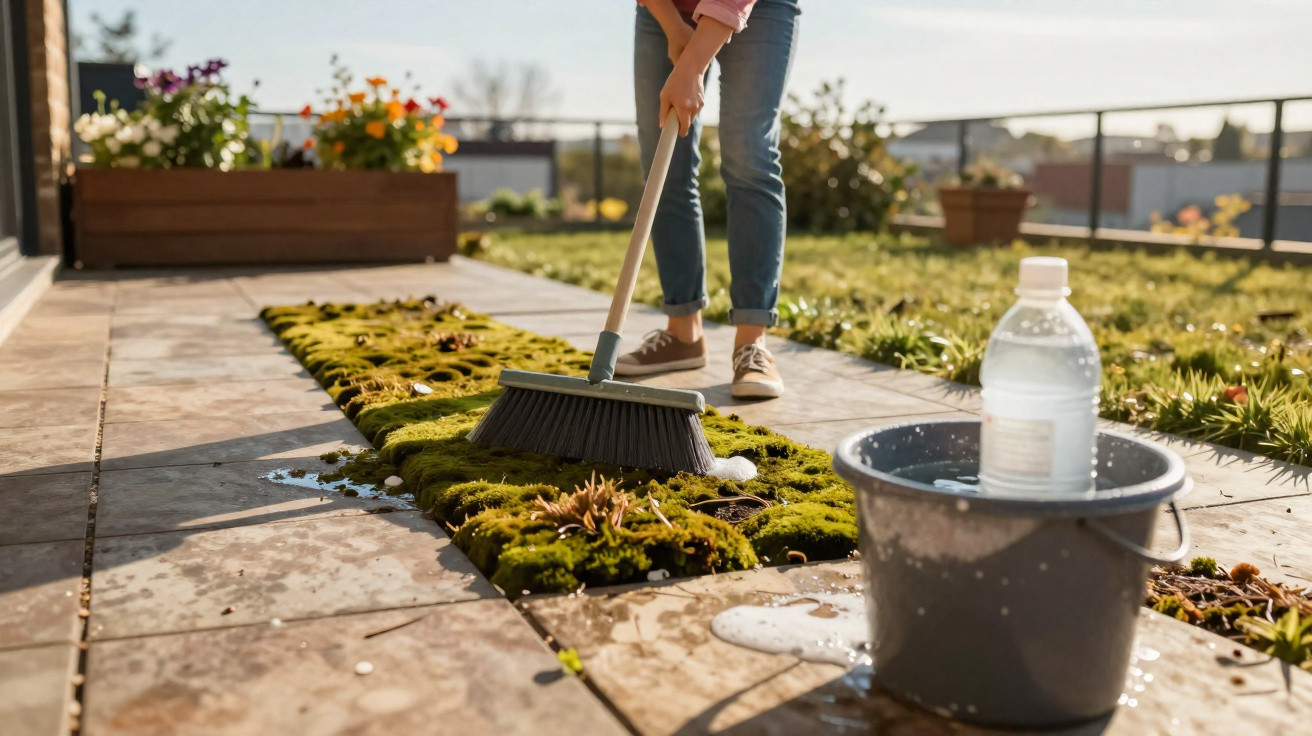
Many homeowners put off terrace cleaning because they picture heavy equipment, costly specialist cleaners and losing half a Saturday. Yet a straightforward cupboard staple costing only a few pence can often greatly reduce moss, algae and grime.
Why a green film appears on many terraces after winter
Following extended wet weather, many stone surfaces remain damp for long periods. Standing water, limited sunlight and porous materials create ideal conditions for moss and algae. The areas most commonly affected include:
- concrete slabs with a rough finish
- joints between paving blocks
- spaces beneath and behind plant pots
- shaded corners beside house walls and fences
This is more than an untidy-looking problem. The green coating can make slabs and steps slippery. Anyone with children, older relatives, or who is unsteady on their feet will know the uneasy feeling when a terrace starts to resemble an ice rink.
Many people immediately reach for a pressure washer. Although it removes dirt quickly, it can also blast out jointing material, spray grime up to the house walls, and use both electricity and water. Others buy powerful DIY-store chemicals, often accompanied by prominent label warnings and a strong smell.
The unexpectedly simple solution: ordinary white wine vinegar
A British gardening expert has used a much simpler approach for years: plain, clear table vinegar, available in supermarkets for just a few pence a bottle. In the UK, she pays around 30p and uses roughly half a bottle for an average-sized terrace, bringing the calculated cost of the cleaning job to only a few pence.
“This vinegar contains acetic acid, which weakens surface moss and algae while also attacking small weeds in the joints.”
Unlike many specialist cleaning products, it does not come with lengthy ingredient lists. Used correctly, it can noticeably brighten a terrace in around an hour, without a pressure washer or harsh fumes in the garden.
Step by step: how to clean your terrace with vinegar
No professional gardening knowledge is needed for this method. Anyone with a bucket, a broom and a little time can begin straight away.
1. Clear and sweep the area thoroughly
First, move chairs, the table, barbecue and plant pots to one side or onto the lawn. The clearer the area, the more effectively the solution can reach every part of it. Next, use a stiff-bristled broom. Remove leaves, loose debris and small twigs so the vinegar reaches the paving rather than simply soaking the dirt.
2. Mix the vinegar solution
A one-to-one mixture is generally sufficient for cleaning:
- one part clear table vinegar
- one part water, either cold or lukewarm rather than boiling hot
Pour the mixture into a bucket or watering can. Those with sensitive skin should wear gloves-not because it is extremely hazardous, but because acetic acid can mildly irritate the skin.
3. Apply the solution and leave it to work
Spread the mixture generously across the terrace. Give particularly stubborn marks and paving joints an extra dose. The surface should be visibly damp, but not so saturated that the liquid immediately runs away.
“In many cases, allowing around an hour for it to work is enough to loosen the green growth noticeably and make small weeds wilt.”
Use this time for other jobs: wipe down the garden furniture, prepare the barbecue or take a break indoors. Direct sunshine is not ideal, as it can cause the liquid to evaporate too quickly.
4. Scrub with a stiff broom
Once the waiting time has passed, it is time for the physical work. Use the same broom again, this time with more force. Scrubbing lifts off moss remnants, algae layers and films of dirt. Many terrace owners say the difference is visible straight away while scrubbing: the paving looks lighter and the joints become clearer.
If desired, rinse the surface afterwards with clean water; a garden hose is sufficient. This removes loosened grime and any remaining vinegar from the terrace.
Which terrace surfaces are suitable for vinegar-and where caution is needed
Vinegar works because its acetic acid affects the cell structure of moss and algae. Occasional use on hard-wearing concrete slabs or basic paving is usually unproblematic. Sensitive natural stone, however, is a very different matter.
The following materials are often vulnerable to acidic cleaners:
- sandstone
- limestone
- marble
- old, crumbling joint mortar
Vinegar can encourage discolouration, dull patches or flaking on these surfaces. If in doubt, first test a tiny, inconspicuous area. If the stone remains unchanged, a cautious application may be worth considering. Stop the test immediately if any bloom or roughening appears.
Take care around flower beds and lawns
While the mixture kills small weeds growing in joints, it cannot distinguish between “weeds” and treasured garden plants. If the solution runs into nearby beds or onto the lawn, leaves may yellow and plants can also die.
If the edge of your terrace directly meets a perennial border, it is better to direct run-off towards a corner where it cannot cause damage. Alternatively, gentler options may be more suitable for sensitive areas, such as specialist eco-friendly cleaners or regular scrubbing with water alone.
How to greatly reduce moss growth over the long term
A vinegar treatment provides a quick result, but it does not address every cause. To keep the green film under control in the longer term, it helps to adjust a few habits.
- More light: Shaded spots where hedge foliage hangs densely over the paving encourage dampness. Pruning brings air and sunlight to the surface.
- Improved drainage: Puddles after every rainfall reveal where a slope or outlet is missing. Even minor work on the joints or an additional drainage channel can help.
- Moveable plant containers: Do not leave pots in exactly the same place throughout winter. Shifting them from time to time prevents dark, permanently damp patches.
- Regular sweeping: A quick sweep once or twice a week removes much of the material on which moss and algae thrive.
“Small everyday changes mean the green film returns far more slowly, making the major spring clean much less laborious.”
Alternative methods: when other cleaners or a pressure washer are worthwhile
Some terrace owners prefer products that avoid any issue with acids. Slow-acting products that are applied and then left to the weather may use surfactants or specialist active ingredients to break down algae and fungi gradually. They require less scrubbing, but demand some patience.
A pressure washer is most effective on very coarse dirt or when a surface is being cleaned ahead of renovation work. However, repeatedly directing it at paving joints also washes out sand and jointing material. Over time, blocks can loosen, water can penetrate, and this may lead to damage in winter.
Practical tips for safe everyday use
A few simple rules make the vinegar method suitable for everyday use:
- use it only in dry weather with no rain expected
- keep pets and children away from the area while the solution is working
- do not use it on newly laid paving
- in built-up areas, consider neighbours who may be sensitive to the smell
The smell in particular puts some people off. It normally disappears after a few hours or by the following day. Anyone who is especially sensitive should choose a breezy day, so vapours disperse more quickly.
Why the effort is often worthwhile after just one hour
For many households, the main appeal of this approach is its combination of low cost, easy availability and a manageable timescale. A bottle of vinegar is already in most kitchens, and the entire job fits into a Saturday morning without taking over the weekend.
Those who treat their terrace once in spring and monitor standing water and dirt build-up during the season will need to use more drastic methods less often. The green, slippery winter coating then becomes a brief, predictable task rather than an unavoidable nuisance that is postponed for months.
Comments
No comments yet. Be the first to comment!
Leave a Comment