
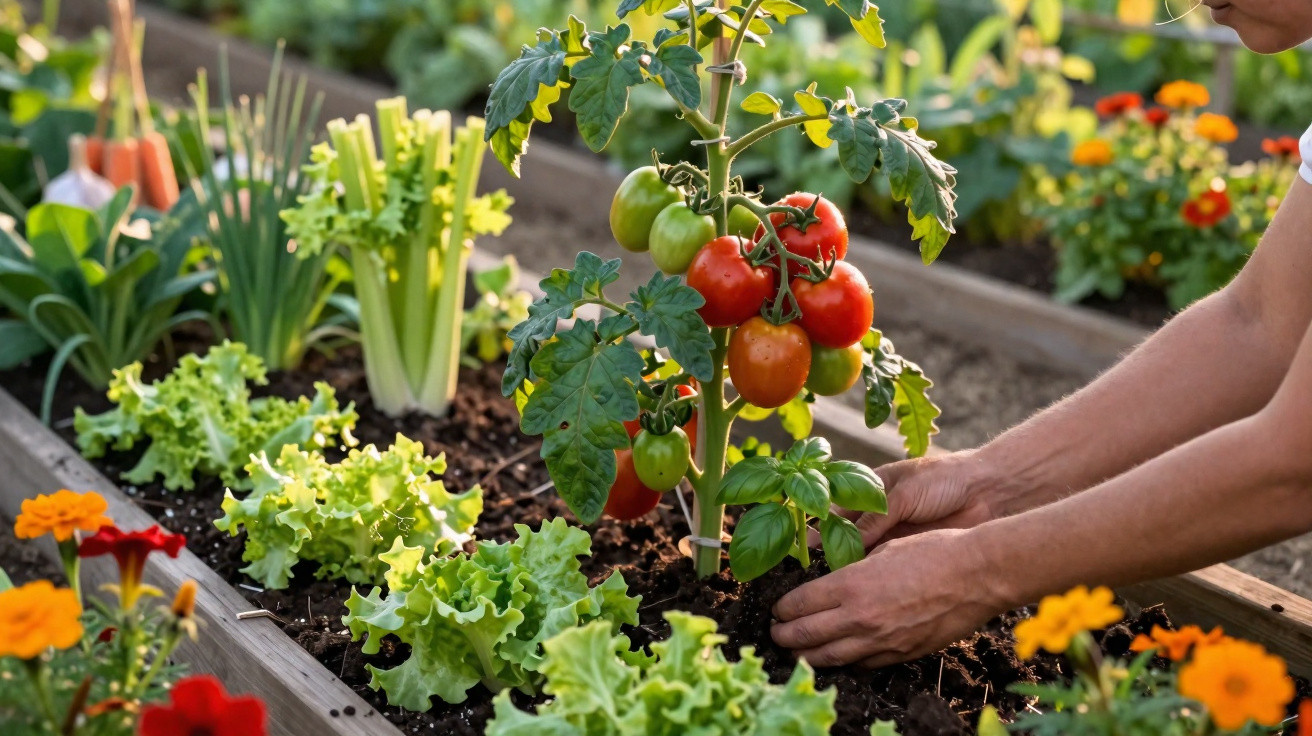
Choose the right neighbours here and you can get surprisingly much more from your plants.
Tomatoes are often seen as the divas of the vegetable garden: prone to fungal diseases, quickly stressed by heat, thirsty and sensitive. For that reason, many home gardeners plant them neatly in rows, carefully separated from everything else. Yet this often holds the plants back. Carefully chosen companion vegetables, herbs and flowers can noticeably improve tomato health – entirely without chemicals.
Why good neighbours help tomatoes grow more strongly
Plants do not communicate through words, but via scents and compounds released into the soil. You can make use of this invisible network in the bed. Some species protect tomatoes from pests, while others improve the soil or regulate the microclimate around each plant.
“Those who plant tomatoes in a well-planned mixed crop often get fewer diseases, more even growth and a significantly better harvest.”
The main benefits at a glance:
- Pest deterrence: Certain herbs mask the characteristic scent of tomatoes and confuse sap-sucking insects.
- Soil health: Deep-rooted vegetables loosen the soil and make room for strong tomato roots.
- Living mulch: Low-growing plants cover the soil and retain moisture in the bed.
- Flower magnet: Flowering plants attract pollinators and can substantially increase fruit set.
The technical term is companion planting: plants support one another instead of competing for nutrients and light.
The best vegetable neighbours for tomatoes
A small plant community can be established around every tomato plant. The key is to choose companions that stay low, have fine roots and grow relatively gently, so they do not crowd the tomato.
Carrots, celery, radishes and more
So-called low-impact crops are ideal: they can be harvested quickly and make useful use of the available space.
- Carrots: Their taproots loosen deeper soil layers and create air pockets for tomato roots.
- Celery or leaf celery: These grow well alongside tomatoes and use the space close to the ground.
- Radishes: They develop exceptionally quickly and can be harvested long before the tomatoes cast significant shade.
- Early turnip varieties or swedes: These fill gaps between tomato plants without blocking their light.
- Marrowfat peas or mangetout: They fix nitrogen in the soil and improve nutrient availability over time.
This is especially useful in raised beds or vegetable beds planted in rows: these intercrops occupy the ground until the tomatoes develop into large bushes. That leaves very little bare soil that would otherwise dry out quickly.
Leaf lettuce and spinach as natural moisture protection
Leaf lettuces and spinach are excellent as “living mulch”:
- Butterhead lettuce, loose-leaf lettuce or baby leaf: They cover the soil, keep it cool and slow evaporation.
- Spinach: It grows quickly, can be picked very early and lightly shades the soil.
Beneath this green cover, the soil stays moist for longer. You will need to water less frequently, while tomato roots benefit from reliably pleasant conditions – a clear advantage during hot spells in particular.
Alliums as a natural protective barrier
The large allium family offers more than gap-filling plants in a tomato bed. Allium crops contain sulphur compounds that may slightly slow fungal diseases and disrupt pests.
| Plant | Benefit in the tomato bed |
|---|---|
| Garlic | can reduce fungal infection and confuse sap-sucking insects |
| Bulb onion | fills gaps well and offers a slight protective effect against fungi |
| Leek | combines well with carrots and promotes mutual protection against pest insects |
A common organic gardening trick is to push one garlic clove into the soil directly beside each tomato plant. It grows fairly unobtrusively, barely obstructs the roots and provides fragrant garlic for the kitchen when lifted.
The familiar pairing of “carrot and leek side by side” can easily be combined with tomatoes nearby. The two vegetables offer each other a degree of protection from typical pest insects, while also covering the ground around the tomatoes.
Flavour, flowers and warning signs: herbs and flowers in the tomato bed
Basil – the tomato’s best friend
Basil is an almost perfect companion for tomato plants. Both prefer plenty of sunshine, consistent moisture and nutrient-rich soil. This brings several practical advantages:
- Basil scent disrupts aphids and other sap-sucking insects.
- Its leaves wilt quickly when conditions are too dry, making it an ideal watering indicator for tomatoes.
- Tomatoes and basil frequently end up together on the plate anyway.
Planting several basil plants along the edge of a tomato row therefore creates a natural scented barrier and keeps fresh seasoning leaves within easy reach.
Flowers that divert pests and attract pollinators
Even a purely productive garden benefits from a small mix of flowers. It does not simply look attractive; it also performs clear functions.
- Calendula and French marigolds: can suppress harmful soil organisms while also attracting beneficial insects.
- Nasturtiums: act as an aphid magnet, drawing them away from tomatoes.
- Borage, cosmos, zinnias and phacelia: Their nectar attracts numerous pollinators and beneficial insects.
“Studies suggest that richly flowering companion plants can increase tomato yields by well over a third.”
There is another advantage: packets of flower and herb seeds often cost less than several young tomato plants from a garden centre. With just a few pounds, you can create an entire mixed bed that fulfils several roles at once.
Plants that should not grow beside tomatoes
Helpful neighbours can be highly beneficial, but unsuitable combinations can cause problems. Some plants share diseases with tomatoes, while others demand too many nutrients or actively inhibit nearby crops.
- Maincrop potatoes: They belong to the same plant family and are highly susceptible to late blight. If both are planted directly alongside one another, a fungal outbreak can ruin both crops at the same time.
- Brassicas such as white cabbage, Brussels sprouts and broccoli: They need plenty of water and nutrients, quickly drain tomatoes of vigour and cast heavy shade.
- Fennel: It releases compounds into the soil that inhibit the growth of other plants. Beside tomatoes, this often results in stunted bushes.
- Plants with lots of foliage and a tendency towards fungal disease, such as some cucumber varieties: They occupy a great deal of space, are themselves prone to fungal diseases and raise the infection risk throughout the bed.
As a general rule, anything that spreads widely, requires a great deal of nutrients or is known to be particularly vulnerable to fungal disease is better grown in a separate bed with some distance from tomatoes.
How to plan a tomato bed with perfect neighbours
If you are new to companion planting, it helps to think in simple zones:
- Directly at the tomato stem: Basil, leaf lettuce, spinach and radishes.
- Within roughly 30–40 centimetres: Carrots, celery, onions and garlic.
- A little further out or along the edge of the bed: Nasturtiums, borage and colourful summer flowers.
This gives tomatoes sufficient air and light, while keeping their companion plants close enough for their protective effects to work. Importantly, tomatoes still need a sturdy support or string to grow upwards, regardless of their companions, so the foliage can dry well and fungi have fewer opportunities.
Practical guidance on care, spacing and watering
A densely planted bed must not turn into an impenetrable jungle. A few straightforward rules will help:
- Plant outdoor tomatoes at least 60 centimetres apart; allow a little more space in a greenhouse.
- Position low-growing companions so you can still reach between plants to water and harvest.
- Moisten the soil only around the root area and keep foliage as dry as possible.
- Regularly remove yellow leaves between the plants to improve air circulation.
The combination of airy planting and well-considered companions makes tomatoes more resilient and noticeably reduces maintenance.
Why companion planting also makes ecological sense
Paying attention to good neighbours in the vegetable bed reduces the need for sprays and artificial fertiliser. Plants support each other, while a diverse bed attracts more beneficial insects. Ladybirds, lacewings, hoverflies and parasitic wasps find food in the flower mix and help clear up aphids and similar pests.
Another benefit is that improved ground cover keeps the soil moist for longer and makes it less vulnerable to being washed away by rain. Earthworms and microorganisms thrive more readily, which improves soil structure. Tomatoes grow far more steadily in this environment, and crop losses caused by stress or disease decline noticeably.
Anyone who gradually experiments with companion planting will soon see that it is not about one single “magic” plant beside a tomato, but about the interaction between many species. Those who plan this interaction skilfully will see more clearly each season just how much strength lies in a well-balanced plant community.

Comments
No comments yet. Be the first to comment!
Leave a Comment