
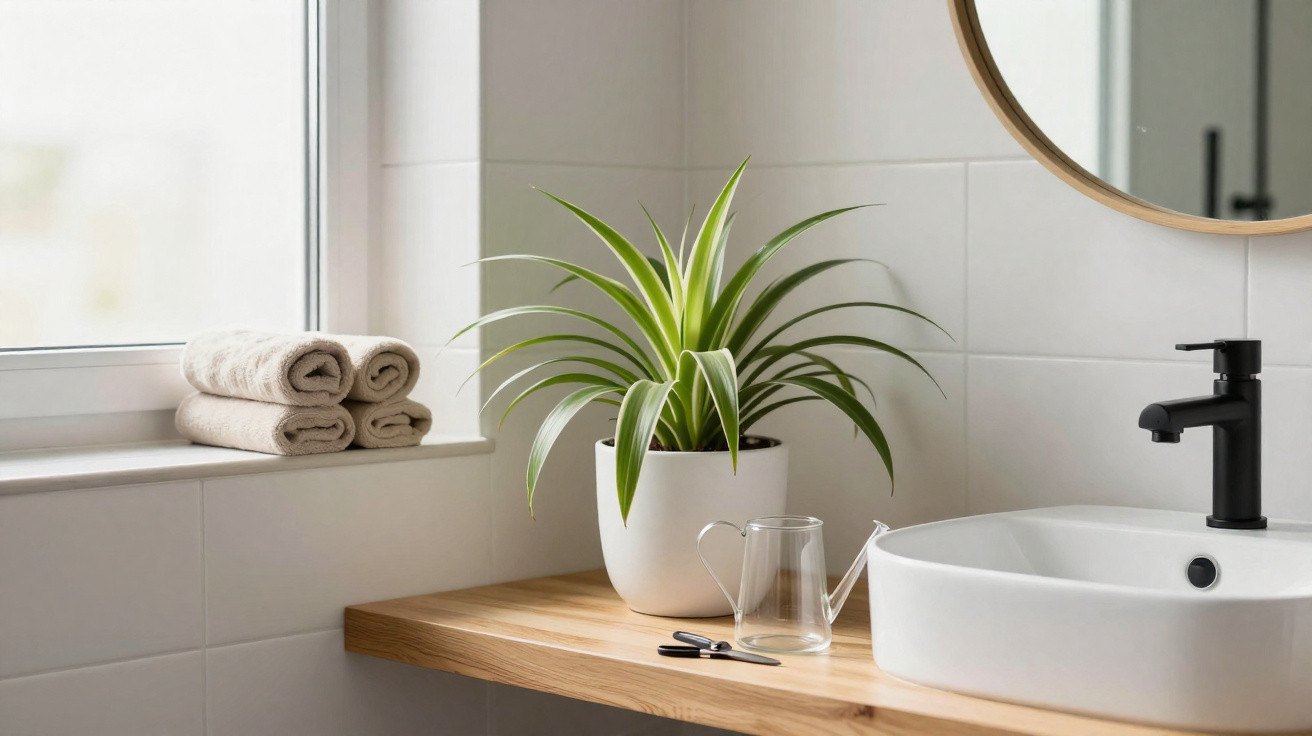
Many bathrooms in the UK are practical rather than inviting: harsh overhead lighting, yellowing grout and tiles that look dated. Major refurbishments are often not an option in rented flats. Yet a small houseplant that thrives in humid air while taking up very little room can make more difference than expected. That is why interior designers are currently turning their attention to a particular variety of spider plant.
The ideal bathroom plant: a compact spider plant for humid rooms
The plant in question is a distinctive cultivated form of the much-loved spider plant: Chlorophytum comosum ‘Ocean’. Unlike the standard spider plant, which often produces long cascading leaves and needs plenty of space, this variety stays deliberately neat and compact.
It usually grows to only about 20 centimetres tall. Its leaves are broader and slightly shorter, with striking variegation: a rich green middle framed by creamy white edges. The pattern has a graphic quality, almost like a natural design piece. It is ideal for bringing a quick fresh touch to a small bathroom without taking over half the basin.
“The compact spider plant makes excellent use of the bathroom’s high humidity and fits even on the narrowest ledges.”
From a plant physiology perspective, it is well suited to the conditions commonly found in bathrooms. These plants are happiest at humidity levels of roughly 40 to 60 per cent. Most bathrooms naturally sit within this range, often rising well above it for a short time after a hot shower. ‘Ocean’ copes easily with brief humidity peaks, provided that the room is neither permanently soaking wet nor completely dark.
Why interior designers favour bathroom greenery
Bathroom design is moving clearly away from the purely functional room and towards a space with a more homely feel. Anyone unable to create a basement spa can at least make the bathroom feel less clinical. Plants are becoming increasingly important in achieving this.
Green foliage softens the hard surfaces of tiles, ceramics and metal. A small plant placed within the eyeline can also draw attention away from tired taps or untidy silicone sealant. For designers, it is an inexpensive way to give a bathroom a more modern appearance without altering the fabric of the property.
- A warmer feel: Green leaves make sterile spaces seem more lived-in.
- A focal point: The eye is drawn to the plant, leaving problem areas less noticeable.
- Flexibility: Move a pot rather than knock through walls.
- A small investment: No tiles, tradespeople or noise are required.
The compact spider plant is especially useful because it blends in discreetly rather than creating an “urban jungle” effect. That is an advantage in small city bathrooms where there is simply no room for a rainforest.
The best position in the bathroom: where this mini plant will thrive
Although ‘Ocean’ is resilient, it should not simply be placed anywhere without thought. A few straightforward guidelines will help it stay attractive for a long time.
Light: bright but away from strong sun
The compact spider plant prefers bright, indirect light. A frosted-glass windowsill, a ledge close to the window or a shelf opposite it are all suitable positions. Over time, direct sun through clear glass may scorch the leaves, particularly at a south-facing window.
In an internal bathroom without a window, an alternative light source is needed. A bright LED ceiling light or light strip above the mirror will often be sufficient for a few hours a day, as long as the plant is not banished to the darkest corner. If it remains permanently in low light, its condition will visibly decline over time.
Compost and pot: prevent waterlogging
While the bathroom itself may be humid, the spider plant does not want its roots sitting in water. A loose, free-draining houseplant compost mix is perfectly adequate. Most importantly, the pot must have drainage holes so excess water can escape.
Many professionals use:
- an inner pot with drainage holes;
- a decorative outer pot made of ceramic or glazed terracotta;
- a thin drainage layer of expanded clay pebbles or gravel inside the outer pot.
This arrangement prevents water from spilling when watering and stops the roots from standing in water, one of the most common reasons bathroom plants die.
Watering and care routine: keeping the spider plant attractive for longer
Even though bathroom air is humid, the compost will still gradually dry out because of the warm indoor temperature. Following a clear routine makes care mistakes less likely.
Watering: less often, but thoroughly
The best method is to soak the compost completely once, then wait until the top layer has dried slightly before watering again. In very small bathrooms with strong heating, this may be necessary weekly; in cooler rooms, it will be needed much less frequently.
A practical finger test is useful: if the top two centimetres still feel damp, it is better to wait. If the compost feels dry throughout and the plant looks slightly limp, it is time to water.
Feeding and trimming: little effort, noticeable results
From spring until late summer, apply a liquid fertiliser for green plants once a month by adding it to the watering water. Growth slows in autumn and winter, so fertiliser can be omitted then.
Carefully trim dry leaf tips and older leaves with clean scissors. This maintains the compact shape and encourages fresh shoots. If desired, gently wipe dust from the upper surfaces of the leaves with a soft cloth from time to time. Hairspray and cosmetic products can leave deposits more quickly in a bathroom.
How the mini spider plant improves the look of a bathroom
Its effect on the room is greater than the size of its pot might suggest. The change is particularly noticeable in bathrooms that feel rather bleak.
“A single pot beside the mirror can feel like a small facelift for the entire bathroom.”
The two-tone foliage works with a wide range of styles:
- Scandinavian bathroom: Light wood, white tiles and a matte ceramic pot in beige or grey.
- Period bathroom: Dark tiles or older taps, with the plant providing a fresh contrast in a coloured outer pot.
- Minimalist look: Clean lines, few accessories and one green element used as an intentional focal point.
For a calmer appearance, choose an outer pot in a shade that matches the tiles. To create a deliberate accent, opt for bold colours such as petrol blue, mustard yellow or terracotta, which make the green foliage stand out even more.
Propagation without spending more money
Like its larger relative, the compact variety produces small plantlets, though usually in lower numbers. These miniature plants generally hang from thin shoots and can be rooted easily.
- Choose plantlets with visible root beginnings.
- Place them in a small pot filled with moist compost.
- Keep the compost evenly and lightly moist for several weeks.
Before long, there will be extra plants for other rooms or to give away. In rented homes with several small bathrooms, this can quickly create a consistent, fresh look without additional cost.
How the plant performs in different types of bathroom
| Bathroom type | Conditions | Recommendation for ‘Ocean’ |
|---|---|---|
| Windowless bathroom | Artificial light, often high humidity | Position it close to the mirror or beneath a bright light |
| Small city bathroom with a window | Changing humidity, good daylight | An ideal spot is on a windowsill or shelf beside the basin |
| Large family bathroom | Heavy use, sometimes draughty ventilation | Several pots are possible, for example beside the bath and on the vanity unit |
When the spider plant reaches its limits in the bathroom
The plant is not completely indestructible. Running an extractor fan constantly while barely heating the room creates a cooler, drier environment; in that case, an office or hallway may suit it better than the bathroom. It will also be unhappy directly on the floor beside a draughty door.
Yellow leaves with a soft, mushy texture are a warning sign. This usually indicates that there is too much water in the compost. Brown, crisp tips may result from a combination of dry heated air, too much fertiliser or very hard water. In many cases, watering a little less frequently with tap water that has been left to stand will help.
Benefits beyond appearance
Spider plants have long been regarded as hardy indoor companions and are often associated with a better sense of wellbeing in a room. Whether they genuinely make a measurable contribution to air purification is difficult to prove in everyday life. What is clear, however, is that having a living plant within view can reduce stress and make the start of the day more pleasant, especially when the bathroom is the first place visited in the morning.
Anyone already reorganising their bathroom can easily combine the compact spider plant with other simple changes: a new towel set in a coordinating colour, an understated soap dispenser and a tidy shelf. Together, these details can turn a strictly functional room into a place to retreat to briefly-almost like a mini spa, without having to break up tiles or replace the taps.
Comments
No comments yet. Be the first to comment!
Leave a Comment