
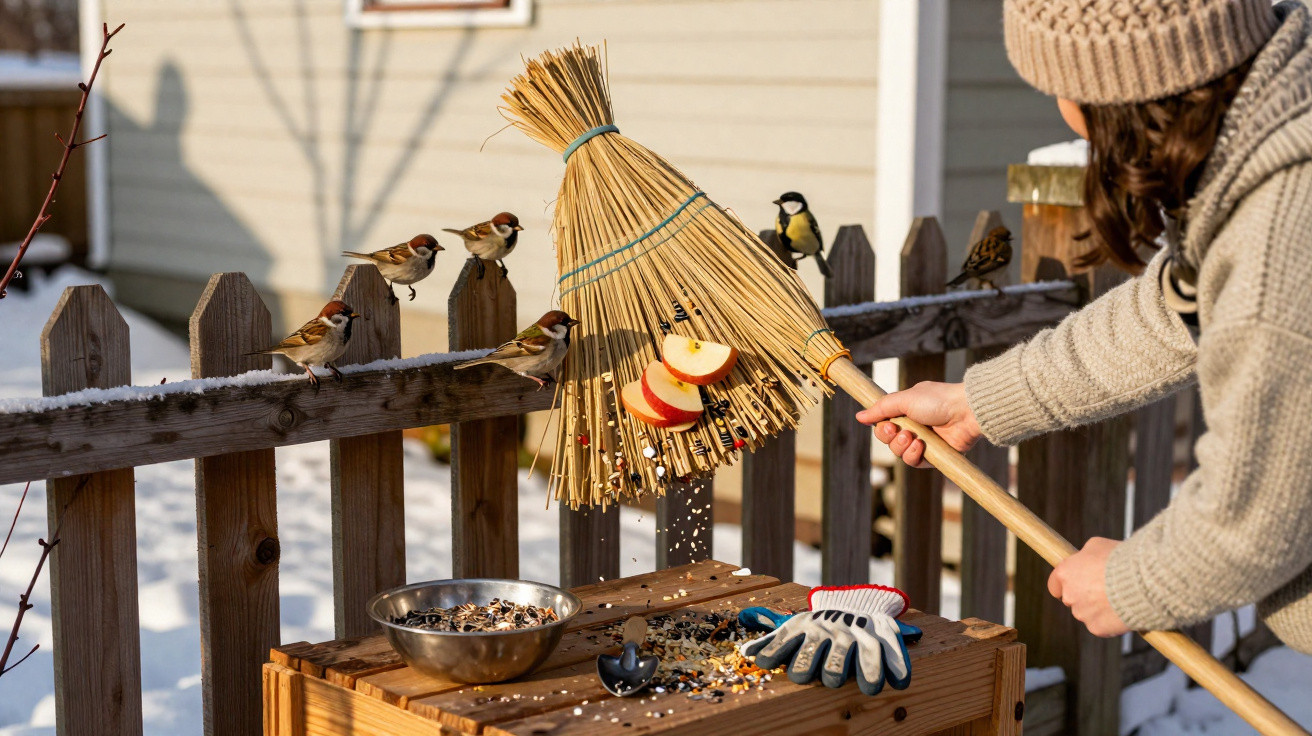
Many people feed birds in winter with the best intentions, yet often achieve little. As the cold intensifies, food becomes scarce and the ground freezes. At precisely this point, an item that almost everyone has tucked away in a shed can help: an old broom. It may sound odd, but it works remarkably well.
Why birds struggle so much in winter
Once temperatures remain below freezing, the conditions in the garden change completely. Insects disappear, earthworms retreat deep into the soil and seeds are buried beneath a thick layer of snow. For small species such as tits, robins and sparrows, every day becomes a test of endurance.
Small songbirds can lose up to ten per cent of their body weight during an icy night – they need a constant supply of energy or they may freeze to death.
Many people assume: “I’ll just put up a bird feeder, and that will be enough.” In reality, birds need three things at the same time:
- high-calorie food
- a sheltered place to feed
- a safe structure where they can perch and hide
This is exactly where the old broom comes in – and why it can surprisingly often make costly specialist products from the garden centre unnecessary.
How an old broom becomes a lifeline for birds
At first, a discarded yard broom or straw broom appears entirely unremarkable. Yet its shape is ideally suited to small birds: it has plenty of sturdy bristles, narrow gaps between them and, at the top, a handle or shaft to which things can be attached.
With just a few simple steps, this cleaning tool can become a multifunctional feeding and shelter spot:
- The bristles create a kind of “replacement nest” where birds can land and grip securely.
- Food can be wedged between the fibres so that it does not immediately fall to the ground.
- Keeping it off the ground offers protection from damp conditions and many predators.
The greatest advantage is that a broom can be fixed almost anywhere – on a house wall, in an apple tree, within a hedge or on a fence.
Step by step: setting up a broom bird feeding station
Choosing the right location
The site determines whether birds feel safe enough to use it. A quiet, partly sheltered area a little way from the patio or front door is ideal, while still allowing the birds a clear view of their surroundings.
Suitable locations include:
- on a fruit tree at chest height
- on the side of a shed or garage wall
- in a dense hedge, turned slightly outwards
Important: cats should not be able to creep up unnoticed. It is better to position the broom slightly higher rather than close to the ground.
Securing the broom correctly
Several arrangements are possible, depending on the type of broom available:
| Arrangement | How to secure it | Particular benefit |
|---|---|---|
| Hung horizontally | Suspend it from the handle in a tree using wire or cord | Plenty of perching spaces, with food hanging freely |
| Angled against a wall | Secure the handle with a hook or nail | Good protection from wind and easy to access |
| Vertical in a hedge | Wedge it between branches or tie it in place | A very discreet sheltered spot |
Food that works particularly well
To make the broom genuinely appealing, it needs a “buffet effect”. Natural, energy-rich foods are especially suitable.
- Fat balls or energy cakes – hang them from the shaft or bristles
- Apple slices – attach them with wire or push them into the fibres
- Raisins or dried grapes – hang them in small bunches
- Unsalted nuts and seeds – tuck them into the bristles
- Wild bird food mixes – scatter them into the gaps
Avoid seasoned or salted leftovers – they do more harm to birds than good.
What makes a broom better than many bird feeders
Compared with conventional bird feeders, a broom offers an unusual combination of protection and flexibility.
Three features stand out:
- Wind protection: Dense bristles break up draughts, helping birds lose less body heat.
- A hiding place: When danger approaches, birds can press themselves into the fibres and remain difficult to spot.
- Hygiene: Food does not sit directly in wet snow or puddles, reducing the risk of mould.
Particularly during snowy winters, the broom’s height creates a dry feeding area. Mice and rats also find it considerably harder to reach the treats than they would food placed on the ground.
How the broom affects garden life
Anyone who turns a broom into a bird support station often notices changes within only a few days. The bolder species usually arrive first: great tits, blue tits and house sparrows. Robins soon follow, sometimes joined by nuthatches or great spotted woodpeckers that curiously investigate what is happening.
Many amateur gardeners report that:
- birds remain in the garden for longer instead of merely flying through
- more species appear than in previous winters
- children suddenly become interested in watching nature
Anyone who supports birds in winter gets hardworking pest hunters back in spring – a win-win for nature and the garden.
Tits and other small birds consume large quantities of aphids, caterpillars and other pests in spring. The environmental value of winter support becomes visible months later in a healthy vegetable or fruit garden.
What to keep in mind when feeding birds
Although the broom is forgiving, a few rules help protect the birds:
- Replace food regularly so that nothing spoils.
- Check leftover food during milder weather and remove mouldy pieces.
- Do not put out leftovers containing sauce, salt or seasonings.
- Remove plastic nets from fat balls, as birds can become entangled in them.
Anyone who is unsure can use ready-made wild bird mixes and simply work them creatively into the broom. Small amounts are enough when they are replenished consistently. Birds quickly learn where they can find something every day.
More than a simple trick: upcycling in the garden
The broom is only a starting point. Many tools that might otherwise be thrown away can be turned into useful aids with very little effort:
- Old rake heads: hung horizontally, they make ideal perching and feeding spots.
- Broken handles: use them as perches or supports for fat cakes.
- Small trowels: add holes to create miniature feeding trays.
Gradually, this creates a small “rescue park” for birds without the need to buy new products. It saves money and reduces waste.
Practical tips for families and beginners
For households with children, this subject can easily become part of daily life. The broom soon turns into a shared project:
- choose and prepare food together
- make a simple list of the species that appear
- take photographs and observe changes in the garden
In this way, children learn through play what biodiversity means and see how much small gestures can achieve. For adults, making a visible contribution in the middle of a grey winter can feel especially rewarding.
Risks worth keeping an eye on
Even well-meant help can go wrong. An overly concentrated gathering of birds around one feeding point can encourage disease if food remains permanently wet and dirty. For this reason, it is worthwhile using several small stations rather than relying on a single site.
During exceptionally wet weather, the broom can be positioned under some cover – for example, beneath the eaves or under an overhanging balcony slab. This keeps the food dry for longer and exposes birds less to rain and sleet.
Why now is the right time
Most people have an old broom somewhere at home. A few minutes, some string and a few pieces of apple or nuts can turn it into a winter project with genuine value: for birds, for the garden and for your own peace of mind.
While frost and snow cover everything outside, a nearly forgotten cleaning tool becomes a small gathering place full of life. Every fluttering bundle of feathers that settles on the broom clearly shows just how much difference an apparently tiny action can make.

Comments
No comments yet. Be the first to comment!
Leave a Comment