
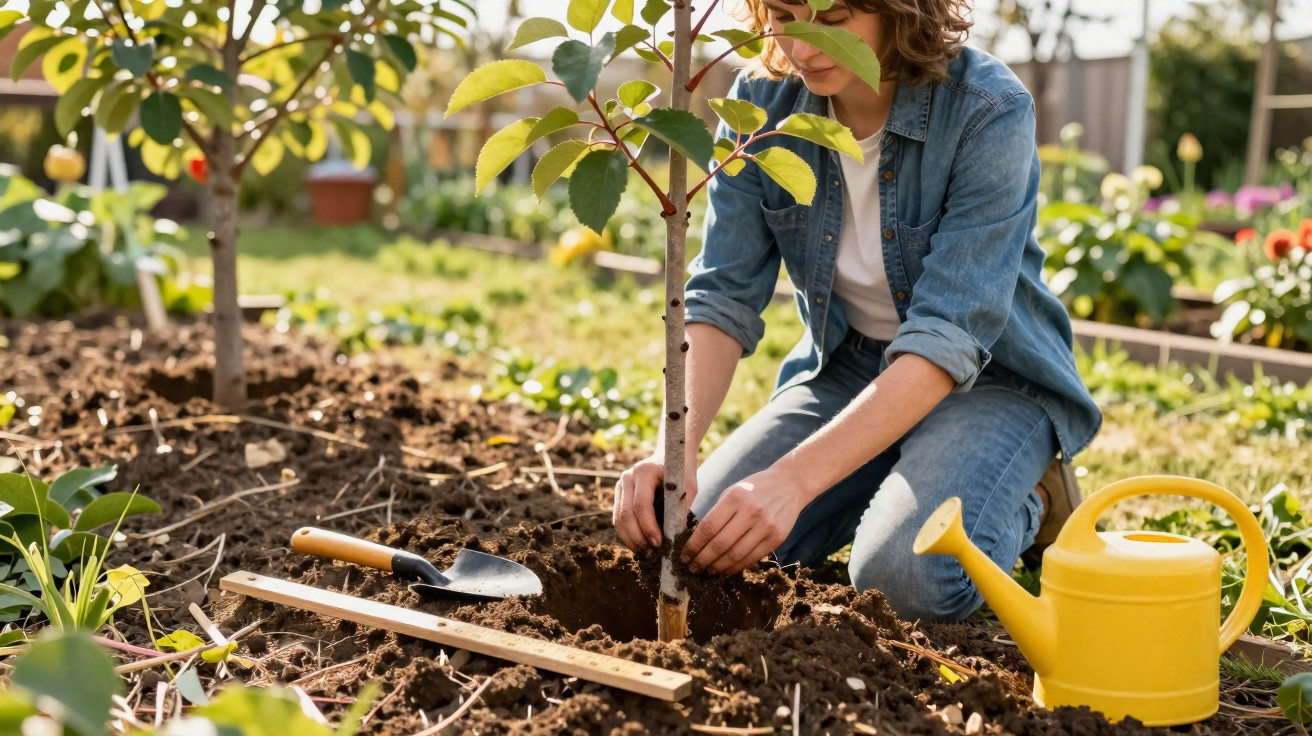
The first apple from your own tree, or a bowl heaped with cherries picked straight from the garden: that is exactly what countless people dream of in spring. So they head to the garden centre, buy a young fruit tree, dig a hole, cover it well with soil – job done. Yet if one particular area of the trunk is buried, the dream tree often remains sparse, unhealthy and without blossom. Knowing where this sensitive spot is can save your fruit garden from years of disappointment.
Why fruit trees planted too deeply rarely crop properly
Well intended but disastrous: the myth of “planting nice and deep”
Many people assume: “The deeper the tree sits, the more stable it will be.” They carefully cover the base of the trunk with soil, firm it down and almost bury it. It feels secure and looks professional – but it creates a major problem for fruit trees.
Fruit trees, especially grafted ones, must not disappear beneath the soil around the base of the trunk. This area needs to breathe.
The soil then wraps around the trunk like a thick scarf. Oxygen is lacking, moisture becomes trapped, and the bark gradually starts to rot. The tree may still look reasonably healthy in its first year, but the real cause of its later decline was already created in the planting hole.
Constant moisture around the trunk: fungi, rot and blocked nutrient transport
Trunk bark is not designed to remain in damp soil permanently. It softens, small injuries develop and pathogens can enter. Fungi exploit this weakness, while the wood gradually rots beneath the surface, out of sight.
The consequences are serious:
- The channels carrying water and nutrients are partly destroyed.
- The crown no longer receives adequate nourishment.
- The tree forms hardly any flower buds because it is occupied with “survival”.
This later becomes visible as stunted growth, yellowing foliage and years without flowering. The cause is simply a few centimetres of soil in the wrong place.
The crucial area on the trunk: how to identify it
Telling the root collar and graft union apart
Most fruit trees from a nursery are grafted. This means that a fruiting variety is joined to a robust rootstock. At the boundary between the two is the sensitive area that must never be buried.
You should be able to identify two points clearly:
- Root collar: the transition from roots to trunk, usually where the strongest roots begin.
- Graft union: a small bend, swelling or scar slightly above it. It resembles an old “weld seam” in the wood.
The graft union is the heart of your fruit tree – it must stay permanently above ground, clearly visible and dry.
What happens when the graft union disappears below ground
If this swelling is covered over, the upper section of the tree attempts to produce roots of its own. Specialists refer to this as the variety “becoming independent”. It sounds harmless, but it is highly problematic.
The robust rootstock loses its purpose. Instead of putting energy into flower buds, the tree invests it in emergency roots. Characteristics such as:
- restricted growth (for example, for small gardens)
- improved winter hardiness
- earlier cropping
are lost. The result is a tree with inconsistent health, late or absent harvests, and completely unpredictable growth.
How to plant fruit trees correctly in March
The correct planting height: always keep the trunk area clear
For newly planted fruit trees in spring, one basic rule applies:
The graft union must sit around 5 to 10 centimetres above the final soil level, and the root collar must not be covered.
In practice, this means:
- Place and position the tree in the planting hole.
- Check the height of the swelling on the trunk.
- Add or remove soil until this point remains clearly visible above the eventual soil surface.
When the scar remains exposed, the sensitive bark also stays dry and well ventilated. The tree can direct all its energy into leafing out, flowering and fruiting.
A trick for sinking soil: keeping the planting height stable
Freshly loosened soil settles over time. If you do not allow for this, the tree may seem to be planted correctly at first, only to sit too deeply in the hole a few weeks later.
Good horticultural practice includes:
- Forming a firm, slightly raised mound of soil at the bottom of the planting hole.
- Spreading the roots over this mound like a fan rather than forcing them straight down.
- Laying a straight cane or spade handle across the hole to indicate the future soil level roughly.
- Checking repeatedly while backfilling: does the graft union remain clearly above this line?
Firm the soil lightly; it should be stable enough to support the tree, but must not become a solid block. Compacted soil restricts root formation and worsens the moisture problem around the trunk.
Warning signs: how a fruit tree reveals it has been buried too deeply
Poor growth, yellow leaves and dead buds
Fruit trees can need two or three years before they crop properly. Even so, a tree planted too deeply will show much sooner that something is wrong.
Typical signs include:
- In spring, it produces only a few very weak shoots.
- The leaves stay small or turn yellow early.
- Bud shoots dry out before opening.
- The tree appears generally “stuck”, as though it is getting nowhere.
If this pattern occurs despite sufficient watering and fertiliser, inspect the base of the trunk closely.
Rescue action: uncover the trunk area without damaging roots
If you notice that the critical area has vanished beneath the soil, act promptly. This can also be done with trees that are already planted, provided you work carefully.
Method:
- Use your hand or a small hand trowel to move the soil gently away from the trunk.
- Create a shallow depression in a radius of around 20 to 30 centimetres around the trunk.
- Remove soil until the root collar and graft union are both plainly visible.
The bark on the trunk must not be damaged during this work – every scrape is an invitation to fungi and rot.
Fine surface roots should remain undamaged wherever possible. If they are left slightly exposed afterwards, a thin layer of loose soil or mulch set a little way back from the trunk is usually enough to protect them from drying out – but never pile it directly against the trunk again.
Checklist for fruit trees that flower freely in your own garden
Points to tick off when planting
Following these rules lays the foundations for a vigorous tree that crops over many years:
- Position the graft union 5–10 centimetres above soil level.
- Keep the root collar visible; do not mound soil directly against the trunk.
- Make the watering basin slightly away from the trunk, not right beside it.
- Loosen the soil thoroughly, but do not compact it excessively.
- If needed, tie the tree to a stake rather than “burying it firmly” for support.
This lets you benefit from the very qualities for which nursery fruit trees are grafted: early flowering, reliable harvests and a tree size suited to ordinary home gardens.
What amateur gardeners should also know about fruit trees
Why fruit trees are almost always grafted
Many people wonder why an apple grown from compost produces fruit that is very different from the original apple. The reason is that true-to-variety fruit trees rarely come from seed; they are almost always created through grafting. Only this method reliably passes on particular characteristics.
The rootstock influences:
- the tree’s final height (spindle bush, half-standard, standard)
- root behaviour and stability
- adaptation to soil and climate
Anyone who destroys this combination by planting at the wrong depth gives away precisely this advantage.
Practical example: one apple tree, two different outcomes
In many gardens, two young apple trees stand side by side: both are the same age, in the same location and of the same variety. There is only one difference: one has its graft union clearly above the soil, while the other has it halfway buried.
After three to four years, the contrast is clear. The correctly planted tree flowers, bears its first fruit and develops a balanced crown. The other looks weak, produces erratic growth and may yield a few small apples – if any at all. A closer look at ground level reveals damp, cracked bark on its trunk. The problem began on planting day.
Precisely because fruit trees are an investment for many years, this detail deserves attention. A few extra minutes spent considering planting depth and the trunk area ensure that the tree does not have to struggle with rot and stress, but can put its energy into blossom, fruit and steady growth.



Comments
No comments yet. Be the first to comment!
Leave a Comment