
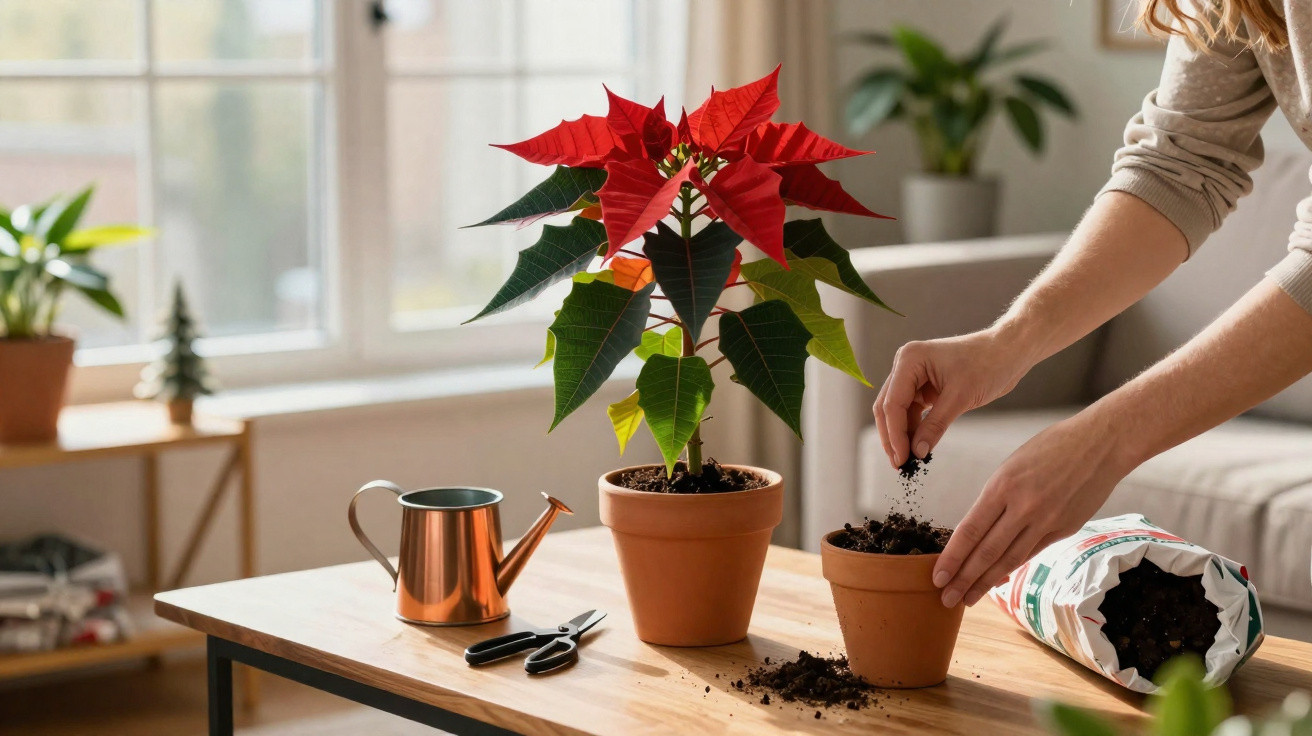
The red display has faded, the bracts are turning pale, and a few leaves are already lying on the windowsill – so the poinsettia goes straight into the bin. Plant experts say that is a serious mistake. March and April are precisely when it is decided whether this supposedly disposable festive decoration becomes a strong, deep-green houseplant for the whole summer or quietly dies away.
Why the poinsettia looks so “sorry for itself” after Christmas
The poinsettia, botanically known as Euphorbia pulcherrima, originates in the tropical regions of Central America. During the heating season, it is commonly kept too warm, too dry or too wet here, while also having to cope with dry central-heating air and draughts. It is hardly surprising that it looks tired after the festive period.
By nature, the poinsettia is not a single-use decoration but a perennial plant that can survive for many years – provided it is treated properly in spring.
In late winter, the plant slows down. Its flowering period comes to an end, the red bracts lose their colour and growth stops. Anyone who continues watering and caring for it as they did in December risks root rot, leaf drop and, ultimately, a severely weakened plant.
March is delicate: allow rest rather than “care it to death”
At the beginning of March, the poinsettia enters something akin to winter dormancy. Experts call this dormancy: a resting period in which the plant builds up strength for its next growth cycle. This is exactly where many people make the crucial mistake: they try to “save” it and overdo the care.
What the poinsettia’s proper March resting period looks like
- Location: A bright spot without direct sunshine, in a relatively cool room at around 13 to 16°C.
- Keep it away from radiators: Dry, warm air places additional stress on the plant.
- Avoid draughts: Blasts of cold air can quickly cause leaves to drop.
When it comes to watering in March, the right approach is almost the opposite of what many people instinctively do:
- Water very sparingly: Only when the compost has dried out almost completely.
- Watering interval: Depending on the room conditions, every two to three weeks rather than every few days.
- No waterlogging: Always pour away water left in the saucer.
Another area in which many people go wrong is reaching for the scissors. A drastic prune in March puts further pressure on a plant that is already exhausted. A gentle bit of “cosmetic maintenance” is the better option.
Remove only brown, dried-out leaves, and wear gloves while doing so. The white milky sap, or latex, can irritate the skin. Thick, healthy shoots should remain at this stage, as they serve as the plant’s reserves.
April brings a fresh start: do not rush the poinsettia
As soon as fresh, light-green tips appear on the shoots – usually in April – the poinsettia is gradually waking up again. This is the signal for the next step: repotting and adjusting its care.
Repotting correctly in spring
The new pot does not need to be huge. A container just slightly larger than the old one is entirely sufficient. Proceed as follows:
- Carefully ease the plant out of its old pot.
- Gently loosen matted roots with your fingers.
- Remove old, heavily compacted compost.
- Place it in a pot with drainage holes.
- Fill around it with loose, nutrient-rich compost: houseplant compost is suitable, ideally with a little sand, perlite or expanded-clay pieces to improve aeration.
After repotting, water only lightly: the roots need oxygen, not sludge. The plant should now gradually adjust to a bright position with indirect light and temperatures of around 18 to 20°C.
In April, the combination of light, temperature and watering determines whether your poinsettia develops a vigorous summer coat or becomes limp again.
A simple way to check its water requirement is to push a finger 2 cm into the compost. If it feels dry at that depth, it is time to water. If it is still slightly damp, wait a few more days. This prevents the classic mistake of “spring enthusiasm plus watering can”.
From late April: from festive star to impressive summer plant
From around the end of April, the poinsettia starts growing properly again. New leaves emerge and the plant becomes fuller. It can now be treated like a tropical foliage plant, with a few special considerations.
The right summer care at a glance
| Care area | Recommendation |
|---|---|
| Watering | Water regularly, but without waterlogging; let the compost dry slightly between waterings |
| Feeding | Add liquid fertiliser for flowering plants to the water every two to three weeks |
| Indoor position | Bright location without scorching midday sun; do not place directly beside windows that become very hot |
| Outdoor position | Put it on a balcony or terrace once frost is no longer expected; choose partial shade and acclimatise it gradually to outdoor temperatures |
Anyone with a balcony or garden can move the poinsettia outdoors after the last frosts. A bright site without blazing sun is important: partial shade, morning sun or evening sun is ideal. For the first few days outside, keep it in a sheltered spot so that it can adapt.
As temperatures rise, poinsettias often grow surprisingly quickly. Selectively shortening individual shoots in May or June encourages a compact, bushy form. Always trim only lightly rather than cutting everything back at once. This creates a dense, decorative “green bush” that barely recalls its role as a Christmas decoration in summer.
How the poinsettia turns red again in autumn
Many people are surprised to learn that the red “petals” are actually bracts. They change colour when the days become short enough. To encourage colour again in autumn, the poinsettia needs an artificial form of “short day”.
From around October, the natural day length on a windowsill is often insufficient because living-room lighting disrupts the effect. Anyone wishing to trigger colouring deliberately can use this method:
- Give the plant around 14 hours of complete darkness every day, for example by covering it with a large paper bag or cardboard box.
- Continue this routine for eight to ten weeks.
- During the “dark period”, keep watering moderately and feed every two to three weeks.
The healthier and stronger the poinsettia has remained through spring and summer, the better it will respond to this short-day treatment. A plant weakened or nearly dried out in March can usually no longer be restored to its former glory.
Common mistakes – and how to avoid them easily
Many of the same problems recur in homes year after year. With a little knowledge, three common errors are easy to stop:
- Too much water in March: The plant is resting and needs very little extra water. Water sparingly and with care.
- A location that is too warm during dormancy: A living room with the heating on is harmful. A bright, cooler bedroom or stairwell is a better choice.
- Incorrect repotting: Do not use an oversized pot or heavy garden soil. Choose light, loose compost and a pot only one size larger.
Anyone who keeps these points in mind has a good chance of maintaining their poinsettia year after year. It also saves money and reduces waste, because a vigorous reused poinsettia replaces a newly bought disposable plant each time.
A few more professional tips for a long-lived poinsettia
Poinsettias are sensitive to cold. Even a short journey in sub-zero temperatures without protection can damage them. When buying one, always make sure it is wrapped properly and avoid carrying it through the winter cold for long.
Anyone with young children or pets should be aware that poinsettia sap is mildly toxic. Chewing a leaf is rarely life-threatening, but it can cause nausea or skin irritation. Keeping the plant out of reach of dogs, cats and small children helps to avoid problems.
Pairing it with other houseplants can also be beneficial. If the poinsettia spends summer in a kind of “plant group” alongside spider plants, devil’s ivy or ferns, the humidity around its leaves rises slightly. Many tropical species, including the poinsettia, prefer this microclimate to dry isolation on a windowsill.
Those who enjoy experimenting can even turn one strong specimen into several plants. In early summer, take tip cuttings and root them in moist compost beneath a transparent cover. Over time, this creates a small poinsettia collection – and an impressive red-and-green display in December that nobody would have expected from the unassuming, half-bare little plant seen in March.
Comments
No comments yet. Be the first to comment!
Leave a Comment