
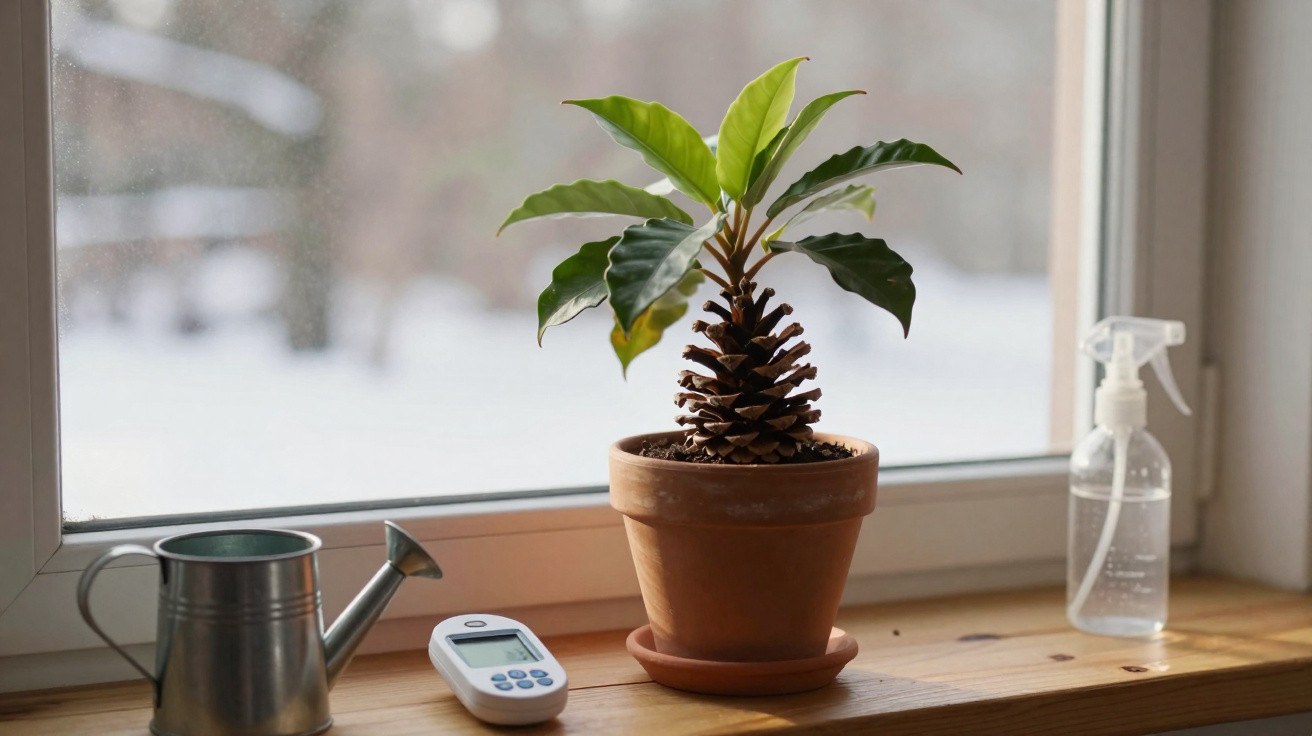
The heating is blasting, the windows stay shut – and suddenly your favourite houseplants start to fail.
The solution is, quite literally, waiting in the forest.
Many amateur gardeners only notice when leaves begin to droop or turn yellow: winter puts houseplants under real pressure. The problem is not the frost outside, but dry heated air and too much water in the pot. A simple pine cone from the nearest park can help here, acting as a natural guardian of roots, moisture and mould.
Why houseplants suddenly become limp in winter
An invisible drama plays out in homes during winter. We turn up the heating, air rooms less often and frequently water by instinct. This can quickly create a risky combination for plant roots.
During winter, most houseplants slow their metabolism. This is known as a dormant phase. Growth becomes slower, they use less water, and their roots absorb moisture far more sluggishly.
“Anyone who waters in winter as they do in summer will usually drown their plants slowly from below.”
The usual scenario is this: the soil looks dry on top and a leaf is hanging wearily, so out comes the watering can. Yet the compost lower down is still wet. Water collects, oxygen is lacking around the root ball, and rot begins to spread. Everything may look normal from the outside for a long time, until the plant suddenly collapses.
Heated air adds another complication. It dries out leaves and the air in the room, but does not necessarily dry the base of the pot. Anyone checking only the surface can therefore easily misjudge the situation.
The overlooked risk: wet soil and too little air
Waterlogged conditions around the roots are among the most common causes of lost plants in winter. The following are particularly vulnerable:
- large container plants in dense compost
- plants in pots without a drainage hole
- tropical plants such as Monstera, Ficus or Philodendron in warm living rooms
- potted plants positioned directly above a radiator
Several warning signs can reveal the consequences:
- leaves turn yellow despite sufficient watering
- stems feel soft and mushy
- the soil smells stale or musty
- a white or greenish crust appears on the surface
This brings us to a tool that seems remarkably simple but can ease several issues at once: a dry pine cone.
Why a pine cone is more than winter decoration
Most people know pine cones only from Christmas arrangements. Yet this natural material has qualities that make it surprisingly useful in a flowerpot.
“A dry pine cone works in a pot like a combination of moisture regulator and warning light.”
One important point: do not bury the cone. Simply place it on top of the soil. Its role is to stabilise the area between the air and the growing medium.
How the pine cone works in a pot
The woody structure of its scales can absorb moisture and release it again. When a pine cone sits directly on the soil, it takes up some of the surface moisture. This helps keep the area around the stem drier, slowing rot and mould.
At the same time, the cone reduces evaporation directly from the surface. The growing medium dries out more gradually without the bottom of the pot becoming excessively wet. This creates a kind of buffer zone, which is especially beneficial in winter when the air is dry.
Natural moisture meter: what pine cone scales reveal
Pine cones react sensitively to moisture. Their scales are hygroscopic, meaning that they change shape according to the conditions around them. This can be put to very practical use.
A quick look at the cone tells you more than repeatedly poking around in the growing medium:
- Scales close together and fairly shut: The surroundings are still quite damp and the soil continues to release moisture. Do not water yet.
- Scales widely open and spread out: The air and soil surface are dry. Now it is worth checking the soil at a depth of two to three centimetres. Water only if it also feels dry there.
| Pine cone condition | Meaning | Action |
|---|---|---|
| closed | high moisture in the surrounding area | do not water; keep observing the plant |
| partly open | moderate moisture | check again in a few days at the earliest |
| widely open | dry air / dry surface | check the soil at depth, then water sparingly |
As an additional benefit, the cone can prevent the notorious white or greenish layer from forming on the soil. These deposits of limescale, fertiliser residue and algae obstruct airflow to the roots and look unhealthy.
How to prepare pine cones for use in a flowerpot
Anyone who picks up a damp cone from the woods and puts it straight into a pot may easily bring tiny unwanted guests into the living room. A brief preparation routine makes using one safe.
Step-by-step guide
- On a walk through woodland or a park, collect only dry, well-opened pine cones.
- Brush off coarse dirt with a brush or your hands.
- Put the cones on a baking tray and place them in the oven at around 90°C for 20–30 minutes or leave them on a radiator for several days.
- Allow them to cool completely afterwards.
- Rest the cones loosely on the soil rather than pressing them in.
For larger pots, feel free to use two or three pine cones. This not only creates a decorative woodland-floor appearance, but also spreads the effect over the entire surface.
What the pine cone can do – and what it cannot
One point matters: a pine cone is not a replacement for fertiliser. It does not automatically make your soil richer in nutrients; instead, it primarily helps to create a healthier moisture environment. In winter, this is almost more important than extra nutrients, as many plants need hardly any fertiliser during dormancy anyway.
Its advantages are clearly concentrated in three areas:
- reducing surface waterlogging
- helping to prevent mould and deposits
- providing a visual indication of when watering may be needed again
If a plant is already severely dying and its roots are dark and mushy, a pine cone cannot reverse the damage. It works as a preventive measure and early warning system, not as a miracle cure.
Helping houseplants safely through the heating season
The pine cone is one part of a winter-care package, but it is not the only one. To help houseplants through the cold months, it is worth following a few basic rules.
Adjust watering to the season
The key factor is the amount of water given. In the darker months, many species need only around half as much as they do in summer. A simple routine helps:
- always check the soil at a depth of two to three centimetres first
- water less frequently but thoroughly
- remove excess water from the saucer after around 15 minutes
Together with the pine cone, this creates a system of feeling and seeing: put a finger in the soil, look at the cone, then decide.
Position, humidity and light
There are also a few details many people underestimate:
- Distance from the radiator: Move pots at least 30–50 centimetres away from radiators.
- Light requirements: During the darker season, place plants nearer bright windows, but do not let leaves press against cold glass.
- Increase humidity: Put bowls of water on radiators, arrange several plants in groups, and occasionally mist them with lukewarm water (not plants with heavily hairy leaves).
Anyone keeping these factors in mind will notice that many issues once thought of as “sudden plant diseases” are actually connected to water and location.
When a pine cone is especially useful – and when it is not
There are certain situations in which a pine cone can be particularly helpful:
- for freshly repotted plants, to prevent mould forming on new compost
- in homes with very dry heated air
- for large-leaved tropical species that are sensitive to waterlogging
- in households where different people water according to instinct – the cone provides a shared signal
It is less suitable for succulents and cacti in highly mineral growing media. These plants need very little water anyway, so restraint when watering is the main priority. A pine cone will not do any harm, but it offers only limited additional benefit here.
A simple natural tool instead of expensive high-tech
Many guides promote digital moisture sensors, watering apps or complex hydroponic systems for houseplants. All of these can work, but they cost money and create additional electronic waste. A pine cone works purely mechanically, responds only to air and moisture, and can simply be replaced if necessary.
For people who enjoy filling their home with greenery but have repeatedly had to accept losses in winter, trying this carries virtually no risk. On your next walk through the park, take a closer look at the ground. A few unassuming pine cones can become quiet sentries in a pot, helping Monstera, Ficus & Co. get through winter far more comfortably.

Comments
No comments yet. Be the first to comment!
Leave a Comment