
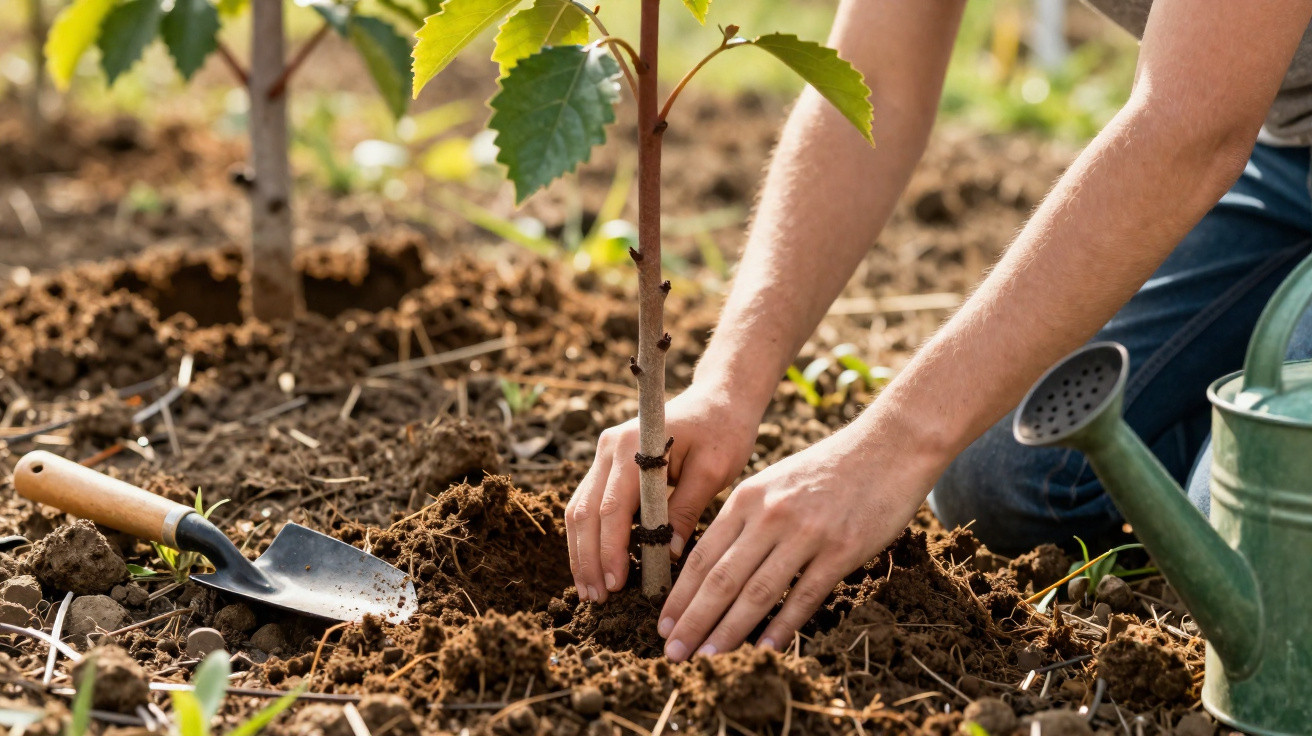
Anyone planting an apple, cherry or apricot tree in spring dreams of fragrant blossom and a generous harvest. Yet this is precisely where a serious misconception can arise: the well-intentioned protection given to a young tree may leave it stunted for years, producing few flowers or none at all.
The one part of the trunk that must never be buried
The common mistake often happens while backfilling the planting hole. Many people press an extra layer of soil up against the trunk, “so that the tree has better support” and “doesn’t dry out”. It sounds sensible, but in practice it damages the very area that is crucial for flowering and fruit production.
The vital area around the trunk must remain visible – burying it deprives a fruit tree of air, vigour and its willingness to flower.
There are two areas that should be clearly identifiable on a young fruit tree:
- Root collar: the transition between the roots and trunk – where the roots finish and the trunk begins.
- Graft union: a ring-shaped swelling, bend or “scar” just above it – this is where the fruiting variety has been joined to a hardy rootstock.
This swelling must never disappear below the soil. Planting a tree too deeply buries its “control centre” for blossom and yield.
Why planting fruit trees too deeply can effectively suffocate them
A well-meant soil ‘bank’ becomes an oxygen trap
Trunk bark is not designed to remain in damp soil permanently. It needs air and light. Once it is covered with soil, the following happens:
- soil remains constantly damp against the bark;
- a humid, airless environment develops;
- moisture penetrates the bark and softens it.
Fungi and rot-causing bacteria quickly establish themselves in this area. The trunk then begins to decay slowly below ground level. Nothing may be visible at first, but internally the flow of nutrients is disrupted and the conducting tissues narrow.
A fruit tree planted too deeply may appear to survive, but it is effectively “cut off” – it grows, yet never truly performs as it should.
When the graft produces the wrong roots
If the graft union is buried, the fruiting variety will often try to form roots of its own. At first, that might sound like “more roots, more strength”, but it is actually a problem:
- the hardy rootstock becomes less important;
- its special qualities, such as disease resistance, growth vigour or early fruiting, are lost;
- the tree uses energy on emergency roots rather than flower buds.
This is exactly why many incorrectly planted fruit trees remain reluctant to flower for years, have sparse foliage and are noticeably more susceptible to disease.
How to plant fruit trees at the correct height
The golden rule: keep the graft union clearly above soil level
For newly planted fruit trees, one simple rule of thumb applies:
The graft union must remain around 5 to 10 centimetres above the final soil surface at all times.
Here is the process in detail:
- Dig a planting hole large enough for the roots to spread out freely.
- Shape a small, firm mound of soil at the bottom, on which the roots can rest.
- Position and straighten the tree on this mound so that the root collar sits approximately at soil level.
- Check that the graft swelling is clearly visible several centimetres above the surrounding ground.
- Only then refill the hole with loose soil – do not pull soil upwards against the trunk.
For extra certainty, place a stake or spade across the planting hole while planting. This makes it easy to judge how far the trunk and graft union will stand above the finished soil level.
Allow for soil settlement – otherwise the tree will sink
Freshly loosened soil settles considerably with rainfall and watering over the following weeks. If the tree is only just at the right height initially, it will end up too deep once the ground settles.
A practical tip is to plant the tree slightly higher than looks “perfect” at first. Once the soil has settled, the root collar will be exactly where it belongs and the graft union will remain clearly above ground.
Warning signs: how to spot a fruit tree planted too deeply
When spring arrives and almost nothing happens
A fruit tree planted too low does not immediately cry out for help. The warning signs develop gradually, often only in the second or third year:
- shoots remain short and thin, and the tree looks sparse and twiggy;
- leaves turn yellow early or stay small and dull;
- buds dry out before they open;
- there is little or no blossom, even though the tree is old enough to flower.
If, in spring, other trees are already coming into leaf while your own fruit tree stands there as though “frozen”, inspect the base of its trunk straight away.
Rescue action: expose the trunk without damaging roots
If you suspect the tree is planted too deeply, careful digging is the only solution. To do it as gently as possible:
- Loosen the soil around the trunk using your hands or a small hand trowel.
- Work carefully downwards until the root collar and graft union are visible again.
- Form a shallow watering basin that does not touch the trunk but sits a short distance away from it.
- Avoid damaging the bark and fine roots – every scrape provides an entry point for disease.
Often, exposing the base of the trunk in time is enough – the tree will repay this with visibly greater vigour in the following years.
Checklist: planting your fruit tree correctly
The most important checks when backfilling the planting hole
- The graft swelling is clearly visible, at least a hand’s width above ground level.
- No soil has been heaped directly against the base of the trunk.
- The watering rim is positioned a little way from the trunk so water does not sit continually against the bark.
- Firm the soil only lightly; do not compact it until it is as hard as concrete.
Following these few points lays the foundations for a tree that stands firmly, remains healthy and enters its flowering phase without stress.
Why the graft union and root collar react so sensitively
What is really behind the ‘scar’ on the trunk
The inconspicuous swelling on the trunk is much more than an old wound. It marks the point at which two plants have fused into one: below is the hardy rootstock with its strong root system, while above is the cultivated variety with its large, flavoursome fruit.
This combination provides:
- an appropriate mature height, for example a spindle tree rather than a standard tree;
- better adaptation to the soil and climate;
- earlier and more abundant fruiting.
When this joining point is hidden in the soil, the carefully engineered system is thrown out of balance. The tree is forced to work against its own “construction”.
Practical examples from everyday gardening
A typical case is seen on new-build developments, where many owners plant their first fruit trees in recently raised ground. Over several months, the land settles slightly and the tree “sinks” with it. Two years later, there is no significant new growth and scarcely any blossom. When the base of the trunk is then uncovered, the graft union is found beneath the soil.
In another scenario, an older tree has new layers of bark mulch pushed directly against its trunk year after year. During wet weather, mulch can also act like a permanently damp wrap and encourage rot. The solution is to pull the mulch back so that it sits several centimetres away from the trunk.
Higher yields with simple measures
Anyone who respects the anatomy of a fruit tree at planting time will avoid a great deal of later frustration with trees that are reluctant to flower or prone to ill health. A clearly visible root collar, an uncovered graft union and soil that is not overly compacted are small details with a major effect.
When walking through the garden this spring, take a critical look at your young trees. Is the base of the trunk visible? Does the graft union really stand clearly above the soil? These two questions often determine whether, in a few years, the tree produces only green leaves – or its branches bend beneath the weight of sun-ripened fruit.


Comments
No comments yet. Be the first to comment!
Leave a Comment