
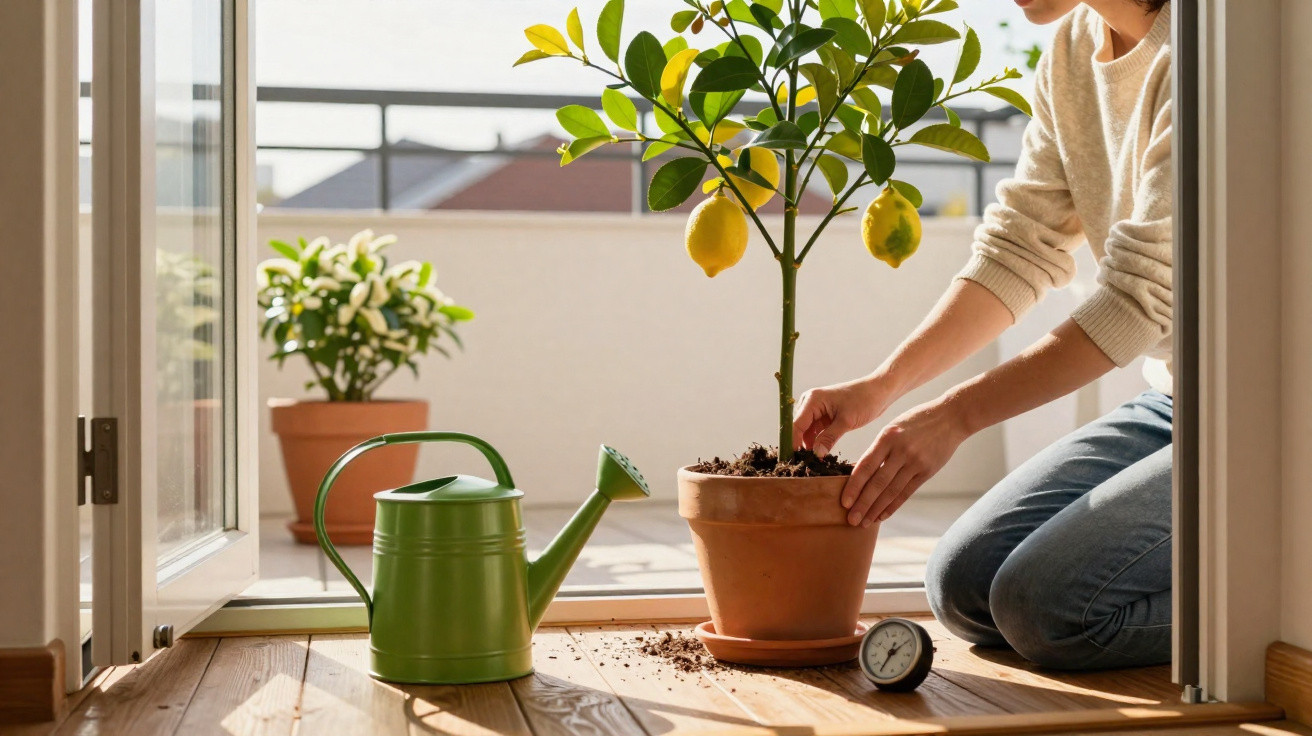
The first mild days of March make you want to use the balcony and patio again. Many people then carry their potted lemon tree outside, water it generously and hope for a bumper crop. Yet what seems like attentive care can deprive the plant of its blossom at precisely this point – and with it, the entire year’s fruit.
The biggest March mistake with a potted lemon tree
March can be deceptive. The sun already feels almost spring-like, while daytime temperatures often reach 15 to 18 °C. When people see their potted lemon tree after winter, often already covered in buds, they think: “Get it out into the sunshine – that will do it good.”
That is exactly the problem: the apparent start of spring is misleading. Many areas in Germany, Austria and Switzerland still experience severe overnight frosts in March. Although the woody parts of a small potted lemon tree can tolerate slight sub-zero temperatures reasonably well, its buds, flowers and young shoots are extremely sensitive.
“Temperatures around freezing can already be enough to destroy the entire spring blossom – and with it the later harvest.”
Putting the pot outside permanently too early can therefore result in a complete loss of the crop before the season has truly begun.
False spring: why nights pose a greater risk than days
A typical March situation looks like this: in the afternoon, the thermometer reads 18 °C, the sun is shining and the lemon tree is visibly putting on new growth. Overnight, however, the temperature drops to 2 °C or even lower, perhaps with a subtle white layer of frost.
For the plant, this is intense stress. Daytime warmth triggers strong sap flow. The young cells in buds and flowers become full, and the plant effectively assumes that spring has properly arrived. When the cold night follows, the sap cools sharply, cells rupture on a microscopic scale, and blossoms darken before drying out.
Many people only notice the consequences several days later:
- Flowers turn brown or black before dropping off.
- Tiny developing fruits shrivel.
- Young shoots appear soft and weakened.
- The small tree suddenly sheds a large number of leaves.
The tree will generally survive this treatment, but the lemons expected for spring and early summer will be gone.
The second trap: watering as though it were midsummer
There is another common mistake alongside moving the plant outside too soon: many people start watering in March as if it were already July. A cold root zone, roots that are still sluggish, and plenty of water in the pot are a harmful combination for the plant.
A potted lemon tree needs very little water in its winter quarters. At 5 to 10 °C, its roots work far more slowly. Suddenly watering heavily and frequently effectively floods a root system that is still only half awake.
“Too much water in cold growing medium quickly leads to root rot – and this often only becomes visible once the canopy has already started losing leaves.”
Typical signs of excess water in cold growing medium
- Leaves yellow and fall at the same time.
- The compost smells stale or musty.
- The pot stays wet for a long time, even though the surface appears dry.
- New shoots remain short and soft.
In the worst cases, fungal pathogens spread through the root area. The fine feeder roots then rot away, leaving the plant unable to take up water even when the compost appears moist – so it effectively dries out while sitting in wet soil.
How to check whether your lemon tree needs water
The simplest and most reliable option is the finger test. You need no measuring device or complicated formula – simply put a finger into the compost.
- Push your finger around five centimetres into the growing medium.
- If it still feels distinctly damp or cool, do not water.
- If the compost is crumbly and dry at that depth, water moderately.
In winter quarters, watering once every two weeks is enough in many cases. Good drainage is crucial: water must never remain in the saucer permanently. Waterlogging combined with cold is the quickest route to root problems.
When can a potted lemon tree genuinely go outside?
The right time depends greatly on the climate, though some broad guidance is still possible.
| Region / climate | Earliest safe period | Special consideration |
|---|---|---|
| Mild wine-growing areas, sheltered city centres | Late April to early May | Only when nights consistently remain above 5 °C |
| Typical locations in Germany, Austria and Switzerland | Usually after the mid-May “Ice Saints” period | Late frosts are common before then |
| Particularly harsh or high-altitude locations | Late May | Wait longer to be safe |
A useful rule of thumb is that the forecast should show overnight lows clearly above 5 °C for at least ten consecutive days. Only then should the lemon tree stay permanently on the balcony or patio.
Acclimatising your lemon tree gradually for the outdoor season
Even when temperatures are suitable, the lemon tree needs a kind of transition period. After weeks or months in bright but comparatively diffused light indoors, direct March or April sunshine can quickly scorch it.
The changeover works much better this way:
- First week: place it outdoors in partial shade during the day, then bring it back inside or into a greenhouse at night.
- Second week: allow gradually more sun, while continuing to shield the pot from wind.
- From week three: leave it outside permanently in stable temperatures, choosing a progressively sunnier position.
A sunny, wind-protected spot against a house wall is ideal. The wall stores warmth, moderates temperature extremes and protects the plant from cold draughts.
Adjusting watering for spring
As temperatures rise, the volume of water can increase too – but in stages, rather than all at once. Thoroughly soaking the root ball with icy cold water immediately suppresses root activity again.
Practical guidance:
- March: water only once the compost is dry to a depth of five centimetres; never water the pot when it is ice-cold.
- April: water slightly more often on warmer days, but still allow the compost to dry out between waterings.
- Summer: in sunny positions, water is often needed every two days, or daily during hot spells – provided drainage remains unobstructed.
From spring onwards, using a specialist citrus fertiliser is worthwhile. Applying it every two weeks from March to September supports flower formation and fruit set. Fertilise only when the compost is properly moist, never into a bone-dry root ball.
Warmer roots, healthier growth
One small detail can make a major difference: where the pot stands. If it sits directly on a cold stone slab or metal surface, the roots stay noticeably cooler than the air temperature would suggest. This is exactly when the previously mentioned issues with wet, cold compost can easily arise.
“Just a few wooden battens or bricks beneath the pot can raise the root area by two to three degrees – often enough to prevent stress.”
Choosing a light-coloured rather than overly dark pot also helps prevent excessive heating in summer and severe temperature fluctuations around the roots.
Pruning, care and common pitfalls
From March to May, a potted lemon tree can be shaped effectively. Remove dry, dead branches and thin out shoots that are growing too densely. This lets more light reach the inside of the canopy, enables leaves to dry faster after rain and makes fungal diseases less likely.
Common mistakes that can cost you the crop in addition to the March timing error include:
- Moving the plant constantly – lemon trees prefer consistency.
- Cold draughts in stairwells or near windows in the winter quarters.
- Pots that are too small and contain exhausted compost where water circulates poorly.
- Failing to check for pests such as scale insects or spider mites when moving the tree outside.
A quick inspection when taking the tree outdoors can prevent prolonged trouble: look at the undersides of the leaves and check for pale speckles, sticky patches or fine webbing. Pests are much easier to remove when spotted early.
Why patience pays off in March
The urge to make the most of the first sunshine is only natural. For a potted lemon tree, however, the calendar matters less than the pattern of night-time temperatures and the condition of its root ball. Waiting one or two extra weeks, watering carefully and increasing exposure gradually will usually reward you with substantially more flowers and fruit.
This is particularly true of citrus plants, where the effects build on one another: a stable start to spring produces stronger shoots, better-quality flowers and more resilient fruit set. The plant recovers more quickly from wind, rain and hot spells – and its performance throughout the gardening year will show whether you stayed patient in March or gave in to the damaging early-spring impulse.

Comments
No comments yet. Be the first to comment!
Leave a Comment