
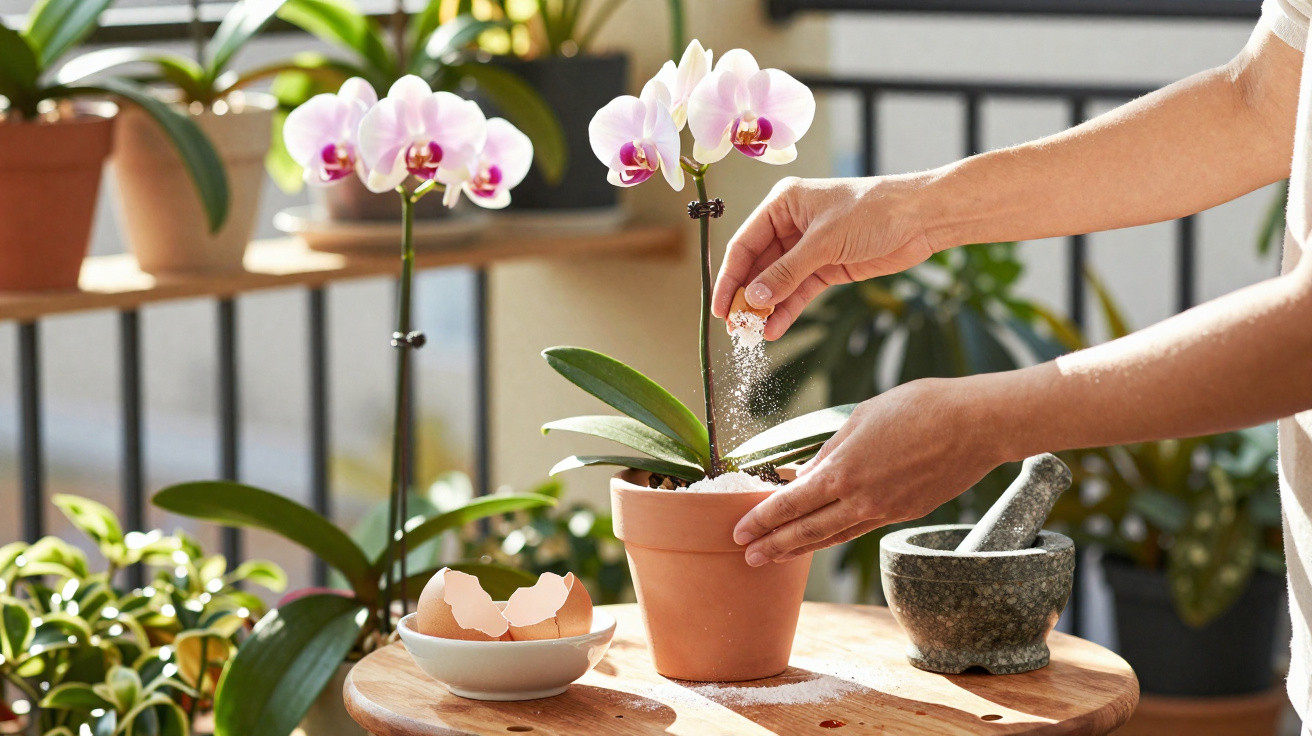
Using eggshells for orchids has become popular among people seeking straightforward ways to care for houseplants, making use of a kitchen by-product as a potential calcium source to strengthen roots and leaves. Even so, there is still considerable uncertainty about how much this practice genuinely affects plant health and flowering.
What do eggshells provide for orchids?
Eggshells consist largely of calcium carbonate, alongside small amounts of magnesium and other minerals. Calcium contributes to the structure of cell walls, helping to create firmer tissues, which may support stable roots and leaves over time.
Although calcium matters when orchids are grown in pots, it remains less important than nitrogen, phosphorus and potassium. Eggshells should therefore be treated only as a mineral supplement: they do not replace dedicated fertilisers and, when overused, may disrupt the substrate’s chemical balance and affect the uptake of other nutrients.
How can eggshells be used without harming orchids?
Preparation and application largely determine the outcome. Large shell fragments barely dissolve and act simply as a top dressing. Finely ground powder, on the other hand, has more contact with the substrate and releases calcium slowly and progressively, rather than producing an immediate effect or sudden flowering.
To minimise the risk of build-up, unpleasant smells and suffocated roots, the shells must be cleaned, dried and thoroughly crushed. Always apply small amounts to the surface of the pot. This simple process helps keep the method organised:
- Wash the shells thoroughly, removing all traces of egg white and yolk.
- Allow them to dry fully in a well-ventilated place.
- Grind them into a fine powder using a pestle and mortar or a food processor.
- Scatter a thin layer over the substrate without pressing it down.
- Repeat only after a few weeks, if required.
When do eggshells genuinely help orchids?
Eggshells are generally more useful when an orchid already receives balanced fertilisation and grows in suitable substrate, yet shows mild signs of calcium deficiency, particularly where the watering water contains very few mineral salts. In these circumstances, they provide modest reinforcement rather than a miracle cure.
Many frequent orchid issues result from unsuitable care and will not be corrected by adding more calcium. In the following situations, changing the growing conditions has a far greater effect than adding eggshells:
- Overwatering: waterlogged, dark roots require affected sections to be pruned and longer intervals between watering.
- Unsuitable light: deep shade limits flowering, whereas strong direct sun scorches the leaves.
- Degraded substrate: an old, compacted growing medium reduces aeration and encourages fungi.
- Lack of complete fertiliser: without sufficient nitrogen, phosphorus and potassium, the plant produces limited growth and fewer flowers.
Are eggshells for orchids worthwhile in everyday care?
In day-to-day care, eggshells are an inexpensive, readily available resource that supplies small quantities of calcium over several months. In well-maintained pots with good ventilation, balanced fertiliser application through watering and suitable light, this habit is an added detail rather than something that transforms the plant’s behaviour.
It is best to regard eggshells as a supporting measure: they can help a little, especially with very soft water and well-managed orchid collections, but they are no substitute for good substrate, suitable fertilisers and regular observation. Adjusting light, watering and pot renewal usually delivers far more noticeable results than any individual kitchen trick.

Comments
No comments yet. Be the first to comment!
Leave a Comment