
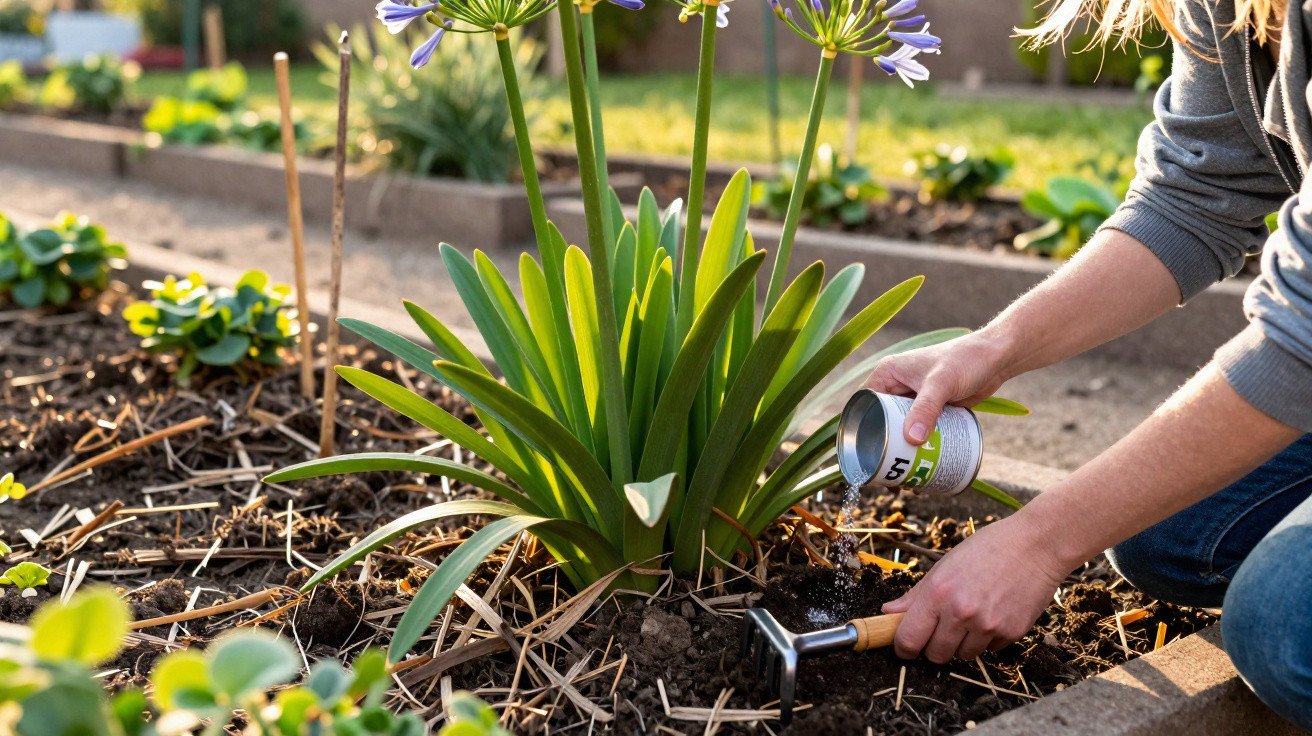
Many amateur gardeners wonder every summer why their Agapanthus produces vigorous leaves but only feeble flower stems, or none at all. However, the plant does not make that decision in June: it happens weeks earlier, during the period immediately after winter dormancy, usually before the end of March. Acting purposefully at this point can almost multiply the height of the flowers.
Why March determines flower-stem height
Most people know Agapanthus, also called the African lily, as a container plant with blue or white globes of flowers. Depending on the variety, its flowering season runs from June or July through to September. Its stems may reach anywhere from 30 to 120 centimetres tall. That height is not accidental, but comes from providing the right care at the right time.
As temperatures rise, winter dormancy comes to an end. Buds begin to wake, while the roots become active again in the upper soil layers. During this brief window, the plant determines where to direct its energy: into abundant foliage or into strong flower stems.
“Giving the African lily targeted care shortly after its winter rest directs energy away from leaf growth and towards sturdy, tall flower stems.”
Professional growing advice stresses that this direction is set early, often before the end of March. Combining a mechanical intervention with an appropriate nutrient blend encourages the plant to “switch to flowering mode”.
The P–K protocol: helping flower stems reach for the sky
The key is the nutrient balance. Phosphorus (P) and potassium (K) support bud formation, root strength and firm stems. Nitrogen, by contrast, mainly promotes leafy growth. March is therefore the time to strongly prioritise P and K while clearly limiting nitrogen.
Step 1: Spring clean around the plant
Start by tidying the area thoroughly:
- Remove dry and soggy leaves.
- Cut old, withered flower stems close to the base.
- Clear away organic debris and weeds around the plant.
This “clean start” helps prevent rot, improves air circulation around the plant and makes room for fresh shoots.
Step 2: Lightly roughen the soil surface
The next task may seem inconspicuous, but it is crucial: gently cultivate the area around the root crown. Using a small hand cultivator or fork, loosen the top 3 to 5 centimetres of soil carefully, taking care not to damage the fleshy roots.
This delivers several benefits at once:
- It breaks up the hard winter surface crust.
- Air can penetrate the soil more easily.
- Earthworms and other soil organisms are stimulated.
- Nutrients reach the active root zones more quickly.
“This brief cultivation works like opening a motorway: water and nutrients arrive exactly where the plant needs them most at that moment.”
Step 3: The right nutrient blend – plenty of P and K, little N
It is now time to feed the plant. For each plant, use:
- 1–2 handfuls of mature compost or worm compost as a foundation.
- A thin layer of finely sieved wood ash, from untreated and unpainted wood, as a natural potassium source.
Compost provides trace elements and some phosphorus, while wood ash supplies mainly potassium. Avoid chemical general-purpose fertilisers with a high nitrogen content at this time, as they will simply encourage leaves.
A practical household tip is to work finely chopped banana skins, in pieces of roughly 1 centimetre, very shallowly into the soil. They break down slowly, releasing potassium gradually.
Step 4: Top-dressing and mulch layer
After fertilising, apply a thin top-dressing of compost. Cover this with an organic mulch layer around two centimetres deep, such as flax or hemp mulch. This layer:
- Keeps soil moisture more even.
- Protects soil life.
- Reduces competition from weeds.
Finally, water slowly and deeply so that the nutrients and mulch connect well with the upper root layer.
Agapanthus in pots and borders: adapting the care
African lily in a pot: hungry despite a full container
After several years, container-grown Agapanthus can end up in real difficulty. Roots fill the entire pot, the rootball contracts as it dries, and water then runs only around the edges. As a result, the plant effectively “starves” despite regular watering, producing only thin, short stems that bend over in the first wind.
As long as the plant still appears reasonably vigorous, carrying out the P–K protocol in spring and adding fresh compost to the surface will be enough. If the pot is completely rootbound, repotting is the only solution:
- Ease the plant carefully out of its container.
- Move it into a pot that is only slightly larger and has good drainage.
- Fill around it with fresh, structurally stable compost.
- Then follow the same March programme again: light cultivation, compost, potassium and mulch.
African lily in a border: divide it to counter poor flowering
Conditions are generally easier in a garden border, but older clumps become very dense over time. Roots push towards the surface, the centre becomes exhausted and flowering declines. March is the ideal time to intervene.
Proceed as follows:
- Carefully lift the clump.
- Divide it with a sharp spade or knife.
- Select sections that each have one or two growing points and healthy roots.
- Replant the divisions, water them well and protect them with a thin layer of organic mulch.
Adding worm compost at planting gives the divisions the necessary boost for the next flowering season.
What if March has already passed?
Anyone who misses the timing, or lives in a colder region, does not have to forgo flowers. What matters is not the date on the calendar but the plant’s actual restart. As soon as the soil is no longer icy cold and fresh leaf tips are visible, catch up with the P–K programme: lightly cultivate the soil, apply a phosphorus- and potassium-focused nutrient blend, add a thin top-dressing and mulch.
For potted plants, this stage can begin slightly earlier than it does in borders. If containers stand close to the house, check regularly for the first shoots and act promptly.
Summer care: keeping flower stems strong and upright
The March boost lays the groundwork, but seasonal care determines whether the stems remain genuinely sturdy. Important points include:
- Water consistently during dry spells, more often in pots than in borders.
- Empty saucers if water collects in them, so that roots do not rot.
- Remove faded stems promptly to prevent energy being used for seed production.
- For container plants, occasionally use a liquid fertiliser for flowering plants at the recommended dose.
“If your African lily produces leaves but hardly any flowers, the cause is almost always too much nitrogen and too little potassium.”
Anyone who has used mostly nitrogen-heavy fertilisers, large amounts of fresh grass clippings or manure for years may inadvertently have created a foliage plant rather than a flowering plant. The answer is to consistently switch to potassium-led feeds, then return to the early P–K protocol next spring.
Background: why P and K matter so much for Agapanthus
Phosphorus plays a central part in bud formation and energy transfer within cells. Without an adequate supply, flower buds remain weak or may fail to form properly at all. Potassium strengthens cell walls, improves water regulation and makes stems more resistant to wind and drought.
This combination is particularly effective for Agapanthus because the plant decides early in the year how many flower stems it will produce and how strong they will be. Shifting the nutrient balance towards P and K during this period noticeably influences that decision.
Practical examples and everyday mistakes
One common mistake is keeping the African lily in an oversized pot filled with very loose, peat-rich compost, then regularly feeding it with conventional “green plant fertiliser”. The result is plentiful soft leaves, weak stems and few buds. A better approach is a relatively compact, well-drained pot with restricted root space and nutrition specifically geared towards flowering.
Another familiar problem is waterlogging and heavy soil. Although Agapanthus does not tolerate complete drying out, standing water damages its roots. In clay soils, it is worthwhile adding a drainage layer of coarse sand or grit, along with a substantial proportion of structural material in the planting compost.
Those with several plants can easily test the P–K protocol: give some Agapanthus the complete treatment in March while leaving others as they are. The difference in summer flowering is usually so pronounced that the new routine is adopted for every specimen the following year without hesitation.



Comments
No comments yet. Be the first to comment!
Leave a Comment