
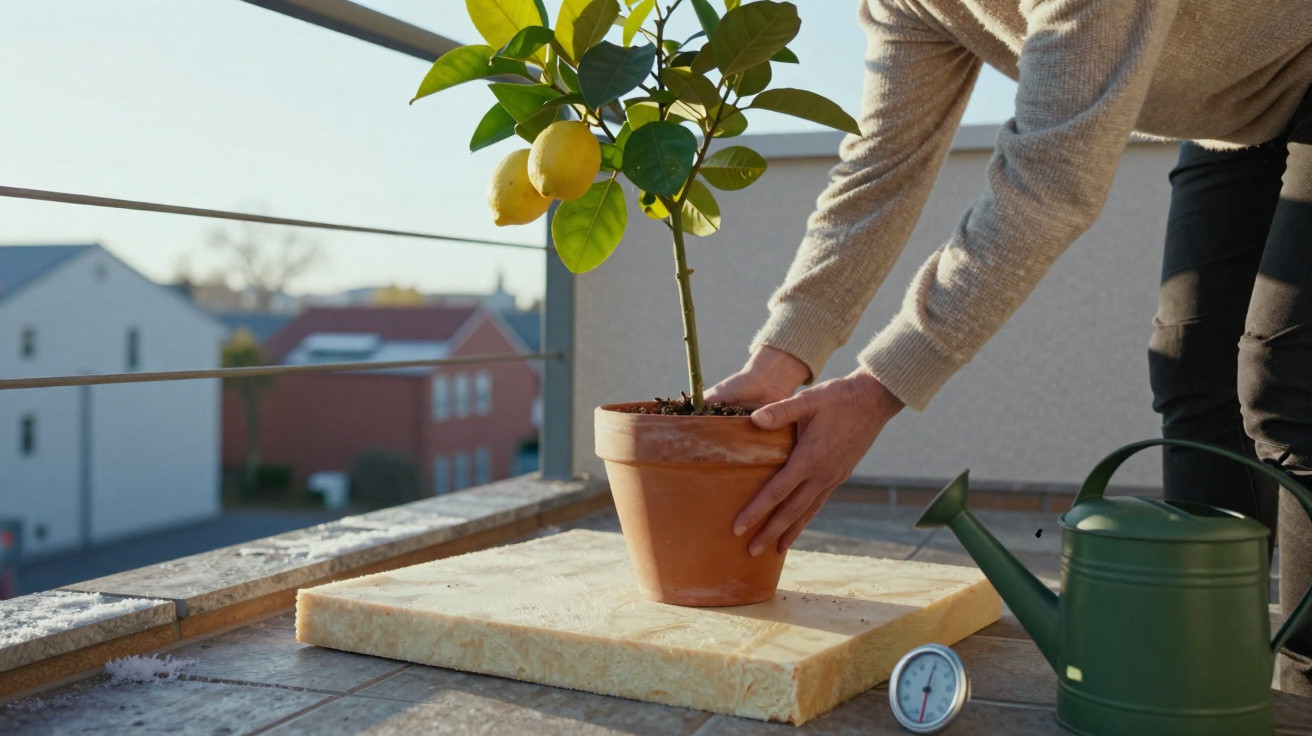
Many amateur gardeners develop a false sense of security too early in spring. The days turn milder, the lemon tree in its pot appears healthy, and everything seems ready for the new season. Then late frost arrives – often not from above, but stealthily from below through the balcony or patio. An inconspicuous item placed beneath the pot interrupts this cold shock and can, quite literally, save the tree.
Why a potted lemon tree can suddenly decline in March
Anyone growing a lemon tree in a container may recognise the scenario: everything looked fine in February, but by March the leaves suddenly turn brown, shoots shrivel and the plant appears unwell overnight. Water shortage or fungal disease are common suspicions. Often, however, the real cause is a freezing night.
The usual sequence is:
- Mild daytime temperatures and sunshine on the balcony encourage the tree to produce fresh growth.
- Overnight, temperatures drop to -1 to -3°C beneath a clear sky.
- Concrete or stone flooring holds the cold and transfers it straight into the base of the pot.
- Parts of the root zone freeze, killing the delicate root hairs.
The external signs often do not show until several days later: foliage becomes dull, leaves curl up and entire branches look scorched. In many instances, the canopy suffers more damage than the visible trunk. Put simply, the tree can no longer take up water through its roots.
“For a potted lemon tree, late frost often kills the roots first – not the leaves.”
The overlooked threat: a cold bridge from the balcony floor
Agricultural scientists have highlighted this for years: in a pot, cold reaches the plant not only through the air but also powerfully through the surface beneath it. Concrete slabs and tiled balconies act like a cooling plate, driving down the temperature of the compost inside the pot.
Locations that are especially risky include:
- A balcony or patio with tiled or concrete flooring
- Stone slabs laid directly on the ground
- Metal or stone stands without an insulating layer
During the day, these surfaces may warm up, but they cool down rapidly overnight. The cold then creeps upwards into the pot from below. This is the well-known “temperature shock”, which affects citrus plants far more severely than many native woody plants.
Invisible protection: an insulating board beneath the pot
The good news is that this cold bridge can be tackled with one small but highly effective measure: place an insulating board directly under the pot.
Suitable materials for a lemon tree pot
Materials that trap air and conduct heat poorly are particularly suitable:
- A sturdy polystyrene board, such as one from packaging
- A thick cork or wooden pot stand
- Rigid insulation material from a DIY shop
- A waterproof camping mat folded into several layers
The board should:
- Be at least 2 to 5 centimetres thick
- Extend slightly beyond the edge of the pot by 1–2 centimetres
- Cover the entire base so that no part of the pot sits directly on the cold surface
“A simple insulating board beneath the pot breaks the ice-cold contact with the ground – often the decisive difference between continued growth and total loss.”
Keeping drainage clear
Many people avoid using such boards because they worry that water will no longer drain away. There is an easy solution:
- Cut three corks lengthways in half.
- Arrange the halves in a triangle beneath the base of the pot.
- Place the insulating board underneath them.
This creates a thin air gap between the pot and the board. Drainage remains unobstructed, waterlogging does not develop, and the pot is still kept warmly insulated. It takes five minutes to assemble and costs virtually nothing, yet it greatly reduces the risk from frosty nights.
How much frost can a lemon tree really tolerate?
Lemon trees are considered frost-sensitive, but they can withstand brief cold spells better than many people expect. Well-established specimens can tolerate around -6 to -7°C for short periods, provided the root area remains protected.
A typical protection combination includes:
- An insulating board below the pot as the foundation
- Lightweight horticultural fleece around the canopy and pot
- A position close to a house wall, ideally facing south
On average, fleece provides a buffer of around three degrees. Combined with insulation beneath the pot, this offers enough protection in many areas to get through the critical nights of March and April.
Protection until the Ice Saints: combining the measures
Keep the insulating board beneath the pot until mid-May. Late frosts can occur up to the period known as the Ice Saints, and warm days followed by very cold nights are particularly deceptive.
For especially risky weather conditions, using several protective measures is worthwhile:
- Board beneath the pot – leave it in place continuously until mid-May.
- Horticultural fleece – place it over the canopy only when frost is forecast overnight.
- Improve the position – move the tree against a sheltered house wall, preferably beneath a roof or canopy.
- Raise the pot slightly – use pot feet or brick supports, for example, if the surface is extremely cold.
- Insulate the pot wall – a second covering of bubble wrap wrapped in hessian gives the roots additional protection.
Important: the root ball must not be soaking wet before a frosty night. Completely saturated compost cools more strongly and is more likely to damage the roots. Slightly moist is ideal; wet is risky.
Common spring mistakes that can cost lemon trees their lives
Many losses are not caused by prolonged severe frost at all, but by small oversights during the transition to warmer weather. The most frequent are:
- Placing the pot directly on stone or tiles
- Protecting only the canopy with fleece while neglecting the root area
- Bringing the tree out of winter protection too early without safeguards
- Watering heavily before an expected cold spell
- Repeatedly moving the plant back and forth, which stresses it
Keeping these points in mind and adding the unobtrusive insulating board beneath the pot greatly increases the tree’s chance of survival, particularly for young or newly repotted lemon trees.
How to tell whether the roots have already been damaged
Sometimes the concern only arises once the frost has long passed. Several signs can indicate that the roots have been affected:
- New shoots suddenly wilt even though the compost is still slightly moist
- Leaves darken and fall without a prolonged yellowing stage
- Entire branches remain bare while other areas of the canopy begin to grow
In these cases, it is worth carefully inspecting the pot: if the compost smells musty and fine roots are mushy or black, frost combined with wet conditions has probably caused the damage. The only options then are to keep the plant drier, prune it back and be patient – while making sure it is consistently insulated from below in future.
Why the effort is worthwhile for other container plants too
The insulating-board method is not limited to lemon trees. Many Mediterranean container plants react just as sensitively to cold root zones, including:
- Olive trees
- Bay trees in pots
- Fig trees in containers
- Grapevines in large pots
Anyone who already has insulation boards or leftover cork at home can protect several containers in the same way. The boards are almost entirely hidden beneath the pots, so they affect neither appearance nor daily use – they simply work quietly in the background, cushioning every unexpected cold snap.
Ultimately, a potted lemon tree’s survival often depends less on elaborate winter protection than on this small detail at ground level. By blocking frost from below, you have taken the most important step towards ensuring the tree produces fresh flowers and fruit year after year.


Comments
No comments yet. Be the first to comment!
Leave a Comment