
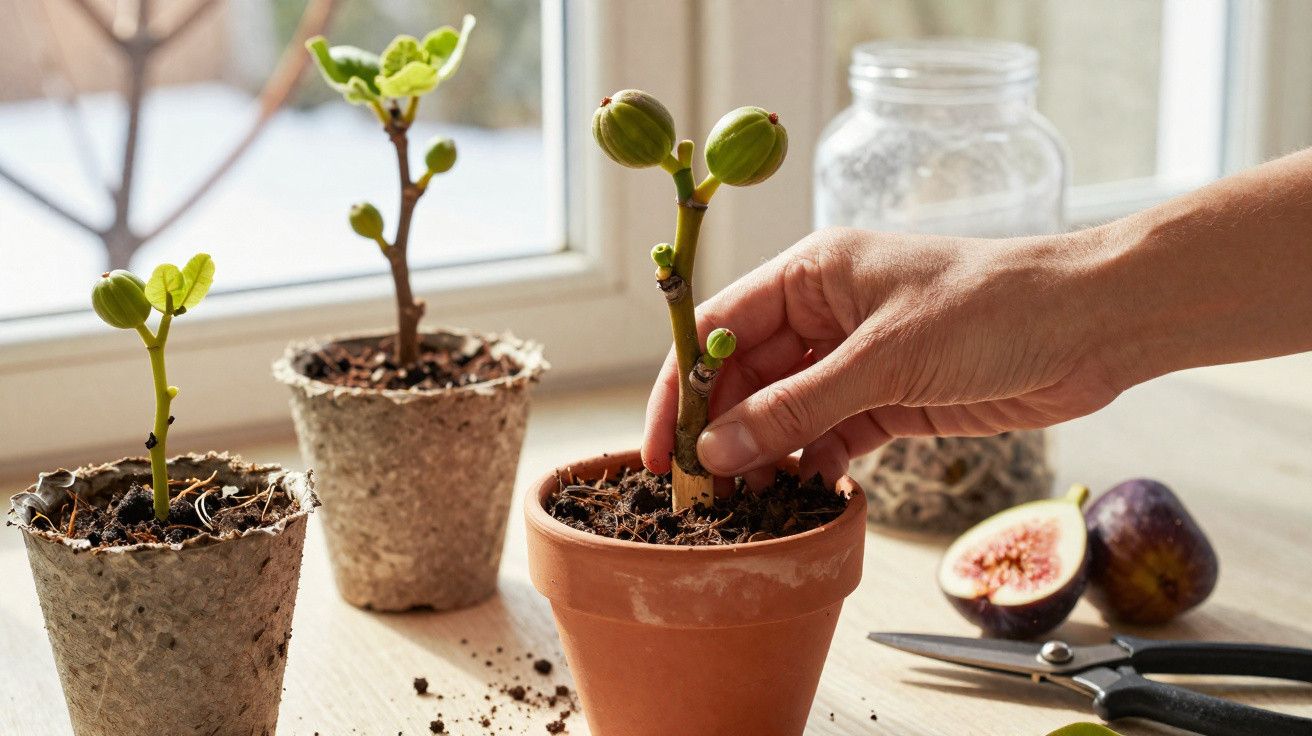
Many amateur gardeners do not realise how easily a fig tree can be propagated. Late winter in particular gives the tree ideal conditions for growing a strong new plant from a single branch. Anyone who knows the right timing and a few basic rules can build a small fig plantation for virtually nothing.
Why late winter is the best time to propagate a fig tree
In February or early March, a fig tree often still looks bare and lifeless. Yet a great deal is already happening beneath the surface: sap is slowly beginning to rise again, while the tree’s stored reserves remain concentrated in the wood.
This is precisely what makes this period so useful for propagation:
- The buds have not yet opened, so they use very little energy.
- Stored nutrients are available to the newly cut hardwood cuttings for root formation.
- Temperatures are gradually increasing without placing the young plant under stress.
“If you cut before growth begins, you direct the branch’s energy into roots rather than leaves, which would only dry out later.”
In mild-climate regions, you can begin as early as February. In colder locations, the suitable window lasts until around the beginning of March. After that, buds begin growing too vigorously and rooting becomes considerably more difficult.
Choosing the perfect shoot: what to look for when cutting
Success starts with selecting the right branch. Just any piece of wood will not do; you need a suitable shoot.
How to identify a suitable fig tree branch
- The shoot grew during the previous year.
- It has already become woody: firm and grey to brown rather than freshly green.
- It looks healthy, with no cracks, marks or signs of pest damage.
- It is roughly the thickness of a pencil.
Cut this shoot into sections measuring 20 to 25 centimetres long. Each of these hardwood cuttings should have three to four clearly visible buds.
Cut correctly: straight at the bottom, angled at the top
To avoid mixing up the ends later, each cutting needs two distinct cut surfaces:
- At the lower end: make a straight, horizontal cut directly beneath a bud.
- At the upper end: make an angled cut roughly one centimetre above the final bud.
This makes it immediately clear which end is the top and which is the bottom, even when several cuttings are lying together. It prevents a shoot from accidentally being inserted into the compost upside down, which is a common beginner’s mistake.
“A sharp, clean tool reduces damage to the wood and lowers the risk of rot and infection.”
Disinfect the blades with alcohol or boiling water before cutting. If you are cutting several plants one after another, clean them again between plants to prevent diseases from spreading.
Compost and pot: helping the young fig tree establish safely
Fig trees are hardy, but they are sensitive to waterlogging while they are forming roots. A deep pot and free-draining compost are therefore essential.
The simple compost mixing ratio
A light, airy mixture that works well consists of:
- 2 parts potting compost or garden soil
- 1 part sand or perlite
For a five-litre pot, this equates approximately to:
| Component | Quantity |
|---|---|
| Compost | approx. 3.3 litres |
| Sand / perlite | approx. 1.7 litres |
The sand provides effective drainage, while the compost supplies nutrients and retains moisture. A layer of expanded clay pellets in the base of the pot can also be useful, especially on a balcony or windowsill.
Planting the cutting and creating a microclimate
Push the hardwood cutting into the prepared compost to around two thirds to three quarters of its length. At least one bud must remain visible above the surface. Firm the compost gently so the shoot stands securely, then water carefully: it should be moist, not wet.
A makeshift mini greenhouse helps maintain consistent humidity around the cutting: cut the base off a plastic bottle and place it over the pot. Leave the cap slightly open so excess moisture can escape and mould does not form.
“The small plastic cover keeps humidity high, protects against draughts and recreates a mild spring greenhouse.”
Care during the first few weeks: be patient and do not pull
Over the following weeks, there is surprisingly little to do – and that is exactly why this method is so appealing to beginners. The pot is best placed somewhere bright but out of intense midday sun. Cool, frost-free spots such as a bright stairwell, a sheltered balcony or an unheated room are all suitable.
The key point is to water sparingly. The root area should remain evenly, lightly moist, but never properly wet. Fig wood rots relatively quickly when it sits in cold, soggy compost.
After a few weeks, the first small leaves will usually emerge. This can make it seem as though the shoot has already developed strong roots, but at this stage it is often still living off the reserves within the wood. Anyone who curiously pulls on the branch to “test” its rooting can easily tear away the delicate newly formed roots.
The dependable sign that it has established is not the first leaf, but steady, continuous new growth over several weeks.
When a young fig tree can be planted outdoors
Patience pays off. The new fig tree should spend its first season in a pot. This enables it to develop a strong root system while being protected from late frosts and heavy rain.
“Autumn is the ideal time for planting out: the soil is still warm, summer heat has passed, and the tree can send out roots into the ground undisturbed.”
Depending on the climate zone, many gardeners plant their young fig in its final position during September or October, or move it into a much larger container. In the ground, the tree benefits from a sunny, sheltered position, ideally in front of a house wall or garden wall that stores warmth.
Choosing the right fig variety for your location
Hardwood cuttings are clones of the parent plant. Propagating a particular variety therefore produces the same vigour, fruit size and harvest time.
One crop or two crops?
Fig trees can broadly be divided into two groups:
- Twice-cropping varieties: produce two harvests each year, usually one in early summer and another in late summer. They prefer warmer regions.
- Once-cropping varieties: provide one main harvest, but cope better with cooler summers.
Gardeners in southern Germany, South Tyrol or especially sheltered urban locations can experiment with twice-cropping varieties. In harsher areas with cold winters, compact once-cropping varieties are often the more dependable option.
Examples and practical advice
Compact figs with less vigorous growth are ideal for balconies and patios. They can be grown well in containers and appreciate a sheltered south- or west-facing balcony. More vigorous, strongly growing fig trees are better suited to larger gardens, where they have room for their canopy.
As fig trees sold commercially are not always clearly labelled, it is worth visiting nurseries that specialise in fruit trees or speaking to neighbours whose trees have already proved successful.
A beginner’s trick: plant several fig tree cuttings at once
Anyone who has never propagated a fig tree can easily underestimate how many factors affect success: weather, cutting quality, moisture and temperature. The simplest safety measure is therefore to cut several hardwood cuttings instead of just one.
- Cut three to four suitable shoots.
- Plant them side by side in one or two pots.
- Watch to see which ones establish best.
“The success rate with fig hardwood cuttings is often remarkably high – using several shoots greatly increases the chance of raising at least one strong young tree.”
If you wish, use one cutting as a “guinea pig”: give it a little more sun, slightly less water or a different position. This quickly shows you how your own fig tree responds best.
Common mistakes – and how to avoid them
The same setbacks occur repeatedly in gardens. Three classic errors are:
- Compost that is too wet: this causes rot before roots can form.
- Full sun too early: this weakens newly emerging leaves and dries out the cutting.
- Impatience: frequent repotting, shaking or pulling damages fine roots.
Leaving the pot undisturbed, watering moderately and using an airy compost will avoid most of these problems. Slightly brown, soft patches on the wood indicate early rot; in that case, it is better to discard the affected cutting and start again with a spare branch.
Why a second fig tree is genuinely worthwhile
An additional fig tree costs virtually nothing, yet offers several practical benefits:
- more fruit, harvested at slightly different times
- a backup if one tree suffers severe winter damage
- the option of keeping one tree in a container and another in the ground
- an ideal gift for friends, neighbours or family members who love figs
Because fig trees bring a Mediterranean feel, a tree you have grown yourself is a real highlight, whether on a patio or in a terraced-house garden. Many amateur gardeners say that the first bite of a home-grown, sun-warmed fig effortlessly brings back memories of their last holiday in the south.
Anyone who deliberately picks up the secateurs in late winter, prepares a pot and plants a hardwood cutting will soon discover that the apparent magic of propagation is actually a simple, easy-to-understand process. A few clear steps at the right time are all it takes to fulfil the dream of a second fig tree at no extra cost.

Comments
No comments yet. Be the first to comment!
Leave a Comment